
丙戊酸(VPA)用于难治性晚期癌症患者:一项剂量递增的I期临床试验。
Valproic acid (VPA) in patients with refractory advanced cancer: a dose escalating phase I clinical trial.
作者信息
Atmaca A, Al-Batran S-E, Maurer A, Neumann A, Heinzel T, Hentsch B, Schwarz S E, Hövelmann S, Göttlicher M, Knuth A, Jäger E
机构信息
II. Medizinische Klinik/Onkologie, Krankenhaus Nordwest, Steinbacher Hohl 2-26, D-60488 Frankfurt am Main, Germany.
出版信息
Br J Cancer. 2007 Jul 16;97(2):177-82. doi: 10.1038/sj.bjc.6603851. Epub 2007 Jun 19.
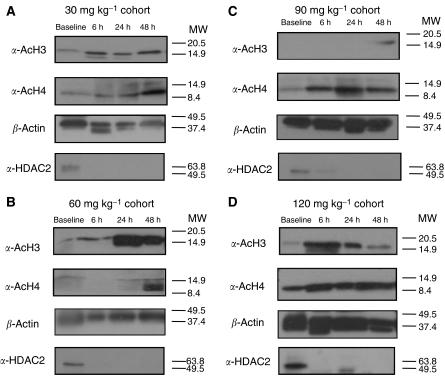
Altered histone deacetylase (HDAC) activity has been identified in several types of cancer. This study was designed to determine the safety and maximum tolerated dose (MTD) of valproic acid (VPA) as an HDAC inhibitor in cancer patients. Twenty-six pre-treated patients with progressing solid tumours were enrolled in dose-escalating three-patient cohorts, starting at a dose of VPA 30 mg kg(-1) day(-1). VPA was administered as an 1-h infusion daily for 5 consecutive days in a 21-day cycle. Neurocognitive impairment dominated the toxicity profile, with grade 3 or 4 neurological side effects occurring in 8 out of 26 patients. No grade 3 or 4 haematological toxicity was observed. The MTD of infusional VPA was 60 mg kg(-1) day(-1). Biomonitoring of peripheral blood lymphocytes demonstrated the induction of histone hyperacetylation in the majority of patients and downmodulation of HDAC2. Pharmacokinetic studies showed increased mean and maximum serum VPA concentrations >120 and >250 mg l(-1), respectively, in the 90 and 120 mg kg(-1) cohorts, correlating well with the incidence of dose-limiting toxicity (DLT). Neurotoxicity was the main DLT of infusional VPA, doses up to 60 mg kg(-1) day(-1) for 5 consecutive days are well tolerated and show detectable biological activity. Further investigations are warranted to evaluate the effectivity of VPA alone and in combination with other cytotoxic drugs.
在多种癌症中已发现组蛋白脱乙酰酶(HDAC)活性发生改变。本研究旨在确定丙戊酸(VPA)作为HDAC抑制剂在癌症患者中的安全性和最大耐受剂量(MTD)。26例经预处理的实体瘤进展患者被纳入剂量递增的三人队列,起始剂量为VPA 30 mg·kg⁻¹·d⁻¹。VPA以1小时输注的方式每日给药,连续给药5天,每21天为一个周期。神经认知障碍在毒性反应中占主导地位,26例患者中有8例出现3级或4级神经副作用。未观察到3级或4级血液学毒性。输注VPA的MTD为60 mg·kg⁻¹·d⁻¹。外周血淋巴细胞的生物监测表明,大多数患者诱导了组蛋白高乙酰化,并下调了HDAC2。药代动力学研究显示,在90和120 mg·kg⁻¹队列中,平均血清VPA浓度和最大血清VPA浓度分别升高至>120和>250 mg·L⁻¹,与剂量限制性毒性(DLT)的发生率密切相关。神经毒性是输注VPA的主要DLT,连续5天剂量高达60 mg·kg⁻¹·d⁻¹耐受性良好,并显示出可检测的生物学活性。有必要进一步研究以评估VPA单独使用以及与其他细胞毒性药物联合使用的有效性。

 Zotero 插件