
痘苗病毒毒力因子B14对IkappaB激酶的抑制作用
Inhibition of IkappaB kinase by vaccinia virus virulence factor B14.
作者信息
Chen Ron A-J, Ryzhakov Grigory, Cooray Samantha, Randow Felix, Smith Geoffrey L
机构信息
Department of Virology, Faculty of Medicine, Imperial College London, London, United Kingdom.
出版信息
PLoS Pathog. 2008 Feb 8;4(2):e22. doi: 10.1371/journal.ppat.0040022.
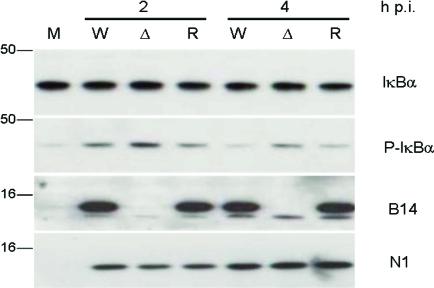
The IkappaB kinase (IKK) complex is a key regulator of signal transduction pathways leading to the induction of NF-kappaB-dependent gene expression and production of pro-inflammatory cytokines. It therefore represents a major target for the development of anti-inflammatory therapeutic drugs and may be targeted by pathogens seeking to diminish the host response to infection. Previously, the vaccinia virus (VACV) strain Western Reserve B14 protein was characterised as an intracellular virulence factor that alters the inflammatory response to infection by an unknown mechanism. Here we demonstrate that ectopic expression of B14 inhibited NF-kappaB activation in response to TNFalpha, IL-1beta, poly(I:C), and PMA. In cells infected with VACV lacking gene B14R (vDeltaB14) there was a higher level of phosphorylated IkappaBalpha but a similar level of IkappaBalpha compared to cells infected with control viruses expressing B14, suggesting B14 affects IKK activity. Direct evidence for this was obtained by showing that B14 co-purified and co-precipitated with the endogenous IKK complex from human and mouse cells and inhibited IKK complex enzymatic activity. Notably, the interaction between B14 and the IKK complex required IKKbeta but not IKKalpha, suggesting the interaction occurs via IKKbeta. B14 inhibited NF-kappaB activation induced by overexpression of IKKalpha, IKKbeta, and a constitutively active mutant of IKKalpha, S176/180E, but did not inhibit a comparable mutant of IKKbeta, S177/181E. This suggested that phosphorylation of these serine residues in the activation loop of IKKbeta is targeted by B14, and this was confirmed using Ab specific for phospho-IKKbeta.
IκB激酶(IKK)复合物是信号转导通路的关键调节因子,该信号转导通路可诱导核因子κB(NF-κB)依赖性基因表达并产生促炎细胞因子。因此,它是抗炎治疗药物开发的主要靶点,并且可能被试图削弱宿主对感染反应的病原体所靶向。以前,痘苗病毒(VACV)株西储B14蛋白被鉴定为一种细胞内毒力因子,其通过未知机制改变对感染的炎症反应。在此我们证明,B14的异位表达抑制了对肿瘤坏死因子α(TNFα)、白细胞介素-1β(IL-1β)、聚肌苷酸:聚胞苷酸(poly(I:C))和佛波酯(PMA)的NF-κB激活。与感染表达B14的对照病毒的细胞相比,在感染缺乏基因B14R的VACV(vΔB14)的细胞中,磷酸化IκBα水平较高,但IκBα水平相似,这表明B14影响IKK活性。通过显示B14与来自人和小鼠细胞的内源性IKK复合物共纯化和共沉淀,并抑制IKK复合物的酶活性,获得了对此的直接证据。值得注意的是,B14与IKK复合物之间的相互作用需要IKKβ而不是IKKα,这表明相互作用是通过IKKβ发生的。B14抑制由IKKα、IKKβ以及IKKα的组成型活性突变体S176/180E的过表达诱导的NF-κB激活,但不抑制IKKβ的类似突变体S177/181E。这表明IKKβ激活环中这些丝氨酸残基的磷酸化是B14的作用靶点,并且使用针对磷酸化IKKβ的抗体证实了这一点。




 Zotero 插件