
急性高血糖和/或高胰岛素血症对人体促炎基因表达、细胞因子产生及中性粒细胞功能的影响。
Effect of acute hyperglycaemia and/or hyperinsulinaemia on proinflammatory gene expression, cytokine production and neutrophil function in humans.
作者信息
Stegenga M E, van der Crabben S N, Dessing M C, Pater J M, van den Pangaart P S, de Vos A F, Tanck M W, Roos D, Sauerwein H P, van der Poll T
机构信息
Centre for Infection and Immunity Amsterdam (CINIMA), Academic Medical Centre, University of Amsterdam, Amsterdam, the Netherlands.
出版信息
Diabet Med. 2008 Feb;25(2):157-64. doi: 10.1111/j.1464-5491.2007.02348.x.
AIMS
Type 2 diabetes is frequently associated with infectious complications. Swift activation of leucocytes is important for an adequate immune response. We determined the selective effects of hyperglycaemia and hyperinsulinaemia on lipopolysaccharide (LPS)-induced proinflammatory gene expression and cytokine production in leucocytes and on neutrophil functions.
METHODS
Six healthy humans were studied on four occasions for 6 h during: (i) lower insulinaemic euglycaemic clamp, (ii) lower insulinaemic hyperglycaemic clamp, (iii) hyperinsulinaemic euglycaemic clamp, and (iv) hyperinsulinaemic hyperglycaemic clamp. Target levels of plasma glucose were 12.0 mmol/l (hyperglycaemic clamps) or 5.0 mmol/l (euglycaemic clamps). Target plasma insulin levels were 400 pmol/l (hyperinsulinaemic clamps) or 100 pmol/l (lower insulinaemic clamps).
RESULTS
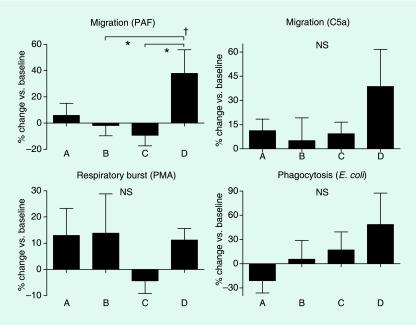
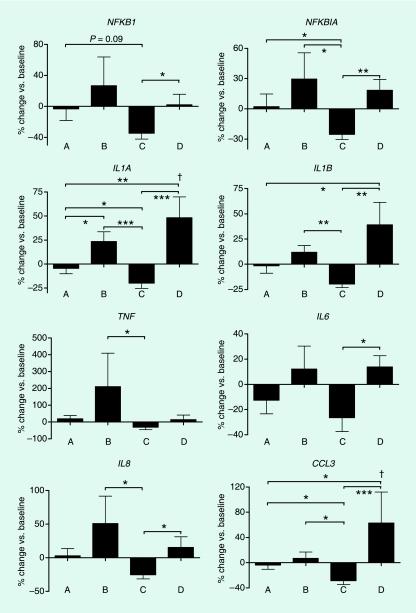
Hyperglycaemia reduced LPS-induced mRNA expression of nuclear factor of kappa light polypeptide gene enhancer in B cells inhibitor alpha (NFKBIA), interleukin-1 alpha (IL1A) and chemokine (C-C motif) ligand 3 (CCL3), whereas during hyperinsulinaemia enhanced mRNA levels occurred in six out of eight measured inflammation-related genes, irrespective of plasma glucose levels. Combined hyperglycaemia and hyperinsulinaemia led to enhanced IL1A, interleukin-1 beta (IL1B) and CCL3 mRNA levels upon LPS stimulation. Neither hyperglycaemia nor hyperinsulinaemia altered cytokine protein production, neutrophil migration, phagocytic capacity or oxidative burst activity.
CONCLUSIONS
These results suggest that short-term hyperglycaemia and hyperinsulinaemia influence the expression of several inflammatory genes in an opposite direction, that the acute effects of hyperinsulinaemia on inflammatory mRNA levels may be stronger than those of hyperglycaemia, and that the effects of insulin, in particular, may be relevant in the concurrent presence of hyperglycaemia.
目的
2型糖尿病常伴有感染性并发症。白细胞的快速激活对于充分的免疫反应很重要。我们确定了高血糖和高胰岛素血症对脂多糖(LPS)诱导的白细胞促炎基因表达、细胞因子产生以及中性粒细胞功能的选择性影响。
方法
对6名健康人进行了4次研究,每次持续6小时,分别处于以下状态:(i)低胰岛素正常血糖钳夹;(ii)低胰岛素高血糖钳夹;(iii)高胰岛素正常血糖钳夹;(iv)高胰岛素高血糖钳夹。血浆葡萄糖目标水平为12.0 mmol/L(高血糖钳夹)或5.0 mmol/L(正常血糖钳夹)。血浆胰岛素目标水平为400 pmol/L(高胰岛素钳夹)或100 pmol/L(低胰岛素钳夹)。
结果
高血糖降低了LPS诱导的B细胞中κ轻链多肽基因增强子抑制因子α(NFKBIA)、白细胞介素-1α(IL1A)和趋化因子(C-C基序)配体3(CCL3)的mRNA表达,而在高胰岛素血症期间,在所检测的8个炎症相关基因中有6个基因的mRNA水平升高,与血浆葡萄糖水平无关。高血糖和高胰岛素血症共同作用导致LPS刺激后IL1A、白细胞介素-1β(IL1B)和CCL3的mRNA水平升高。高血糖和高胰岛素血症均未改变细胞因子蛋白产生、中性粒细胞迁移、吞噬能力或氧化爆发活性。
结论
这些结果表明,短期高血糖和高胰岛素血症对几种炎症基因的表达有相反的影响,高胰岛素血症对炎症mRNA水平的急性影响可能强于高血糖,特别是胰岛素的影响可能在高血糖同时存在时起作用。
 Zotero 插件