
短肽片段的锚定侧链触发II类主要组织相容性复合体分子的配体交换。
Anchor side chains of short peptide fragments trigger ligand-exchange of class II MHC molecules.
作者信息
Gupta Shashank, Höpner Sabine, Rupp Bernd, Günther Sebastian, Dickhaut Katharina, Agarwal Noopur, Cardoso M Cristina, Kühne Ronald, Wiesmüller Karl-Heinz, Jung Günther, Falk Kirsten, Rötzschke Olaf
机构信息
Max-Delbrück-Center for Molecular Medicine, Berlin, Germany.
出版信息
PLoS One. 2008 Mar 19;3(3):e1814. doi: 10.1371/journal.pone.0001814.
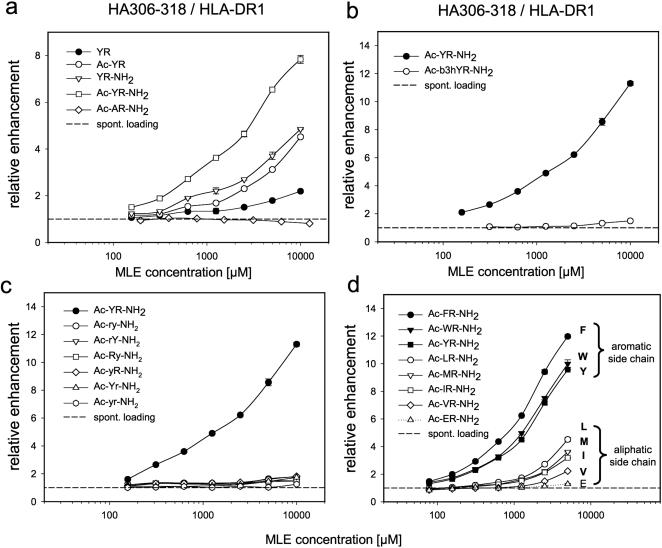
Class II MHC molecules display peptides on the cell surface for the surveillance by CD4+ T cells. To ensure that these ligands accurately reflect the content of the intracellular MHC loading compartment, a complex processing pathway has evolved that delivers only stable peptide/MHC complexes to the surface. As additional safeguard, MHC molecules quickly acquire a 'non-receptive' state once they have lost their ligand. Here we show now that amino acid side chains of short peptides can bypass these safety mechanisms by triggering the reversible ligand-exchange. The catalytic activity of dipeptides such as Tyr-Arg was stereo-specific and could be enhanced by modifications addressing the conserved H-bond network near the P1 pocket of the MHC molecule. It affected both antigen-loading and ligand-release and strictly correlated with reported anchor preferences of P1, the specific target site for the catalytic side chain of the dipeptide. The effect was evident also in CD4+ T cell assays, where the allele-selective influence of the dipeptides translated into increased sensitivities of the antigen-specific immune response. Molecular dynamic calculations support the hypothesis that occupation of P1 prevents the 'closure' of the empty peptide binding site into the non-receptive state. During antigen-processing and -presentation P1 may therefore function as important "sensor" for peptide-load. While it regulates maturation and trafficking of the complex, on the cell surface, short protein fragments present in blood or lymph could utilize this mechanism to alter the ligand composition on antigen presenting cells in a catalytic way.
II类主要组织相容性复合体(MHC)分子在细胞表面展示肽段,以供CD4+ T细胞监测。为确保这些配体准确反映细胞内MHC装载区室的内容物,已经进化出一种复杂的加工途径,该途径仅将稳定的肽/MHC复合物递送至细胞表面。作为额外的保障措施,MHC分子一旦失去其配体,就会迅速进入“非接受性”状态。我们现在表明,短肽的氨基酸侧链可以通过触发可逆的配体交换来绕过这些安全机制。二肽(如酪氨酸-精氨酸)的催化活性具有立体特异性,并且可以通过针对MHC分子P1口袋附近保守氢键网络的修饰来增强。它影响抗原装载和配体释放,并且与报道的P1锚定偏好严格相关,P1是二肽催化侧链的特定靶位点。在CD4+ T细胞检测中,这种效应也很明显,其中二肽的等位基因选择性影响转化为抗原特异性免疫反应敏感性的增加。分子动力学计算支持这样的假设,即P1的占据可防止空肽结合位点“关闭”进入非接受性状态。因此,在抗原加工和呈递过程中,P1可能作为肽负载的重要“传感器”发挥作用。虽然它调节复合物的成熟和运输,但在细胞表面,血液或淋巴中存在的短蛋白片段可以利用这种机制以催化方式改变抗原呈递细胞上的配体组成。




 Zotero 插件