
角质形成细胞分化和激活失调:静脉溃疡的一个标志。
Deregulation of keratinocyte differentiation and activation: a hallmark of venous ulcers.
作者信息
Stojadinovic Olivera, Pastar Irena, Vukelic Sasa, Mahoney My G, Brennan Donna, Krzyzanowska Agata, Golinko Michael, Brem Harold, Tomic-Canic Marjana
机构信息
Hospital for Special Surgery of the Weill Cornell Medical College, Tissue Repair Lab, New York, NY 10021, USA.
出版信息
J Cell Mol Med. 2008 Dec;12(6B):2675-90. doi: 10.1111/j.1582-4934.2008.00321.x. Epub 2008 Mar 28.
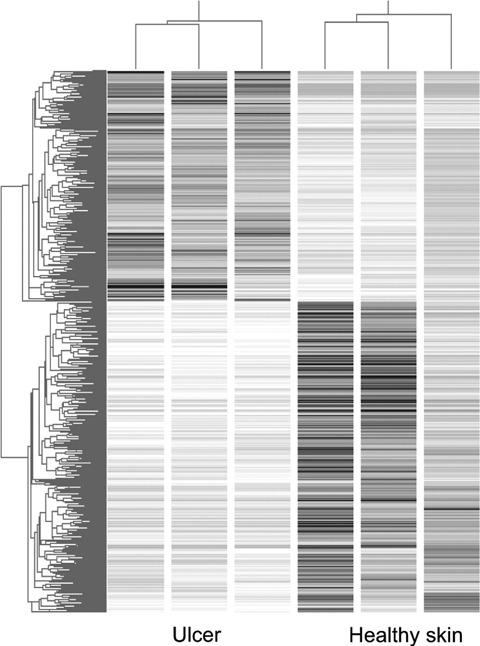
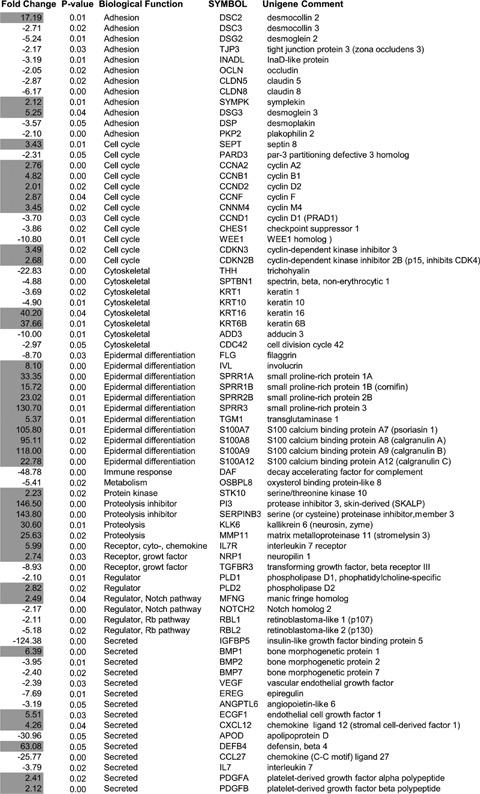
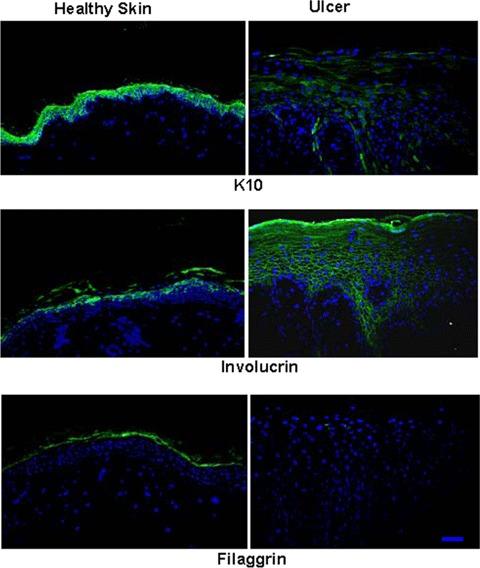
Epidermal morphology of chronic wounds differs from that of normal epidermis. Biopsies of non-healing edges obtained from patients with venous ulcers show thick and hyperproliferative epidermis with mitosis present in suprabasal layers. This epidermis is also hyper-keratotic and parakeratotic. This suggests incomplete activation and differentiation of keratinocytes. To identify molecular changes that lead to pathogenic alterations in keratinocyte activation and differentiation pathways we isolated mRNA from non-healing edges deriving from venous ulcers patients and determined transcriptional profiles using Affymetrix chips. Obtained transcriptional profiles were compared to those from healthy, unwounded skin. As previously indicated by histology, we found deregulation of differentiation and activation markers. We also found differential regulation of signalling molecules that regulate these two processes. Early differentiation markers, keratins K1/K10 and a subset of small proline-rich proteins, along with the late differentiation marker filaggrin were suppressed, whereas late differentiation markers involucrin, transgultaminase 1 and another subset of small proline-rich proteins were induced in ulcers when compared to healthy skin. Surprisingly, desomosomal and tight junction components were also deregulated. Keratinocyte activation markers keratins K6/K16/K17 were induced. We conclude that keratinocytes at the non-healing edges of venous ulcers do not execute either activation or differentiation pathway, resulting in thick callus-like formation at the edge of a venous ulcers.
慢性伤口的表皮形态与正常表皮不同。从静脉性溃疡患者获取的未愈合边缘组织活检显示,表皮增厚且增殖过度,基底上层存在有丝分裂。这种表皮还表现为角化过度和不全角化。这表明角质形成细胞的激活和分化不完全。为了确定导致角质形成细胞激活和分化途径发生致病性改变的分子变化,我们从静脉性溃疡患者的未愈合边缘分离出mRNA,并使用Affymetrix芯片确定转录谱。将获得的转录谱与健康未受伤皮肤的转录谱进行比较。如先前组织学所示,我们发现分化和激活标志物失调。我们还发现调节这两个过程的信号分子存在差异调节。与健康皮肤相比,早期分化标志物角蛋白K1/K10和富含脯氨酸的小分子蛋白的一个子集,以及晚期分化标志物丝聚蛋白受到抑制,而晚期分化标志物内披蛋白、转谷氨酰胺酶1和富含脯氨酸的小分子蛋白的另一个子集在溃疡中被诱导。令人惊讶的是,桥粒和紧密连接成分也失调。角质形成细胞激活标志物角蛋白K6/K16/K17被诱导。我们得出结论,静脉性溃疡未愈合边缘的角质形成细胞既不执行激活途径也不执行分化途径,导致静脉性溃疡边缘形成类似厚胼胝的结构。




 Zotero 插件