
患有和未患脑积水的新生大鼠中淀粉样β蛋白及其转运体的低水平。
Low levels of amyloid-beta and its transporters in neonatal rats with and without hydrocephalus.
作者信息
Deren Kelley E, Forsyth Jennifer, Abdullah Osama, Hsu Edward W, Klinge Petra M, Silverberg Gerald D, Johanson Conrad E, McAllister James P
机构信息
Department of Neurosurgery, Division of Pediatric Neurosurgery, Primary Children's Medical Center and the University of Utah, Salt Lake City, Utah 84132, USA.
出版信息
Cerebrospinal Fluid Res. 2009 May 26;6:4. doi: 10.1186/1743-8454-6-4.
BACKGROUND
Previous studies in aging animals have shown that amyloid-beta protein (Abeta) accumulates and its transporters, low-density lipoprotein receptor-related protein-1 (LRP-1) and the receptor for advanced glycation end products (RAGE) are impaired during hydrocephalus. Furthermore, correlations between astrocytes and Abeta have been found in human cases of normal pressure hydrocephalus (NPH) and Alzheimer's disease (AD). Because hydrocephalus occurs frequently in children, we evaluated the expression of Abeta and its transporters and reactive astrocytosis in animals with neonatal hydrocephalus.
METHODS
Hydrocephalus was induced in neonatal rats by intracisternal kaolin injections on post-natal day one, and severe ventriculomegaly developed over a three week period. MRI was performed on post-kaolin days 10 and 21 to document ventriculomegaly. Animals were sacrificed on post-kaolin day 21. For an age-related comparison, tissue was used from previous studies when hydrocephalus was induced in a group of adult animals at either 6 months or 12 months of age. Tissue was processed for immunohistochemistry to visualize LRP-1, RAGE, Abeta, and glial fibrillary acidic protein (GFAP) and with quantitative real time reverse transcriptase polymerase chain reaction (qRT-PCR) to quantify expression of LRP-1, RAGE, and GFAP.
RESULTS
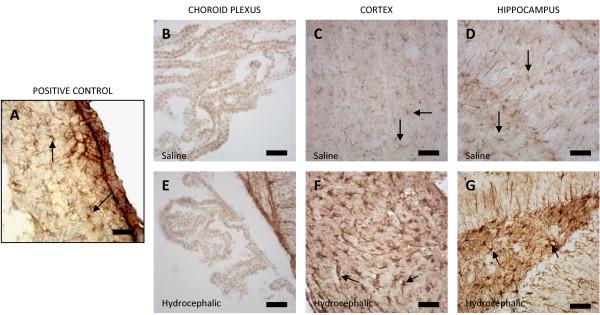
When 21-day post-kaolin neonatal hydrocephalic animals were compared to adult (6-12 month old) hydrocephalic animals, immunohistochemistry demonstrated levels of Abeta, RAGE, and LRP-1 that were substantially lower in the younger animals; in contrast, GFAP levels were elevated in both young and old hydrocephalic animals. When the neonatal hydrocephalic animals were compared to age-matched controls, qRT-PCR demonstrated no significant changes in Abeta, LRP-1 and RAGE. However, immunohistochemistry showed very small increases or decreases in individual proteins. Furthermore, qRT-PCR indicated statistically significant increases in GFAP.
CONCLUSION
Neonatal rats with and without hydrocephalus had low expression of Abeta and its transporters when compared to adult rats with hydrocephalus. No statistical differences were observed in Abeta and its transporters between the control and hydrocephalic neonatal animals.
背景
以往对衰老动物的研究表明,在脑积水期间,β淀粉样蛋白(Aβ)会积聚,其转运蛋白,即低密度脂蛋白受体相关蛋白1(LRP-1)和晚期糖基化终产物受体(RAGE)会受损。此外,在正常压力脑积水(NPH)和阿尔茨海默病(AD)的人类病例中发现了星形胶质细胞与Aβ之间的相关性。由于脑积水在儿童中频繁发生,我们评估了新生脑积水动物中Aβ及其转运蛋白的表达以及反应性星形胶质细胞增生情况。
方法
在出生后第1天通过脑池内注射高岭土诱导新生大鼠发生脑积水,在三周内出现严重的脑室扩大。在注射高岭土后第10天和第21天进行MRI检查以记录脑室扩大情况。在注射高岭土后第21天处死动物。为了进行年龄相关比较,使用了先前研究中在6个月或12个月龄时诱导一组成年动物发生脑积水的组织。对组织进行免疫组织化学处理以观察LRP-1、RAGE、Aβ和胶质纤维酸性蛋白(GFAP),并使用定量实时逆转录聚合酶链反应(qRT-PCR)来定量LRP-1、RAGE和GFAP的表达。
结果
将注射高岭土后21天的新生脑积水动物与成年(6 - 12个月龄)脑积水动物进行比较时,免疫组织化学显示年轻动物中Aβ、RAGE和LRP-1的水平显著较低;相比之下,年轻和老年脑积水动物的GFAP水平均升高。将新生脑积水动物与年龄匹配的对照进行比较时,qRT-PCR显示Aβ、LRP-1和RAGE无显著变化。然而,免疫组织化学显示个别蛋白质有非常小的增加或减少。此外,qRT-PCR表明GFAP有统计学上的显著增加。
结论
与成年脑积水大鼠相比,有或没有脑积水的新生大鼠Aβ及其转运蛋白的表达较低。对照和脑积水新生动物之间在Aβ及其转运蛋白方面未观察到统计学差异。




 Zotero 插件