
在结直肠癌筛查中,粪便潜血试验呈阳性后,使用CT结肠成像作为一种分流技术。
Using CT colonography as a triage technique after a positive faecal occult blood test in colorectal cancer screening.
作者信息
Liedenbaum M H, van Rijn A F, de Vries A H, Dekker H M, Thomeer M, van Marrewijk C J, Hol L, Dijkgraaf M G W, Fockens P, Bossuyt P M M, Dekker E, Stoker J
机构信息
Department of Radiology, Academic Medical Centre, Amsterdam, The Netherlands.
出版信息
Gut. 2009 Sep;58(9):1242-9. doi: 10.1136/gut.2009.176867. Epub 2009 Jul 21.
OBJECTIVE
The purpose of this study was to evaluate the effectiveness of CT colonography (CTC) as a triage technique in faecal occult blood test (FOBT)-positive screening participants.
METHODS
Consecutive guaiac (G-FOBT) and immunochemical (I-FOBT) FOBT-positive patients scheduled for colonoscopy underwent CTC with iodine tagging bowel preparation. Each CTC was read independently by two experienced observers. Per patient sensitivity, specificity and positive and negative predictive values (PPV and NPV) were calculated based on double reading with different CTC cut-off lesion sizes using segmental unblinded colonoscopy as the reference standard. The acceptability of the technique to patients was evaluated with questionnaires.
RESULTS
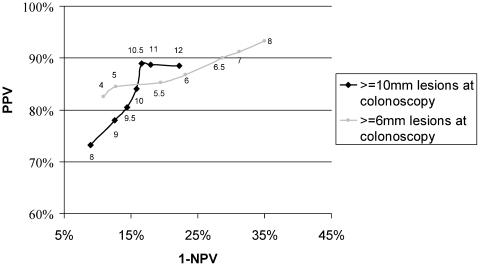
302 FOBT-positive patients were included (54 G-FOBT and 248 I-FOBT). 22 FOBT-positive patients (7%) had a colorectal carcinoma and 211 (70%) had a lesion >or=6 mm. Participants considered colonoscopy more burdensome than CTC (p<0.05). Using a 6 mm CTC size cut-off, per patient sensitivity for CTC was 91% (95% CI 85% to 91%) and specificity was 69% (95% CI 60% to 89%) for the detection of colonoscopy lesions >or=6 mm. The PPV of CTC was 87% (95% CI 80% to 93%) and NPV 77% (95% CI 69% to 85%). Using CTC as a triage technique in 100 FOBT-positive patients would mean that colonoscopy could be prevented in 28 patients while missing >or=10 mm lesions in 2 patients.
CONCLUSION
CTC with limited bowel preparation has reasonable predictive values in an FOBT-positive population and a higher acceptability to patients than colonoscopy. However, due to the high prevalence of clinically relevant lesions in FOBT-positive patients, CTC is unlikely to be an efficient triage technique in a first round FOBT population screening programme.
目的
本研究旨在评估CT结肠成像(CTC)作为粪便潜血试验(FOBT)阳性筛查参与者的分流技术的有效性。
方法
连续的愈创木脂(G-FOBT)和免疫化学(I-FOBT)FOBT阳性且计划进行结肠镜检查的患者接受了碘标记肠道准备的CTC检查。两名经验丰富的观察者分别独立解读每次CTC检查结果。以分段非盲法结肠镜检查作为参考标准,根据不同CTC截断病变大小的双重解读,计算每位患者的敏感性、特异性以及阳性和阴性预测值(PPV和NPV)。通过问卷调查评估该技术对患者的可接受性。
结果
纳入302例FOBT阳性患者(54例G-FOBT和248例I-FOBT)。22例FOBT阳性患者(7%)患有结直肠癌,211例(70%)有≥6mm的病变。参与者认为结肠镜检查比CTC更麻烦(p<0.05)。使用6mm的CTC大小截断值,对于检测结肠镜检查中≥6mm的病变,每位患者CTC的敏感性为91%(95%CI 85%至91%),特异性为69%(95%CI 60%至89%)。CTC的PPV为87%(95%CI 80%至93%),NPV为77%(95%CI 69%至85%)。在100例FOBT阳性患者中使用CTC作为分流技术意味着可以避免28例患者进行结肠镜检查,同时有2例患者会漏诊≥10mm的病变。
结论
肠道准备有限的CTC在FOBT阳性人群中有合理的预测价值,且患者对其接受度高于结肠镜检查。然而,由于FOBT阳性患者中临床相关病变的患病率较高,在第一轮FOBT人群筛查计划中,CTC不太可能是一种有效的分流技术。


 Zotero 插件