
1997/98 年至 2004/05 年期间英格兰两个地区乳腺癌手术后住院时间的变化及其预测因素:一项基于人群的研究。
Changes in and predictors of length of stay in hospital after surgery for breast cancer between 1997/98 and 2004/05 in two regions of England: a population-based study.
机构信息
Centre for Epidemiology & Biostatistics, Room 8,49 Worsley Building, University of Leeds, Leeds, LS2 9LN, UK.
出版信息
BMC Health Serv Res. 2009 Nov 9;9:202. doi: 10.1186/1472-6963-9-202.
BACKGROUND
Decreases in length of stay (LOS) in hospital after breast cancer surgery can be partly attributed to the change to less radical surgery, but many other factors are operating at the patient, surgeon and hospital levels. This study aimed to describe the changes in and predictors of length of stay (LOS) in hospital after surgery for breast cancer between 1997/98 and 2004/05 in two regions of England.
METHODS
Cases of female invasive breast cancer diagnosed in two English cancer registry regions were linked to Hospital Episode Statistics data for the period 1st April 1997 to 31st March 2005. A subset of records where women underwent mastectomy or breast conserving surgery (BCS) was extracted (n = 44,877). Variations in LOS over the study period were investigated. A multilevel model with patients clustered within surgical teams and NHS Trusts was used to examine associations between LOS and a range of factors.
RESULTS
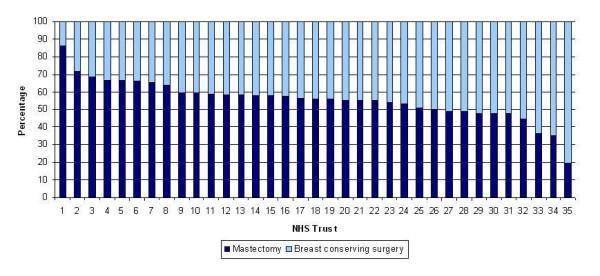
Over the study period the proportion of women having a mastectomy reduced from 58% to 52%. The proportion varied from 14% to 80% according to NHS Trust. LOS decreased by 21% from 1997/98 to 2004/05 (LOSratio = 0.79, 95%CI 0.77-0.80). BCS was associated with 33% shorter hospital stays compared to mastectomy (LOSratio = 0.67, 95%CI 0.66-0.68). Older age, advanced disease, presence of comorbidities, lymph node excision and reconstructive surgery were associated with increased LOS. Significant variation remained amongst Trusts and surgical teams.
CONCLUSION
The number of days spent in hospital after breast cancer surgery has continued to decline for several decades. The change from mastectomy to BCS accounts for only 9% of the overall decrease in LOS. Other explanations include the adoption of new techniques and practices, such as sentinel lymph node biopsy and early discharge. This study has identified wide variation in practice with substantial cost implications for the NHS. Further work is required to explain this variation.
背景
乳腺癌手术后住院时间(LOS)的减少部分归因于手术方式的改变,但在患者、外科医生和医院层面上还有许多其他因素在起作用。本研究旨在描述 1997/98 年至 2004/05 年期间英格兰两个地区乳腺癌手术后住院时间(LOS)的变化,并分析其预测因素。
方法
将两个英国癌症登记处诊断的女性浸润性乳腺癌病例与 1997 年 4 月 1 日至 2005 年 3 月 31 日的医院入院统计数据进行链接。提取了一部分接受乳房切除术或保乳手术(BCS)的记录(n=44877)。研究期间 LOS 的变化情况进行了调查。采用患者按手术团队和国民保健制度信托机构聚类的多水平模型,研究 LOS 与一系列因素之间的关系。
结果
在研究期间,接受乳房切除术的女性比例从 58%降至 52%。根据国民保健制度信托机构的不同,这一比例从 14%到 80%不等。1997/98 年至 2004/05 年期间,LOS 减少了 21%(LOS 比值=0.79,95%CI 0.77-0.80)。与乳房切除术相比,BCS 可使住院时间缩短 33%(LOS 比值=0.67,95%CI 0.66-0.68)。年龄较大、疾病晚期、合并症、淋巴结切除和重建手术与 LOS 增加有关。各信托机构和手术团队之间仍存在显著差异。
结论
几十年来,乳腺癌手术后住院天数持续下降。从乳房切除术到 BCS 的转变仅占 LOS 总体下降的 9%。其他解释包括采用新的技术和实践,如前哨淋巴结活检和早期出院。本研究发现,实践中存在广泛的差异,这对国民保健制度有重大的成本影响。需要进一步研究来解释这种差异。


 Zotero 插件