
C-反应蛋白浓度与冠心病、卒中和死亡风险的关系:一项个体参与者荟萃分析。
C-reactive protein concentration and risk of coronary heart disease, stroke, and mortality: an individual participant meta-analysis.
机构信息
Emerging Risk Factors Collaboration Coordinating Centre, Department of Public Health and Primary Care, University of Cambridge, Strangeways Research Laboratory, Cambridge CB1 8RN, UK.
出版信息
Lancet. 2010 Jan 9;375(9709):132-40. doi: 10.1016/S0140-6736(09)61717-7. Epub 2009 Dec 22.
BACKGROUND
Associations of C-reactive protein (CRP) concentration with risk of major diseases can best be assessed by long-term prospective follow-up of large numbers of people. We assessed the associations of CRP concentration with risk of vascular and non-vascular outcomes under different circumstances.
METHODS
We meta-analysed individual records of 160 309 people without a history of vascular disease (ie, 1.31 million person-years at risk, 27 769 fatal or non-fatal disease outcomes) from 54 long-term prospective studies. Within-study regression analyses were adjusted for within-person variation in risk factor levels.
RESULTS
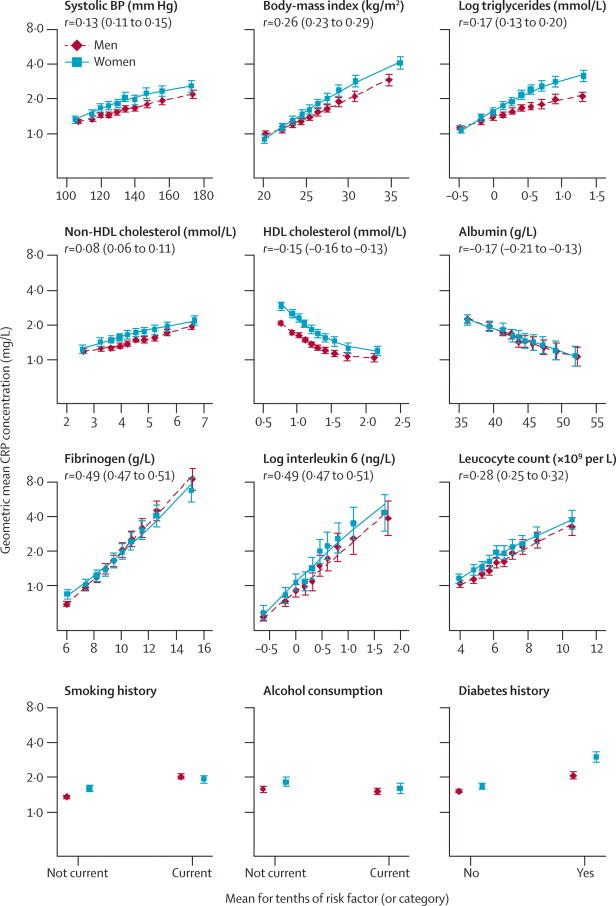
Log(e) CRP concentration was linearly associated with several conventional risk factors and inflammatory markers, and nearly log-linearly with the risk of ischaemic vascular disease and non-vascular mortality. Risk ratios (RRs) for coronary heart disease per 1-SD higher log(e) CRP concentration (three-fold higher) were 1.63 (95% CI 1.51-1.76) when initially adjusted for age and sex only, and 1.37 (1.27-1.48) when adjusted further for conventional risk factors; 1.44 (1.32-1.57) and 1.27 (1.15-1.40) for ischaemic stroke; 1.71 (1.53-1.91) and 1.55 (1.37-1.76) for vascular mortality; and 1.55 (1.41-1.69) and 1.54 (1.40-1.68) for non-vascular mortality. RRs were largely unchanged after exclusion of smokers or initial follow-up. After further adjustment for fibrinogen, the corresponding RRs were 1.23 (1.07-1.42) for coronary heart disease; 1.32 (1.18-1.49) for ischaemic stroke; 1.34 (1.18-1.52) for vascular mortality; and 1.34 (1.20-1.50) for non-vascular mortality.
INTERPRETATION
CRP concentration has continuous associations with the risk of coronary heart disease, ischaemic stroke, vascular mortality, and death from several cancers and lung disease that are each of broadly similar size. The relevance of CRP to such a range of disorders is unclear. Associations with ischaemic vascular disease depend considerably on conventional risk factors and other markers of inflammation.
FUNDING
British Heart Foundation, UK Medical Research Council, BUPA Foundation, and GlaxoSmithKline.
背景
通过对大量人群进行长期前瞻性随访,可最佳评估 C 反应蛋白(CRP)浓度与主要疾病风险的关联。我们评估了 CRP 浓度与不同情况下血管和非血管结局风险的关联。
方法
我们对 54 项长期前瞻性研究中 160309 名无血管疾病史者(即 131 万人年的风险,27769 例致死或非致死性疾病结局)的个体记录进行了荟萃分析。采用个体内变异进行风险因素水平调整的个体内回归分析。
结果
CRP 浓度的自然对数值与多种传统危险因素和炎症标志物呈线性相关,与缺血性血管疾病和非血管性死亡率的相关性几乎呈对数线性。每升高一个标准差(三倍升高),CRP 浓度的对数(e 为底)与冠心病风险比(RR)分别为 1.63(95%CI 1.51-1.76),仅经年龄和性别调整时为 1.37(1.27-1.48);与传统危险因素进一步调整时,RR 分别为 1.44(1.32-1.57)和 1.27(1.15-1.40),与缺血性脑卒中相关;与血管性死亡率相关的 RR 分别为 1.71(1.53-1.91)和 1.55(1.37-1.76);与非血管性死亡率相关的 RR 分别为 1.55(1.41-1.69)和 1.54(1.40-1.68)。排除吸烟者或初始随访后,RR 变化不大。进一步用纤维蛋白原进行调整后,冠心病 RR 分别为 1.23(1.07-1.42);缺血性脑卒中 RR 为 1.32(1.18-1.49);血管性死亡率 RR 为 1.34(1.18-1.52);非血管性死亡率 RR 为 1.34(1.20-1.50)。
解释
CRP 浓度与冠心病、缺血性脑卒中、血管性死亡率以及多种癌症和肺部疾病导致的死亡率呈连续相关,这些疾病的风险大致相同。CRP 与如此广泛的疾病的相关性尚不清楚。与缺血性血管疾病的相关性在很大程度上取决于传统危险因素和其他炎症标志物。
资金
英国心脏基金会、英国医学研究理事会、BUPA 基金会和葛兰素史克公司。



 Zotero 插件