
三磷酸肌醇诱导的 Ca2+信号转导参与雌二醇诱导的乳腺癌上皮细胞生长。
Inositol 1,4,5-trisphosphate-induced Ca2+ signalling is involved in estradiol-induced breast cancer epithelial cell growth.
机构信息
Laboratoire de Physiologie Cellulaire et Moléculaire - JE-2530: Canaux ioniques et cancer du sein, Université d'Amiens, UFR des Sciences, 33 rue Saint-Leu 80039 Amiens, France.
出版信息
Mol Cancer. 2010 Jun 21;9:156. doi: 10.1186/1476-4598-9-156.
BACKGROUND
Ca2+ is a ubiquitous messenger that has been shown to be responsible for controlling numerous cellular processes including cell growth and cell death. Whereas the involvement of IP3-induced Ca2+ signalling (IICS) in the physiological activity of numerous cell types is well documented, the role of IICS in cancer cells is still largely unknown. Our purpose was to characterize the role of IICS in the control of growth of the estrogen-dependent human breast cancer epithelial cell line MCF-7 and its potential regulation by 17beta-estradiol (E2).
RESULTS
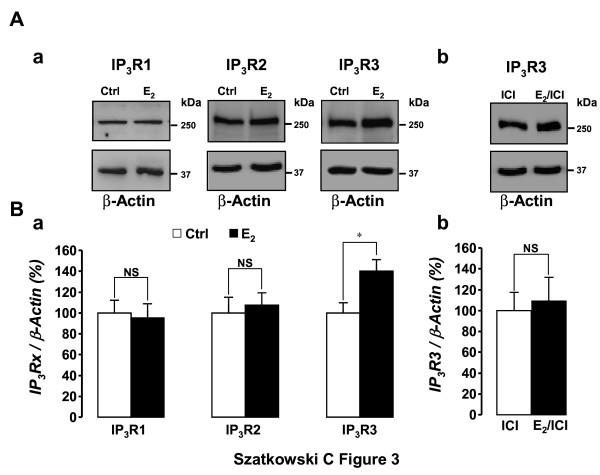
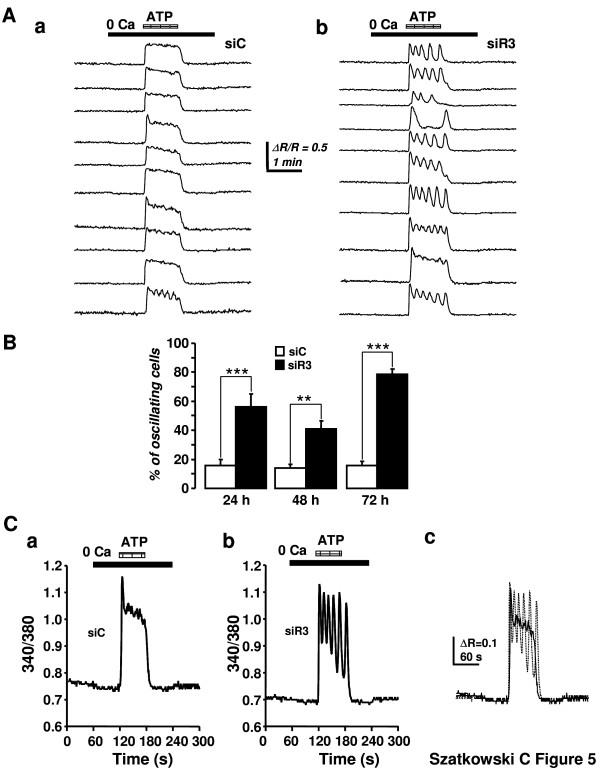
Our results show that the IP3 receptor (IP3R) inhibitors caffeine, 2-APB and xestospongin C (XeC) inhibited the growth of MCF-7 stimulated by 5% foetal calf serum or 10 nM E2. Furthermore, Ca2+ imaging experiments showed that serum and E2 were able to trigger, in a Ca2+-free medium, an elevation of internal Ca2+ in a 2-APB and XeC-sensitive manner. Moreover, the phospholipase C (PLC) inhibitor U-73122 was able to prevent intracellular Ca2+ elevation in response to serum, whereas the inactive analogue U-73343 was ineffective. Western-blotting experiments revealed that the 3 types of IP3Rs are expressed in MCF-7 cells and that a 48 hours treatment with 10 nM E2 elevated IP3R3 protein expression level in an ICI-182,780 (a specific estrogen receptor antagonist)-dependent manner. Furthermore, IP3R3 silencing by the use of specific small interfering RNA was responsible for a drastic modification of the temporal feature of IICS, independently of a modification of the sensitivity of the Ca2+ release process and acted to counteract the proliferative effect of 10 nM E2.
CONCLUSIONS
Altogether, our results are in favour of a role of IICS in MCF-7 cell growth, and we hypothesize that the regulation of IP3R3 expression by E2 is involved in this effect.
背景
钙是一种普遍存在的信使,它被证明负责控制许多细胞过程,包括细胞生长和细胞死亡。虽然 IP3 诱导的钙信号(IICS)在许多细胞类型的生理活性中的作用已有详细记录,但 IICS 在癌细胞中的作用在很大程度上仍不清楚。我们的目的是描述 IICS 在控制雌激素依赖性人乳腺癌上皮细胞系 MCF-7 生长中的作用及其可能被 17β-雌二醇(E2)调节的作用。
结果
我们的结果表明,IP3 受体(IP3R)抑制剂咖啡因、2-APB 和 Xestospongin C(XeC)抑制了 5%胎牛血清或 10 nM E2 刺激的 MCF-7 生长。此外,钙成像实验表明,血清和 E2 能够在无钙培养基中以 2-APB 和 XeC 敏感的方式触发细胞内钙的升高。此外,PLC 抑制剂 U-73122 能够阻止血清引起的细胞内钙升高,而无效类似物 U-73343 则无效。Western blot 实验表明,3 种类型的 IP3R 均在 MCF-7 细胞中表达,10 nM E2 处理 48 小时以 ICI-182,780(一种特异性雌激素受体拮抗剂)依赖性方式升高 IP3R3 蛋白表达水平。此外,使用特异性小干扰 RNA 沉默 IP3R3 导致 IICS 的时间特征发生剧烈变化,而不改变钙释放过程的敏感性,并作用于抵消 10 nM E2 的增殖作用。
结论
总之,我们的结果支持 IICS 在 MCF-7 细胞生长中的作用,我们假设 E2 对 IP3R3 表达的调节参与了这种作用。



 Zotero 插件