
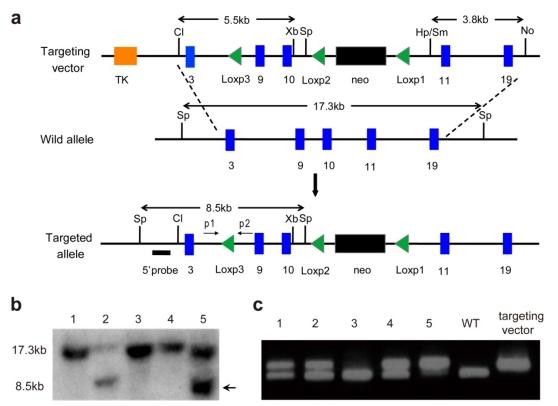
Fgfr3 条件性敲除小鼠的构建。
Generation of Fgfr3 conditional knockout mice.
机构信息
State Key Laboratory of Trauma, Burns and Combined Injury, Center of Bone Metabolism and Repair, Trauma Center, Institute of Surgery Research, Daping Hospital, Third Military Medical University, Chongqing 400042, China.
出版信息
Int J Biol Sci. 2010 Jun 15;6(4):327-32. doi: 10.7150/ijbs.6.327.
Fibroblast growth factor receptor 3 (FGFR3), highly conserved in both humans and murine, is one of key tyrosine kinase receptors for FGF. FGFR3 is expressed in different tissues, including cartilage, brain, kidney, and intestine at different development stages. Conventional knockout of Fgfr3 alleles leads to short life span, and overgrowth of bone. In clinic, human FGFR3 mutations are responsible for three different types of chondrodysplasia syndromes including achondroplasia (ACH), hypochondroplasia (HCH) and thanatophoric dysplasia (TD). For better understanding of the roles of FGFR3 in different tissues at different stages of development and in pathological conditions, we generated Fgfr3 conditional knockout mice in which loxp sites flank exons 9-10 in the Fgfr3 allele. We also demonstrated that Cre-mediated recombination using Col2a1-Cre, a Cre line expressed in chondrocyte during bone development, results in specific deletion of the gene in tissues containing cartilage. This animal model will be useful to study distinct roles of FGFR3 in different tissues at different ages.
成纤维细胞生长因子受体 3(FGFR3)在人类和鼠类中高度保守,是 FGF 的关键酪氨酸激酶受体之一。FGFR3 在不同的组织中表达,包括软骨、大脑、肾脏和肠道,在不同的发育阶段。Fgfr3 等位基因的常规敲除导致寿命缩短和骨骼过度生长。在临床上,人类 FGFR3 突变负责三种不同类型的软骨发育不良综合征,包括软骨发育不全症(ACH)、软骨发育不全症(HCH)和致死性发育不良(TD)。为了更好地理解 FGFR3 在不同组织和病理条件下的不同发育阶段的作用,我们在 Fgfr3 等位基因中用loxp 位点包围外显子 9-10 生成了 Fgfr3 条件性敲除小鼠。我们还证明,在骨骼发育过程中在软骨细胞中表达的 Cre 线 Col2a1-Cre 介导的 Cre 重组导致在含有软骨的组织中特异性缺失该基因。这种动物模型将有助于研究 FGFR3 在不同年龄的不同组织中的不同作用。



 Zotero 插件