
突变等位基因 FAD2-1A 和 FAD2-1B 相结合,可生产出具有高油酸种子油特性的大豆。
Mutant alleles of FAD2-1A and FAD2-1B combine to produce soybeans with the high oleic acid seed oil trait.
机构信息
University of Missouri, Division of Plant Sciences, 110 Waters Hall, Columbia, MO 65211, USA.
出版信息
BMC Plant Biol. 2010 Sep 9;10:195. doi: 10.1186/1471-2229-10-195.
BACKGROUND
The alteration of fatty acid profiles in soybean [Glycine max (L.) Merr.] to improve soybean oil quality is an important and evolving theme in soybean research to meet nutritional needs and industrial criteria in the modern market. Soybean oil with elevated oleic acid is desirable because this monounsaturated fatty acid improves the nutrition and oxidative stability of the oil. Commodity soybean oil typically contains 20% oleic acid and the target for high oleic acid soybean oil is approximately 80% of the oil; previous conventional plant breeding research to raise the oleic acid level to just 50-60% of the oil was hindered by the genetic complexity and environmental instability of the trait. The objective of this work was to create the high oleic acid trait in soybeans by identifying and combining mutations in two delta-twelve fatty acid desaturase genes, FAD2-1A and FAD2-1B.
RESULTS
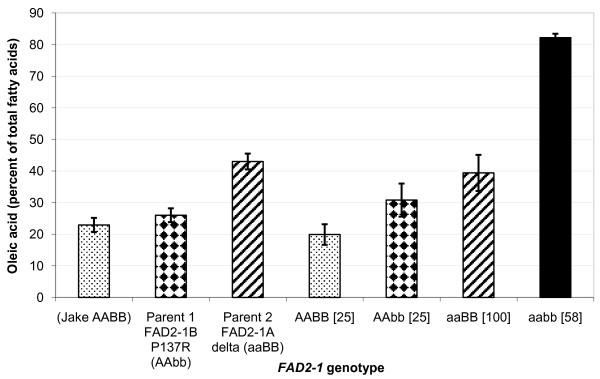
Three polymorphisms found in the FAD2-1B alleles of two soybean lines resulted in missense mutations. For each of the two soybean lines, there was one unique amino acid change within a highly conserved region of the protein. The mutant FAD2-1B alleles were associated with an increase in oleic acid levels, although the FAD2-1B mutant alleles alone were not capable of producing a high oleic acid phenotype. When existing FAD2-1A mutations were combined with the novel mutant FAD2-1B alleles, a high oleic acid phenotype was recovered only for those lines which were homozygous for both of the mutant alleles.
CONCLUSIONS
We were able to produce conventional soybean lines with 80% oleic acid in the oil in two different ways, each requiring the contribution of only two genes. The high oleic acid soybean germplasm developed contained a desirable fatty acid profile, and it was stable in two production environments. The presumed causative sequence polymorphisms in the FAD2-1B alleles were developed into highly efficient molecular markers for tracking the mutant alleles. The resources described here for the creation of high oleic acid soybeans provide a framework to efficiently develop soybean varieties to meet changing market demands.
背景
为了改善大豆油的质量,改变大豆中的脂肪酸谱是大豆研究中的一个重要且不断发展的主题,以满足现代市场的营养需求和工业标准。油酸含量高的大豆油是理想的,因为这种单不饱和脂肪酸可以提高油的营养价值和氧化稳定性。商品大豆油通常含有 20%的油酸,高油酸大豆油的目标是油中约 80%的油酸;以前通过常规植物育种研究将油酸水平提高到油的 50-60%,受到该性状遗传复杂性和环境不稳定性的阻碍。本工作的目的是通过鉴定和组合两个 delta-十二脂肪酸去饱和酶基因 FAD2-1A 和 FAD2-1B 的突变来在大豆中产生高油酸性状。
结果
在两个大豆品系的 FAD2-1B 等位基因中发现了三个多态性,导致错义突变。对于两个大豆品系中的每一个,在蛋白质的高度保守区域内都有一个独特的氨基酸变化。突变的 FAD2-1B 等位基因与油酸水平的升高有关,尽管突变的 FAD2-1B 等位基因本身不能产生高油酸表型。当现有的 FAD2-1A 突变与新的突变 FAD2-1B 等位基因结合时,只有那些两条突变等位基因均为纯合的品系才恢复高油酸表型。
结论
我们能够以两种不同的方式生产出油中油酸含量为 80%的常规大豆品系,每种方式仅需要两个基因的贡献。所开发的高油酸大豆种质资源具有理想的脂肪酸谱,并且在两个生产环境中稳定。在 FAD2-1B 等位基因中假定的因果序列多态性被开发成用于跟踪突变等位基因的高效分子标记。这里描述的用于创建高油酸大豆的资源为满足不断变化的市场需求,有效地开发大豆品种提供了一个框架。




 Zotero 插件