
杂食性的西方污点叶蝉和线斑叶蝉的幼年期和成年期的饮食选择。
Diet selection exhibited by juvenile and adult lifestages of the omnivores Western tarnished plant bug, Lygus hesperus and tarnished plant bug, Lygus lineolaris.
机构信息
United States Department of Agriculture, Agricultural Research Service, Arid-Land Agricultural Research Center, Maricopa, Arizona, USA.
出版信息
J Insect Sci. 2010;10:127. doi: 10.1673/031.010.12701.
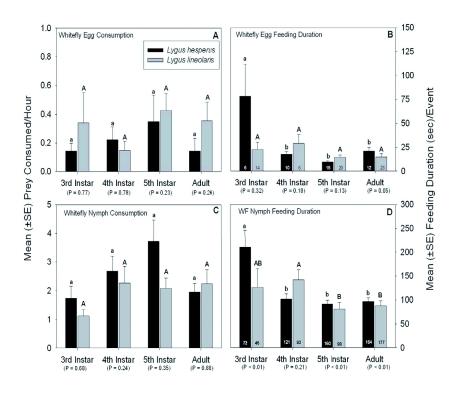
Lygus hesperus Knight and Lygus lineolaris (Palisot de Beauvois) (Heteroptera: Miridae) are economically important plant bugs on many crops worldwide. However, these omnivores are also facultative predators on a wide variety of insects. This study was conducted to quantify and compare herbivory and carnivory exhibited among different lifestages of these two insect pests. The feeding activity of a total of 422 individuals was observed for 1 h each in feeding arenas containing a cotton leaf disk and copious amounts of the sweetpotato whitefly, Bemisia tabaci (Gennadius) (Hemiptera: Aleyrodidae) eggs, nymphs and adults. The L. hesperus and L. lineolaris lifestages examined included adults and 3rd, 4th and 5th instar nymphs. Plant feeding occupied the majority of both species' time budget, regardless of the species or lifestage examined. There was a tendency for L. lineolaris lifestages to feed more often and for longer duration on plant tissue than L. hesperus. All lifestages of both species rarely fed on B. tabaci, but when they did, they preferred nymphs > adults > eggs. There were only a few cases where there were significant differences in predation rates and prey handling times exhibited among lifestages and between species, but juvenile L. hesperus tended to be more predaceous than juvenile L. lineolaris on whitefly nymphs and adults and 5th instar and adult L. lineolaris were significantly more herbaceous than their L. hesperus counterparts. In addition, the younger individuals of both species tended to have greater prey handling times than their older counterparts. The significance of these findings is discussed.
黑肩绿盲蝽和美洲斑潜蝇(Palisot de Beauvois)(半翅目:盲蝽科)是世界上许多作物上具有重要经济意义的植物虫害。然而,这些杂食动物也是各种昆虫的兼性捕食者。本研究旨在量化和比较这两种害虫不同生活阶段表现出的取食和捕食行为。在喂食场中,每个喂食场中含有一个棉花叶盘和大量的甘薯粉虱,Bemisia tabaci(Gennadius)(半翅目:粉虱科)卵、若虫和成虫,共观察了 422 只个体的 1 小时喂食活动。检查的 L. hesperus 和 L. lineolaris 生活阶段包括成虫和 3、4 和 5 龄若虫。植物取食占据了这两个物种时间预算的大部分,无论检查的物种或生活阶段如何。L. lineolaris 生活阶段比 L. hesperus 更倾向于更频繁和更长时间地取食植物组织。两种物种的所有生活阶段很少取食 B. tabaci,但当它们取食时,它们更喜欢若虫>成虫>卵。在生活阶段和物种之间,只有少数情况下捕食率和猎物处理时间存在显著差异,但在白蝇若虫和成虫上,幼年 L. hesperus 比幼年 L. lineolaris 更具捕食性,5 龄和成虫 L. lineolaris 比它们的 L. hesperus 对应物更具草食性。此外,两种物种的年轻个体的猎物处理时间往往比年长个体长。讨论了这些发现的意义。


 Zotero 插件