
CP3 的特征揭示了一个新的 bri1 等位基因 bri1-120,以及 BRI1 的 LRR 结构域在介导 BR 信号中的重要性。
Characterization of cp3 reveals a new bri1 allele, bri1-120, and the importance of the LRR domain of BRI1 mediating BR signaling.
机构信息
Division of Biological Science, Sookmyung Women's University, Seoul, Korea.
出版信息
BMC Plant Biol. 2011 Jan 11;11:8. doi: 10.1186/1471-2229-11-8.
BACKGROUND
Since the identification of BRI1 (BRASSINOSTEROID-INSENSITIVE1), a brassinosteroids (BRs) receptor, most of the critical roles of BR in plant development have been assessed using various bri1 mutant alleles. The characterization of individual bri1 mutants has shown that both the extracellular and cytoplasmic domains of BRI1 are important to its proper functioning. Particularly, in the extracellular domain, regions near the 70-amino acid island are known to be critical to BR binding. In comparison, the exact function of the leucine rich-repeats (LRR) region located before the 70-amino acid island domain in the extracellular cellular portion of BRI1 has not yet been described, due to a lack of specific mutant alleles.
RESULTS
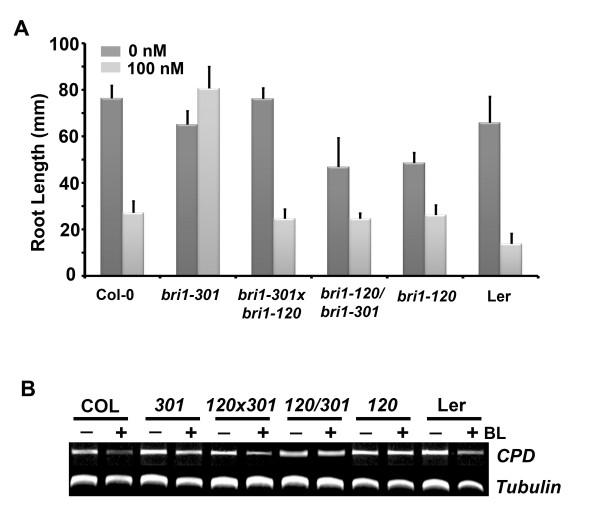
Among the mutants showing altered growth patterns compared to wild type, we further characterized cp3, which displayed defective growth and reduced BR sensitivity. We sequenced the genomic DNA spanning BRI1 in the cp3 and found that cp3 has a point mutation in the region encoding the 13th LRR of BRI1, resulting in a change from serine to phenylalanine (S399F). We renamed it bri1-120. We also showed that overexpression of the wild type BRI1 protein rescued the phenotype of bri1-120. Using a GFP-tagged bri1-120 construct, we detected the bri1-120 protein in the plasma membrane, and showed that the phenotypic defects in the rosette leaves of bri1-301, a kinase-inactive weak allele of BRI1, can be restored by the overexpression of the bri1-120 proteins in bri1-301. We also produced bri1-301 mutants that were wild type in appearance by performing a genetic cross between bri1-301 and bri1-120 plants.
CONCLUSIONS
We identified a new bri1 allele, bri1-120, whose mutation site has not yet been found or characterized. Our results indicated that the extracellular LRR regions before the 70-amino acid island domain of BRI1 are important for the appropriate cellular functioning of BRI1. Also, we confirmed that a successful interallelic complementation occurs between the extracellular domain mutant allele and the cytoplasmic kinase-inactive mutant allele of BRI1 in vivo.
背景
自从鉴定出 BRASSINOSTEROID-INSENSITIVE1(BRI1),一种油菜素内酯(BRs)受体以来,已经使用各种 bri1 突变等位基因来评估 BR 在植物发育中的关键作用。对单个 bri1 突变体的特征描述表明,BRI1 的细胞外和细胞质结构域对于其正常功能都是重要的。特别是,在细胞外结构域中,靠近 70 个氨基酸岛的区域对于 BR 结合至关重要。相比之下,位于细胞外部分的 BRI1 的 70 个氨基酸岛结构域之前的亮氨酸重复(LRR)区域的具体功能尚未描述,这是因为缺乏特异性的突变等位基因。
结果
与野生型相比,在表现出改变的生长模式的突变体中,我们进一步对 cp3 进行了特征描述,cp3 表现出生长缺陷和 BR 敏感性降低。我们对 cp3 中跨越 BRI1 的基因组 DNA 进行测序,发现 cp3 在编码 BRI1 的第 13 个 LRR 的区域有一个点突变,导致丝氨酸突变为苯丙氨酸(S399F)。我们将其重新命名为 bri1-120。我们还表明,过表达野生型 BRI1 蛋白可挽救 bri1-120 的表型缺陷。使用 GFP 标记的 bri1-120 构建体,我们在质膜中检测到 bri1-120 蛋白,并表明 BRI1 的激酶失活弱等位基因 bri1-301 的莲座叶的表型缺陷可以通过 bri1-120 蛋白在 bri1-301 中的过表达来恢复。我们还通过在 bri1-301 和 bri1-120 植物之间进行遗传杂交,产生了外观上为野生型的 bri1-301 突变体。
结论
我们鉴定出了一个新的 bri1 等位基因 bri1-120,其突变位点尚未被发现或描述。我们的结果表明,BRI1 的 70 个氨基酸岛结构域之前的细胞外 LRR 区域对于 BRI1 的适当细胞功能很重要。此外,我们证实,在体内,细胞外结构域突变等位基因和细胞质激酶失活突变等位基因之间存在成功的等位基因互补。


 Zotero 插件