
皮下脂肪组织分类。
Subcutaneous adipose tissue classification.
机构信息
Department of Neurological, Neuropsychological, Morphological and Motor Sciences, Human Anatomy and Histology Section, University of Verona, Italy.
出版信息
Eur J Histochem. 2010 Nov 25;54(4):e48. doi: 10.4081/ejh.2010.e48.
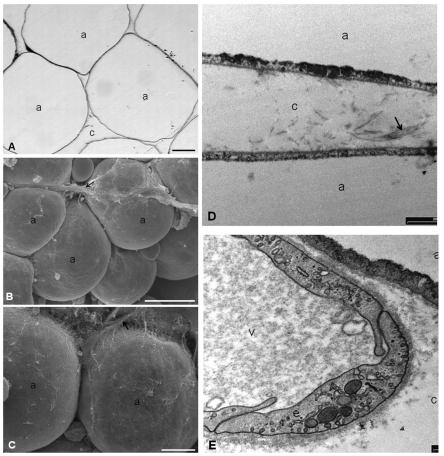
The developments in the technologies based on the use of autologous adipose tissue attracted attention to minor depots as possible sampling areas. Some of those depots have never been studied in detail. The present study was performed on subcutaneous adipose depots sampled in different areas with the aim of explaining their morphology, particularly as far as regards stem niches. The results demonstrated that three different types of white adipose tissue (WAT) can be differentiated on the basis of structural and ultrastructural features: deposit WAT (dWAT), structural WAT (sWAT) and fibrous WAT (fWAT). dWAT can be found essentially in large fatty depots in the abdominal area (periumbilical). In the dWAT, cells are tightly packed and linked by a weak net of isolated collagen fibers. Collagenic components are very poor, cells are large and few blood vessels are present. The deep portion appears more fibrous then the superficial one. The microcirculation is formed by thin walled capillaries with rare stem niches. Reinforcement pericyte elements are rarely evident. The sWAT is more stromal; it is located in some areas in the limbs and in the hips. The stroma is fairly well represented, with a good vascularity and adequate staminality. Cells are wrapped by a basket of collagen fibers. The fatty depots of the knees and of the trochanteric areas have quite loose meshes. The fWAT has a noteworthy fibrous component and can be found in areas where a severe mechanic stress occurs. Adipocytes have an individual thick fibrous shell. In conclusion, the present study demonstrates evident differences among subcutaneous WAT deposits, thus suggesting that in regenerative procedures based on autologous adipose tissues the sampling area should not be randomly chosen, but it should be oriented by evidence based evaluations. The structural peculiarities of the sWAT, and particularly of its microcirculation, suggest that it could represent a privileged source for regenerative procedures based on autologous adipose tissues.
基于自体脂肪组织使用的技术发展引起了人们对可能的采样区域作为次要储存库的关注。其中一些储存库从未被详细研究过。本研究对不同区域采集的皮下脂肪储存库进行了研究,目的是解释其形态,特别是在干细胞龛方面。结果表明,根据结构和超微结构特征,可以将三种不同类型的白色脂肪组织 (WAT) 区分开来:储存脂肪组织 (dWAT)、结构脂肪组织 (sWAT) 和纤维状脂肪组织 (fWAT)。dWAT 主要存在于腹部(脐周)的大脂肪储存库中。在 dWAT 中,细胞紧密排列,由孤立的胶原纤维弱网连接。胶原成分很少,细胞较大,血管较少。深部比浅部更具纤维性。微循环由薄壁毛细血管形成,干细胞龛很少。增强周细胞元素很少明显。sWAT 更具基质性;它位于四肢和臀部的一些区域。基质相当丰富,具有良好的血管生成和适当的干细胞活性。细胞被胶原纤维篮包裹。膝盖和转子区域的脂肪储存具有相当宽松的网状结构。fWAT 具有显著的纤维成分,可在发生严重机械应力的区域找到。脂肪细胞有一个单独的厚纤维壳。总之,本研究表明皮下 WAT 沉积物之间存在明显差异,因此表明在基于自体脂肪组织的再生程序中,采样区域不应随机选择,而应根据循证评估进行指导。sWAT 的结构特征,特别是其微循环,表明它可能是基于自体脂肪组织的再生程序的一个优先来源。


 Zotero 插件