
对热痛的感知和热格栅错觉与 5-羟色胺转运体基因的多态性有关。
Perception of thermal pain and the thermal grill illusion is associated with polymorphisms in the serotonin transporter gene.
机构信息
Osher Center for Integrative Medicine, Stockholm Brain Institute, Department of Clinical Neuroscience Karolinska Institutet, Stockholm, Sweden.
出版信息
PLoS One. 2011 Mar 15;6(3):e17752. doi: 10.1371/journal.pone.0017752.
AIM
The main aim of this study was to assess if the perception of thermal pain thresholds is associated with genetically inferred levels of expression of the 5-HT transporter (5-HTT). Additionally, the perception of the so-called thermal grill illusion (TGI) was assessed. Forty-four healthy individuals (27 females, 17 males) were selected a-priori based on their 5-HTTLPR/rs25531 ('tri-allelic 5-HTTLPR') genotype, with inferred high or low 5-HTT expression. Thresholds for heat- and cold-pain were determined along with the sensory and affective dimensions of the TGI.
RESULTS
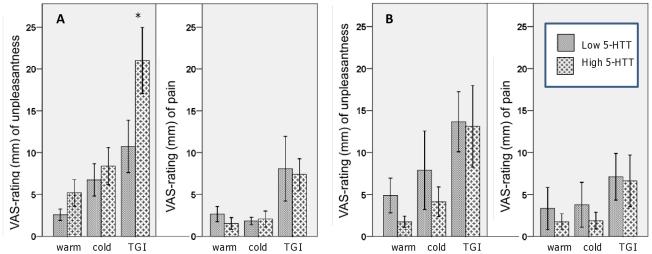
Thresholds to heat- and cold-pain correlated strongly (rho = -0.58, p<0.001). Individuals in the low 5-HTT-expressing group were significantly less sensitive to heat-pain (p = 0.02) and cold-pain (p = 0.03), compared to the high-expressing group. A significant gender-by-genotype interaction also emerged for cold-pain perception (p = 0.02); low 5-HTT-expressing females were less sensitive. The TGI was rated as significantly more unpleasant (affective-motivational dimension) than painful (sensory-discriminatory dimension), (p<0.001). Females in the low 5-HTT expressing group rated the TGI as significantly less unpleasant than high 5-HTT expressing females (p<0.05), with no such differences among men.
CONCLUSION/SIGNIFICANCE: We demonstrate an association between inferred low 5-HTT expression and elevated thresholds to thermal pain in healthy non-depressed individuals. Despite the fact that reduced 5-HTT expression is a risk factor for chronic pain we found it to be related to hypoalgesia for threshold thermal pain. Low 5-HTT expression is, however, also a risk factor for depression where thermal insensitivity is often seen. Our results may thus contribute to a better understanding of the molecular underpinnings of such paradoxical hypoalgesia. The results point to a differential regulation of thermoafferent-information along the neuraxis on the basis of 5-HTT expression and gender. The TGI, suggested to rely on the central integration of thermoafferent-information, may prove a valuable tool in probing the affective-motivational dimension of these putative mechanisms.
目的
本研究的主要目的是评估热痛觉阈值的感知是否与 5-羟色胺转运体(5-HTT)的基因推断表达水平相关。此外,还评估了所谓的热格栅错觉(TGI)的感知。根据其 5-HTTLPR/rs25531(“三等位基因 5-HTTLPR”)基因型,预先选择了 44 名健康个体(27 名女性,17 名男性),具有高或低 5-HTT 表达的推断。确定了热痛觉和冷痛觉的阈值,以及 TGI 的感觉和情感维度。
结果
热痛觉和冷痛觉阈值之间存在很强的相关性(rho=-0.58,p<0.001)。与高表达组相比,低 5-HTT 表达组对热痛觉(p=0.02)和冷痛觉(p=0.03)的敏感性显著降低。对于冷痛觉感知,还出现了显著的性别-基因型相互作用(p=0.02);低 5-HTT 表达的女性敏感性较低。TGI 的评分明显比疼痛(感觉区分维度)更不愉快(情感动机维度)(p<0.001)。低 5-HTT 表达组的女性对 TGI 的评分明显低于高 5-HTT 表达的女性(p<0.05),而男性之间没有差异。
结论/意义:我们证明了在健康非抑郁个体中,推断的低 5-HTT 表达与热痛觉阈值升高之间存在关联。尽管降低 5-HTT 表达是慢性疼痛的危险因素,但我们发现它与阈值热痛觉的低痛觉有关。然而,低 5-HTT 表达也是抑郁的危险因素,其中通常会出现热不敏感。我们的结果可能有助于更好地理解这种矛盾性低痛觉的分子基础。结果表明,基于 5-HTT 表达和性别,沿轴突对热感觉信息进行了差异调节。TGI 被认为依赖于热感觉信息的中枢整合,可能是探测这些假定机制的情感动机维度的有效工具。


 Zotero 插件