
内旋滞后征对于检测全髋关节置换术后髋外展肌腱断裂是否是一项敏感的检查?
Is the internal rotation lag sign a sensitive test for detecting hip abductor tendon ruptures after total hip arthroplasty?
作者信息
Ossendorf Christian, Bohnert Laurent, Mamisch-Saupe Nadja, Rittirsch Daniel, Wanner Guido A, Simmen Hans-Peter, Dora Claudio, Werner Clément Ml
机构信息
Department of Surgery, Division of Trauma Surgery, University Hospital Zurich, Raemistrasse 100, 8091 Zurich, Switzerland.
出版信息
Patient Saf Surg. 2011 Apr 17;5(1):7. doi: 10.1186/1754-9493-5-7.
INTRODUCTION
Total hip arthroplasty (THA) is one of the most frequently performed procedures in orthopaedics and weakness of external rotators is often recognized thereafter. However, the etiology of lateral hip pain is multifaceted. For the diagnosis of abductor tendon rupture, magnetic resonance imaging (MRI) is the gold standard. As not every patient can be subjected to MRI, a clinical diagnostic test for easy detection of lesions of the abductor tendon is missing. Here, we present the internal rotation lack sign indicating abductor tendon pathology.
METHODS
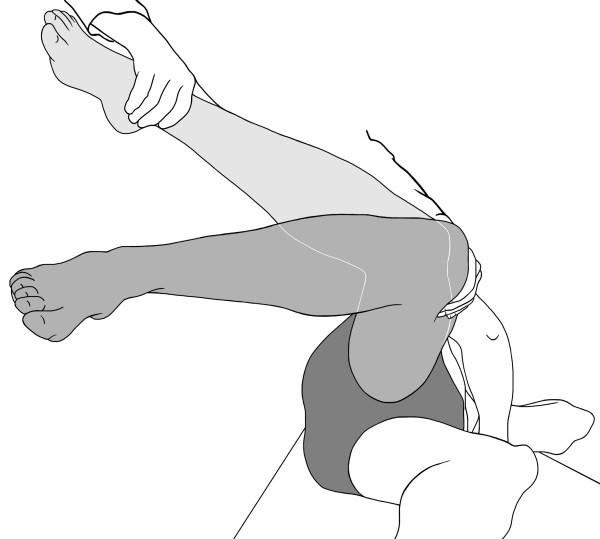
The patient is placed in lateral position on a stretcher with hips and knees in neutral position. The knee is flexed to 45° and the hip passively abducted and elevated by the investigator. With the foot passively abducted, the patient is then asked to bring his knee in direction to the examination table. This motion is also tested passively. The test is regarded positive, if no internal rotation is possible and/or if this is painful. If groin pain is elicited during either of the exercises, the test is also rated positive.
RESULTS
We evaluated this test in 20 patients clinically and by magnetic resonance imaging (MRI). All patients demonstrated a positive internal rotation lag sign. Twelve of them lag of internal rotation and evidence of anterior abductor tendon rupture on MRI, 8 with lag of internal rotation and no evidence of abductor tendon rupture.
CONCLUSION
The new clinical diagnostic sign presented here may improve the diagnosis of abductor tendon rupture in the future.
LEVEL OF EVIDENCE
Diagnostic study, level I.
引言
全髋关节置换术(THA)是骨科最常施行的手术之一,术后常出现外旋肌无力。然而,髋关节外侧疼痛的病因是多方面的。对于外展肌腱断裂的诊断,磁共振成像(MRI)是金标准。由于并非每个患者都能接受MRI检查,目前缺少一种易于检测外展肌腱损伤的临床诊断试验。在此,我们介绍一种提示外展肌腱病变的内旋缺失征。
方法
患者侧卧于担架上,髋膝关节处于中立位。膝关节屈曲至45°,检查者被动外展并抬高髋关节。在足部被动外展的情况下,要求患者将膝关节向检查台方向移动。此动作也进行被动测试。如果无法进行内旋和/或伴有疼痛,则该试验被视为阳性。如果在任何一项运动中引发腹股沟疼痛,该试验也评定为阳性。
结果
我们对20例患者进行了此项试验的临床评估及磁共振成像(MRI)检查。所有患者内旋滞后征均为阳性。其中12例存在内旋滞后,MRI显示有外展肌腱前部断裂;8例存在内旋滞后,但无外展肌腱断裂证据。
结论
本文介绍的新的临床诊断体征未来可能会改善外展肌腱断裂的诊断。
证据水平
诊断性研究,I级。

 Zotero 插件