
吡啶 - 3 - 甲腈 - 氯冉酸 - 乙腈(2/1/2)
Pyridine-3-carbonitrile-chloranilic acid-acetonitrile (2/1/2).
作者信息
Gotoh Kazuma, Ishida Hiroyuki
机构信息
Department of Chemistry, Faculty of Science, Okayama University, Okayama 700-8530, Japan.
出版信息
Acta Crystallogr Sect E Struct Rep Online. 2009 Sep 16;65(Pt 10):o2467. doi: 10.1107/S1600536809036605.
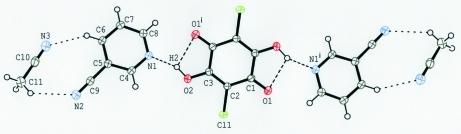
In the crystal structure of the title compound, 2C(6)H(4)N(2)·C(6)H(2)Cl(2)O(4)·2C(2)H(3)N, the two symmetry-related pyridine-3-carbonitrile mol-ecules are linked to either side of a chloranilic acid (systematic name: 2,5-dichloro-3,6-dihydr-oxy-1,4-benzoquinone) mol-ecule via inter-molecular O-H⋯N hydrogen bonds, giving a centrosymmetric 2:1 unit. The dihedral angle between the pyridine ring and the chloranilic acid plane is 26.71 (6)°. In addition, the two acetonitrile mol-ecules are linked to either side of the 2:1 unit through C-H⋯N hydrogen bonds, forming a 2:1:2 aggregate. These 2:1:2 aggregates are further linked by weak inter-molecular C-H⋯N and C-H⋯O hydrogen bonds, forming a tape along the c axis.
在标题化合物2C₆H₄N₂·C₆H₂Cl₂O₄·2C₂H₃N的晶体结构中,两个对称相关的吡啶 - 3 - 甲腈分子通过分子间O - H⋯N氢键连接到氯冉酸(系统名称:2,5 - 二氯 - 3,6 - 二羟基 - 1,4 - 苯醌)分子的两侧,形成一个中心对称的2:1单元。吡啶环与氯冉酸平面之间的二面角为26.71 (6)°。此外,两个乙腈分子通过C - H⋯N氢键连接到2:1单元的两侧,形成一个2:1:2聚集体。这些2:1:2聚集体通过弱分子间C - H⋯N和C - H⋯O氢键进一步连接,沿c轴形成一条带。

 Zotero 插件