
微囊化技术:整合人类胚胎干细胞扩增和冷冻保存的有力工具。
Microencapsulation technology: a powerful tool for integrating expansion and cryopreservation of human embryonic stem cells.
机构信息
Instituto de Tecnologia Química e Biológica, Universidade Nova de Lisboa, Oeiras, Portugal.
出版信息
PLoS One. 2011;6(8):e23212. doi: 10.1371/journal.pone.0023212. Epub 2011 Aug 5.
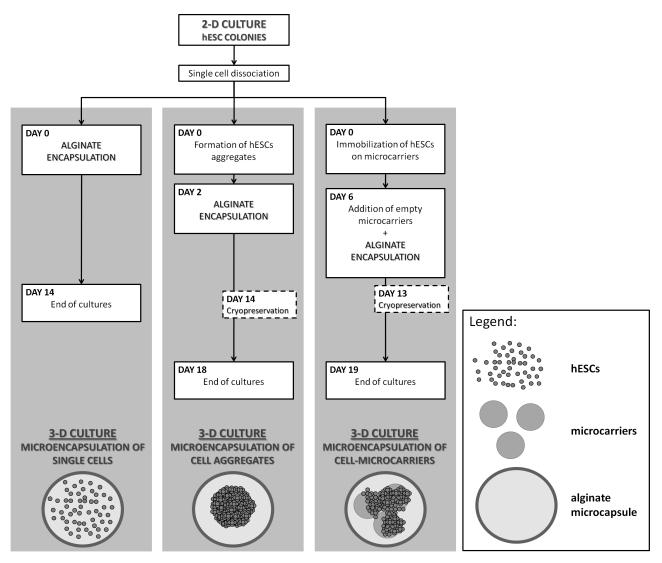
The successful implementation of human embryonic stem cells (hESCs)-based technologies requires the production of relevant numbers of well-characterized cells and their efficient long-term storage. In this study, cells were microencapsulated in alginate to develop an integrated bioprocess for expansion and cryopreservation of pluripotent hESCs. Different three-dimensional (3D) culture strategies were evaluated and compared, specifically, microencapsulation of hESCs as: i) single cells, ii) aggregates and iii) immobilized on microcarriers. In order to establish a scalable bioprocess, hESC-microcapsules were cultured in stirred tank bioreactors.The combination of microencapsulation and microcarrier technology resulted in a highly efficient protocol for the production and storage of pluripotent hESCs. This strategy ensured high expansion ratios (an approximately twenty-fold increase in cell concentration) and high cell recovery yields (>70%) after cryopreservation. When compared with non-encapsulated cells, cell survival post-thawing demonstrated a three-fold improvement without compromising hESC characteristics.Microencapsulation also improved the culture of hESC aggregates by protecting cells from hydrodynamic shear stress, controlling aggregate size and maintaining cell pluripotency for two weeks.This work establishes that microencapsulation technology may prove a powerful tool for integrating the expansion and cryopreservation of pluripotent hESCs. The 3D culture strategy developed herein represents a significant breakthrough towards the implementation of hESCs in clinical and industrial applications.
人类胚胎干细胞(hESCs)技术的成功实施需要产生大量特征明确的细胞,并对其进行有效的长期储存。在这项研究中,我们将细胞包裹在藻酸盐中,开发了一种集成的生物工艺,用于扩增和冷冻保存多能性 hESCs。评估和比较了不同的三维(3D)培养策略,具体包括:i)单细胞、ii)细胞聚集体和 iii)固定在微载体上。为了建立可扩展的生物工艺,我们将 hESC-微胶囊在搅拌槽生物反应器中进行培养。微胶囊化和微载体技术的结合为多能性 hESCs 的生产和储存提供了高效的方案。该策略确保了高扩增倍数(细胞浓度约增加二十倍)和高细胞回收率(冷冻保存后>70%)。与未包裹的细胞相比,冻融后细胞的存活率提高了三倍,而不影响 hESC 的特性。微胶囊化还通过保护细胞免受流体剪切力、控制聚集体大小和维持细胞多能性两周,改善了 hESC 聚集体的培养。这项工作表明,微胶囊化技术可能是整合多能性 hESCs 的扩增和冷冻保存的有力工具。本文开发的 3D 培养策略代表了在临床和工业应用中实施 hESCs 的重大突破。



 Zotero 插件