
作为结肠镜检查准备并发症的博雷尔哈夫综合征:一例报告。
Boerhaave syndrome as a complication of colonoscopy preparation: a case report.
作者信息
Emmanouilidis Nikos, Jäger Mark Dietrich, Winkler Michael, Klempnauer Jürgen
机构信息
Department of General, Visceral and Transplant Surgery, Hannover Medical School, Carl Neuberg Strasse 1, D-30625 Germany.
出版信息
J Med Case Rep. 2011 Nov 5;5:544. doi: 10.1186/1752-1947-5-544.
INTRODUCTION
Colonoscopy is one of the most frequently performed elective and invasive diagnostic interventions. For every colonoscopy, complete colon preparation is mandatory to provide the best possible endoluminal visibility; for example, the patient has to drink a great volume of a non-resorbable solution to flush out all feces. Despite the known possible nauseating side effects of colonoscopy preparation and despite the knowledge that excessive vomiting can cause rupture of the distal esophagus (Boerhaave syndrome), which is a rare but severe complication with high morbidity and mortality, it is not yet a standard procedure to provide a patient with an anti-emetic medication during a colon preparation process. This is the first report of Boerhaave syndrome induced by colonoscopy preparation, and this case strongly suggests that the prospect of being at risk of a severe complication connected with an elective colonoscopy justifies a non-invasive, inexpensive yet effective precaution such as an anti-emetic co-medication during the colonoscopy preparation process.
CASE PRESENTATION
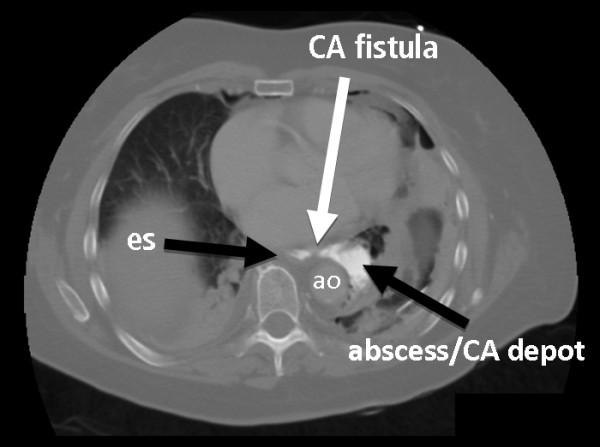
A 73-year-old Caucasian woman was scheduled to undergo elective colonoscopy. For the colonoscopy preparation at home she received commercially available bags containing soluble polyethylene glycol powder. No anti-emetic medication was prescribed. After drinking the prepared solution she had to vomit excessively and experienced a sudden and intense pain in her back. An immediate computed tomography (CT) scan revealed a rupture of the distal esophagus (Boerhaave syndrome). After initial conservative treatment by endoluminal sponge vacuum therapy, she was taken to the operating theatre and the longitudinal esophageal rupture was closed by direct suture and gastric fundoplication (Nissen procedure). She recovered completely and was discharged three weeks after the initial event.
CONCLUSIONS
To the best of our knowledge, this is the first report of a case of Boerhaave syndrome as a complication of excessive vomiting caused by colonoscopy preparation. The case suggests that patients who are prepared for a colonoscopy by drinking large volumes of fluid should routinely receive an anti-emetic medication during the preparation process, especially when they have a tendency to nausea and vomiting.
引言
结肠镜检查是最常进行的择期侵入性诊断干预措施之一。对于每次结肠镜检查,彻底的肠道准备是确保最佳腔内视野的必要条件;例如,患者必须饮用大量不可吸收的溶液以清除所有粪便。尽管已知结肠镜检查准备可能会带来令人恶心的副作用,并且尽管了解到过度呕吐可能导致远端食管破裂(Boerhaave综合征),这是一种罕见但严重的并发症,发病率和死亡率都很高,但在肠道准备过程中为患者提供止吐药物尚未成为标准程序。这是首例因结肠镜检查准备诱发Boerhaave综合征的报告,该病例强烈表明,与择期结肠镜检查相关的严重并发症风险证明了在结肠镜检查准备过程中采取一种非侵入性、廉价且有效的预防措施(如联合使用止吐药物)是合理的。
病例介绍
一名73岁的白人女性计划接受择期结肠镜检查。在家中进行结肠镜检查准备时,她服用了市售的装有可溶性聚乙二醇粉末的袋子。未开具止吐药物。饮用准备好的溶液后,她开始过度呕吐,并突然感到背部剧烈疼痛。立即进行的计算机断层扫描(CT)显示远端食管破裂(Boerhaave综合征)。在通过腔内海绵真空疗法进行初步保守治疗后,她被送往手术室,通过直接缝合和胃底折叠术(nissen手术)闭合了食管纵向破裂处。她完全康复,并在初次发病三周后出院。
结论
据我们所知,这是首例因结肠镜检查准备导致过度呕吐而引发Boerhaave综合征的病例报告。该病例表明,通过大量饮水进行结肠镜检查准备的患者在准备过程中应常规接受止吐药物,尤其是当他们有恶心和呕吐倾向时。


 Zotero 插件