
Sur7 促进质膜的组织,并且对于应对胁迫条件以及白念珠菌的侵袭性生长和毒力是必需的。
Sur7 promotes plasma membrane organization and is needed for resistance to stressful conditions and to the invasive growth and virulence of Candida albicans.
机构信息
Department of Molecular Genetics and Microbiology, Stony Brook University, Stony Brook, New York, USA.
出版信息
mBio. 2011 Dec 27;3(1). doi: 10.1128/mBio.00254-11. Print 2012.
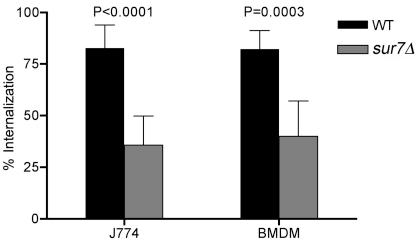
The human fungal pathogen Candida albicans causes lethal systemic infections because of its ability to grow and disseminate in a host. The C. albicans plasma membrane is essential for virulence by acting as a protective barrier and through its key roles in interfacing with the environment, secretion of virulence factors, morphogenesis, and cell wall synthesis. Difficulties in studying hydrophobic membranes have limited the understanding of how plasma membrane organization contributes to its function and to the actions of antifungal drugs. Therefore, the role of the recently discovered plasma membrane subdomains termed the membrane compartment containing Can1 (MCC) was analyzed by assessing the virulence of a sur7Δ mutant. Sur7 is an integral membrane protein component of the MCC that is needed for proper localization of actin, morphogenesis, cell wall synthesis, and responding to cell wall stress. MCC domains are stable 300-nm-sized punctate patches that associate with a complex of cytoplasmic proteins known as an eisosome. Analysis of virulence-related properties of a sur7Δ mutant revealed defects in intraphagosomal growth in macrophages that correlate with increased sensitivity to oxidation and copper. The sur7Δ mutant was also strongly defective in pathogenesis in a mouse model of systemic candidiasis. The mutant cells showed a decreased ability to initiate an infection and greatly diminished invasive growth into kidney tissues. These studies on Sur7 demonstrate that the plasma membrane MCC domains are critical for virulence and represent an important new target for the development of novel therapeutic strategies. IMPORTANCECandida albicans, the most common human fungal pathogen, causes lethal systemic infections by growing and disseminating in a host. The plasma membrane plays key roles in enabling C. albicans to grow in vivo, and it is also the target of the most commonly used antifungal drugs. However, plasma membrane organization is poorly understood because of the experimental difficulties in studying hydrophobic components. Interestingly, recent studies have identified a novel type of plasma membrane subdomain in fungi known as the membrane compartment containing Can1 (MCC). Cells lacking the MCC-localized protein Sur7 display broad defects in cellular organization and response to stress in vitro. Consistent with this, C. albicans cells lacking the SUR7 gene were more susceptible to attack by macrophages than cells with the gene and showed greatly reduced virulence in a mouse model of systemic infection. Thus, Sur7 and other MCC components represent novel targets for antifungal therapy.
人类真菌病原体白色念珠菌能够在宿主体内生长和传播,因此会引发致命的全身感染。白色念珠菌的质膜对于其毒力至关重要,它充当着保护屏障,通过与环境相互作用、分泌毒力因子、形态发生和细胞壁合成等关键作用来实现这一功能。由于研究疏水性膜存在困难,因此对于质膜的组织如何有助于其功能以及抗真菌药物的作用,我们的了解还很有限。因此,通过评估 sur7Δ 突变体的毒力,分析了最近发现的称为包含 Can1(MCC)的质膜亚区室的作用。Sur7 是 MCC 的一种完整的膜蛋白成分,对于肌动蛋白的正确定位、形态发生、细胞壁合成以及对细胞壁应激的反应都是必需的。MCC 域是稳定的 300nm 大小的点状斑块,与称为 eisosome 的细胞质蛋白复合物相关联。对 sur7Δ 突变体的毒力相关特性进行分析,结果表明突变体在巨噬细胞内的生长缺陷与氧化和铜敏感性增加有关。在系统性念珠菌病的小鼠模型中,该突变体也在发病机制中表现出强烈缺陷。突变体细胞显示出较弱的感染起始能力和大大降低的侵袭性生长进入肾脏组织的能力。这些关于 Sur7 的研究表明,质膜 MCC 域对于毒力至关重要,并且代表了开发新型治疗策略的重要新靶标。重要性白色念珠菌是最常见的人类真菌病原体,通过在宿主中生长和传播而导致致命的全身感染。质膜在使白色念珠菌在体内生长方面起着关键作用,它也是最常用的抗真菌药物的靶标。然而,由于研究疏水性成分的实验困难,质膜的组织仍然知之甚少。有趣的是,最近的研究在真菌中发现了一种新型质膜亚区室,称为包含 Can1(MCC)的质膜区室。缺乏 MCC 定位蛋白 Sur7 的细胞在体外显示出广泛的细胞组织缺陷和对应激的反应缺陷。与此一致的是,与具有该基因的细胞相比,缺乏 SUR7 基因的白色念珠菌细胞更容易受到巨噬细胞的攻击,并且在系统性感染的小鼠模型中表现出大大降低的毒力。因此,Sur7 和其他 MCC 成分代表了抗真菌治疗的新靶标。



 Zotero 插件