
大韩民国儿童和青少年的传染病;过去与近期状况
Infectious diseases in children and adolescents in the Republic of Korea; Past & recent status.
作者信息
Kim Jong-Hyun
机构信息
Department of Pediatrics, The Catholic University of Korea School of Medicine, Seoul, Korea.
出版信息
Korean J Pediatr. 2011 Dec;54(12):489-500. doi: 10.3345/kjp.2011.54.12.489. Epub 2011 Dec 31.
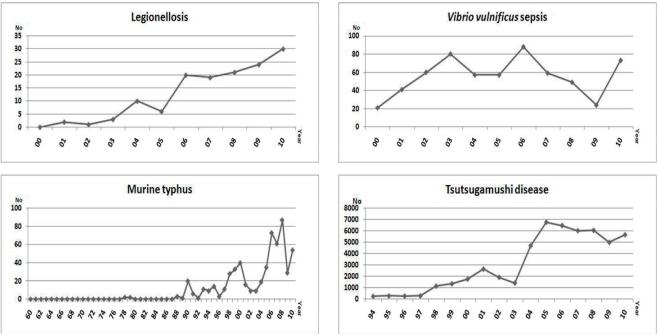
Compared to the past decades, in recent decades, environmental and hygienic conditions in the Republic of Korea have improved along with socioeconomic developments, and the incidence of most infectious diseases, especially vaccine-preventable diseases, has greatly decreased due to active immunization with the developed level of health care. However, the incidence of some diseases has been increasing, and new diseases have been emerging. To cope with such changes actively, the government put the "Law for Control and Prevention of Infectious Diseases" into effect; this law was entirely revised on December 30, 2010. In this report, I review the past and recent status of infectious diseases in the Republic of Korea, following the introduction of this law, on the basis of data in the "National Notifiable Disease Surveillance System", which had been accumulated between the years 1960 and 2010.
与过去几十年相比,近几十年来,随着社会经济的发展,大韩民国的环境和卫生条件得到了改善,并且由于具备发达的医疗保健水平,通过积极免疫,大多数传染病尤其是疫苗可预防疾病的发病率大幅下降。然而,一些疾病的发病率一直在上升,并且新的疾病不断出现。为了积极应对这些变化,政府实施了《传染病防治法》;该法律于2010年12月30日进行了全面修订。在本报告中,我根据1960年至2010年期间积累的“国家法定传染病监测系统”中的数据,回顾了该法律出台后大韩民国传染病的过去和近期状况。



 Zotero 插件