
用于预测基底样乳腺癌患者预后的基因特征。
A gene signature for predicting outcome in patients with basal-like breast cancer.
机构信息
Department of Biochemistry and Biomedical Sciences, Centre for Functional Genomics, McMaster University, 1200 Main Street West, Hamilton, Ontario, Canada.
出版信息
Sci Rep. 2012;2:227. doi: 10.1038/srep00227. Epub 2012 Jan 17.
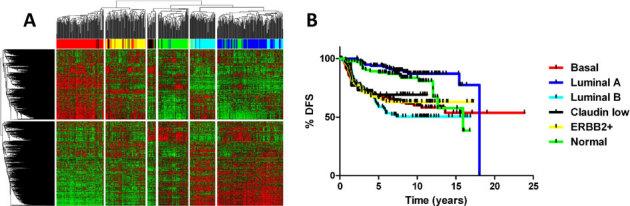
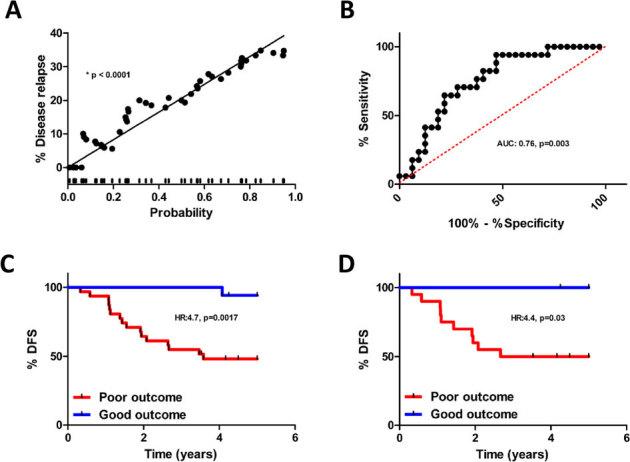
Basal-like breast cancer is a molecular subtype of breast cancer with a poor prognosis. Follow-up studies of long-term outcome in these patients, demonstrates they can be separated into two clinical groups: those who succumb to their disease within the first 5 years and those expected to show excellent long term survival. Currently available clinical/histopathological variables as well as molecular signatures show little capacity to identify basal breast cancer patients with either a high or low risk of disease relapse. Using data derived from 85 basal-like breast cancer patients, we identified a 14-gene signature, which we subsequently validated on an additional 49 basal breast cancer patient set. The ability to distinguish between these two sub-groups of basal breast cancer patients at the time of initial diagnosis would permit tailoring aggressive therapeutic regimens to those patients with a poor prognosis and conversely avoid such therapy in low risk patients.
基底样乳腺癌是一种预后不良的乳腺癌分子亚型。对这些患者进行长期结局的随访研究表明,他们可以分为两个临床组:那些在最初 5 年内死于疾病的患者和那些预计具有良好长期生存的患者。目前可用的临床/组织病理学变量以及分子特征显示,几乎无法识别具有高或低疾病复发风险的基底乳腺癌患者。使用来自 85 例基底样乳腺癌患者的数据,我们确定了一个 14 基因特征,随后在另外 49 例基底乳腺癌患者中进行了验证。在初始诊断时区分这两个基底样乳腺癌患者亚组的能力,可以使那些预后不良的患者接受强化治疗方案,而相反,低风险患者则可以避免这种治疗。



 Zotero 插件