
远程医疗对二级保健利用和死亡率的影响:来自全系统示范集群随机试验的结果。
Effect of telehealth on use of secondary care and mortality: findings from the Whole System Demonstrator cluster randomised trial.
机构信息
The Nuffield Trust, London W1G 7LP, UK.
出版信息
BMJ. 2012 Jun 21;344:e3874. doi: 10.1136/bmj.e3874.
OBJECTIVE
To assess the effect of home based telehealth interventions on the use of secondary healthcare and mortality.
DESIGN
Pragmatic, multisite, cluster randomised trial comparing telehealth with usual care, using data from routine administrative datasets. General practice was the unit of randomisation. We allocated practices using a minimisation algorithm, and did analyses by intention to treat.
SETTING
179 general practices in three areas in England.
PARTICIPANTS
3230 people with diabetes, chronic obstructive pulmonary disease, or heart failure recruited from practices between May 2008 and November 2009.
INTERVENTIONS
Telehealth involved remote exchange of data between patients and healthcare professionals as part of patients' diagnosis and management. Usual care reflected the range of services available in the trial sites, excluding telehealth.
MAIN OUTCOME MEASURE
Proportion of patients admitted to hospital during 12 month trial period.
RESULTS
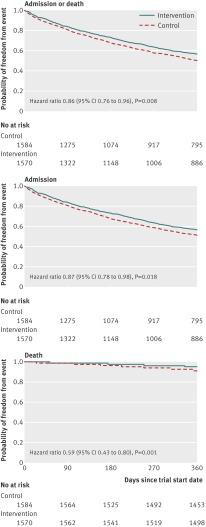
Patient characteristics were similar at baseline. Compared with controls, the intervention group had a lower admission proportion within 12 month follow-up (odds ratio 0.82, 95% confidence interval 0.70 to 0.97, P = 0.017). Mortality at 12 months was also lower for intervention patients than for controls (4.6% v 8.3%; odds ratio 0.54, 0.39 to 0.75, P < 0.001). These differences in admissions and mortality remained significant after adjustment. The mean number of emergency admissions per head also differed between groups (crude rates, intervention 0.54 v control 0.68); these changes were significant in unadjusted comparisons (incidence rate ratio 0.81, 0.65 to 1.00, P = 0.046) and after adjusting for a predictive risk score, but not after adjusting for baseline characteristics. Length of hospital stay was shorter for intervention patients than for controls (mean bed days per head 4.87 v 5.68; geometric mean difference -0.64 days, -1.14 to -0.10, P = 0.023, which remained significant after adjustment). Observed differences in other forms of hospital use, including notional costs, were not significant in general. Differences in emergency admissions were greatest at the beginning of the trial, during which we observed a particularly large increase for the control group.
CONCLUSIONS
Telehealth is associated with lower mortality and emergency admission rates. The reasons for the short term increases in admissions for the control group are not clear, but the trial recruitment processes could have had an effect.
TRIAL REGISTRATION NUMBER
International Standard Randomised Controlled Trial Number Register ISRCTN43002091.
目的
评估基于家庭的远程医疗干预对二级医疗保健和死亡率的影响。
设计
采用实用、多地点、集群随机试验,比较远程医疗与常规护理,使用常规管理数据集的数据。基层医疗是随机分组的单位。我们使用最小化算法进行实践分配,并进行意向治疗分析。
地点
英格兰三个地区的 179 个基层医疗单位。
参与者
2008 年 5 月至 2009 年 11 月期间从基层医疗单位招募的 3230 名患有糖尿病、慢性阻塞性肺疾病或心力衰竭的患者。
干预措施
远程医疗涉及患者和医疗保健专业人员之间的数据远程交换,作为患者诊断和管理的一部分。常规护理反映了试验现场提供的一系列服务,不包括远程医疗。
主要结果测量
12 个月试验期间住院患者的比例。
结果
患者基线特征相似。与对照组相比,干预组在 12 个月随访期间的住院比例较低(比值比 0.82,95%置信区间 0.70 至 0.97,P=0.017)。与对照组相比,干预组患者的 12 个月死亡率也较低(4.6%比 8.3%;比值比 0.54,0.39 至 0.75,P<0.001)。在调整后,这些住院和死亡率的差异仍然显著。每组的平均急诊入院人数也不同(粗率,干预组 0.54 比对照组 0.68);在未调整比较中(发病率比 0.81,0.65 至 1.00,P=0.046)和调整预测风险评分后,这些变化均具有统计学意义,但在调整基线特征后无统计学意义。与对照组相比,干预组患者的住院时间更短(每头平均住院天数 4.87 比 5.68;几何均数差-0.64 天,-1.14 至-0.10,P=0.023,调整后仍有统计学意义)。观察到的其他形式的医院使用差异,包括名义成本,总体上并不显著。在试验开始时,对照组的急诊入院率增加最大,我们观察到对照组的入院率增加尤其大。
结论
远程医疗与较低的死亡率和急诊入院率相关。对照组入院率短期增加的原因尚不清楚,但试验招募过程可能产生了影响。
试验注册
国际标准随机对照试验注册号 ISRCTN43002091。


 Zotero 插件