
鉴定牙周致病菌牙龈卟啉单胞菌的必需基因。
Identification of essential genes of the periodontal pathogen Porphyromonas gingivalis.
机构信息
Department of Molecular Biology and Microbiology, Tufts University Sackler School of Biomedical Sciences, Boston, MA 02111, USA.
出版信息
BMC Genomics. 2012 Oct 31;13:578. doi: 10.1186/1471-2164-13-578.
BACKGROUND
Porphyromonas gingivalis is a Gram-negative anaerobic bacterium associated with periodontal disease onset and progression. Genetic tools for the manipulation of bacterial genomes allow for in-depth mechanistic studies of metabolism, physiology, interspecies and host-pathogen interactions. Analysis of the essential genes, protein-coding sequences necessary for survival of P. gingivalis by transposon mutagenesis has not previously been attempted due to the limitations of available transposon systems for the organism. We adapted a Mariner transposon system for mutagenesis of P. gingivalis and created an insertion mutant library. By analyzing the location of insertions using massively-parallel sequencing technology we used this mutant library to define genes essential for P. gingivalis survival under in vitro conditions.
RESULTS
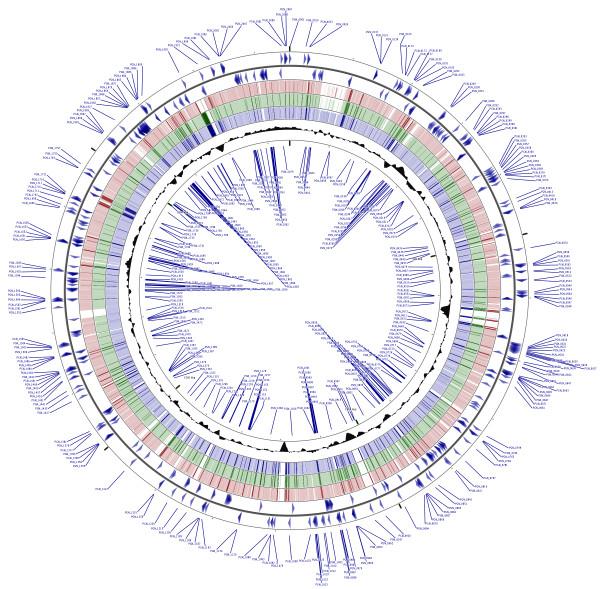
In mutagenesis experiments we identified 463 genes in P. gingivalis strain ATCC 33277 that are putatively essential for viability in vitro. Comparing the 463 P. gingivalis essential genes with previous essential gene studies, 364 of the 463 are homologues to essential genes in other species; 339 are shared with more than one other species. Twenty-five genes are known to be essential in P. gingivalis and B. thetaiotaomicron only. Significant enrichment of essential genes within Cluster of Orthologous Groups 'D' (cell division), 'I' (lipid transport and metabolism) and 'J' (translation/ribosome) were identified. Previously, the P. gingivalis core genome was shown to encode 1,476 proteins out of a possible 1,909; 434 of 463 essential genes are contained within the core genome. Thus, for the species P. gingivalis twenty-two, seventy-seven and twenty-three percent of the genome respectively are devoted to essential, core and accessory functions.
CONCLUSIONS
A Mariner transposon system can be adapted to create mutant libraries in P. gingivalis amenable to analysis by next-generation sequencing technologies. In silico analysis of genes essential for in vitro growth demonstrates that although the majority are homologous across bacterial species as a whole, species and strain-specific subsets are apparent. Understanding the putative essential genes of P. gingivalis will provide insights into metabolic pathways and niche adaptations as well as clinical therapeutic strategies.
背景
牙龈卟啉单胞菌是一种与牙周病发病和进展相关的革兰氏阴性厌氧菌。用于细菌基因组操作的遗传工具允许对代谢、生理学、种间和宿主-病原体相互作用进行深入的机制研究。由于用于该生物体的可利用转座子系统的限制,以前从未尝试过通过转座子诱变分析牙龈卟啉单胞菌的必需基因,即编码序列,这些基因对于该细菌的生存是必需的。我们对 Mariner 转座子系统进行了改造,以用于牙龈卟啉单胞菌的诱变,并创建了一个插入突变体文库。通过使用大规模平行测序技术分析插入的位置,我们使用这个突变体文库来定义在体外条件下对牙龈卟啉单胞菌生存至关重要的基因。
结果
在诱变实验中,我们在牙龈卟啉单胞菌菌株 ATCC 33277 中鉴定出 463 个可能对体外生存至关重要的基因。将 463 个牙龈卟啉单胞菌必需基因与以前的必需基因研究进行比较,其中 364 个与其他物种的必需基因具有同源性;339 个与不止一个其他物种具有同源性。在牙龈卟啉单胞菌和 B. thetaiotaomicron 中只有 25 个基因被认为是必需的。在分类群“D”(细胞分裂)、“I”(脂质运输和代谢)和“J”(翻译/核糖体)中鉴定到必需基因的显著富集。先前已经表明,牙龈卟啉单胞菌的核心基因组可以编码 1909 个可能的蛋白中的 1476 个;463 个必需基因中有 434 个包含在核心基因组中。因此,对于物种牙龈卟啉单胞菌,基因组的分别有 22%、77%和 23%用于必需、核心和辅助功能。
结论
Mariner 转座子系统可以被改造,以创建适合下一代测序技术分析的牙龈卟啉单胞菌突变文库。体外生长必需基因的计算机分析表明,尽管大多数在整个细菌物种中具有同源性,但也出现了物种和菌株特异性的子集。了解牙龈卟啉单胞菌的假定必需基因将为代谢途径和生态位适应以及临床治疗策略提供深入的了解。




 Zotero 插件