
自噬 E1 通过 Atg7-Atg3 和 Atg7-Atg10 结构招募非典型 E2 的结构。
Noncanonical E2 recruitment by the autophagy E1 revealed by Atg7-Atg3 and Atg7-Atg10 structures.
机构信息
Department of Structural Biology, St. Jude Children's Research Hospital, Memphis, Tennessee, USA.
出版信息
Nat Struct Mol Biol. 2012 Dec;19(12):1242-9. doi: 10.1038/nsmb.2415. Epub 2012 Nov 11.
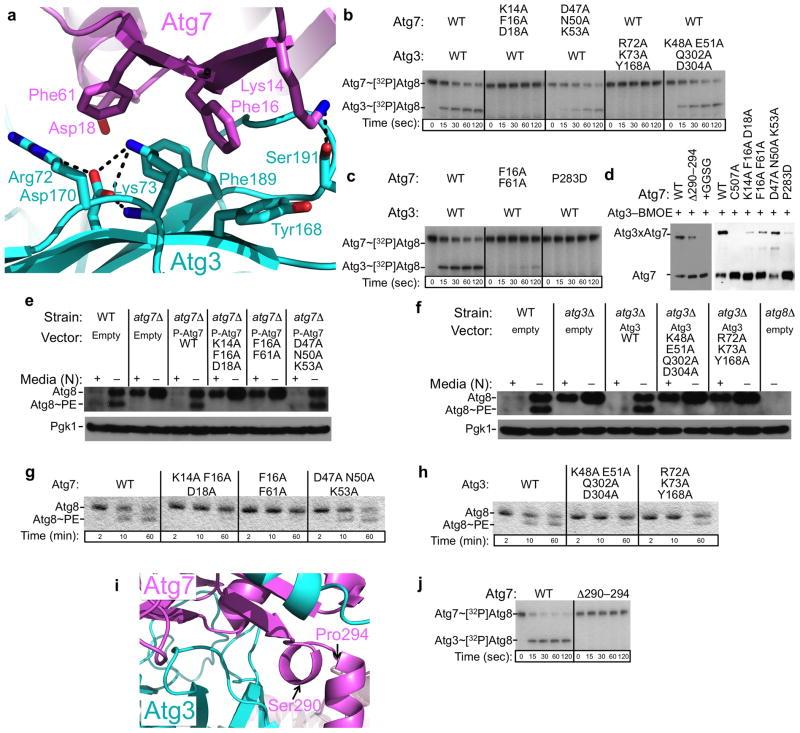
Core functions of autophagy are mediated by ubiquitin-like protein (UBL) cascades, in which a homodimeric E1 enzyme, Atg7, directs the UBLs Atg8 and Atg12 to their respective E2 enzymes, Atg3 and Atg10. Crystallographic and mutational analyses of yeast (Atg7-Atg3)(2) and (Atg7-Atg10)(2) complexes reveal noncanonical, multisite E1-E2 recognition in autophagy. Atg7's unique N-terminal domain recruits distinctive elements from the Atg3 and Atg10 'backsides'. This, along with E1 and E2 conformational variability, allows presentation of 'frontside' Atg3 and Atg10 active sites to the catalytic cysteine in the C-terminal domain from the opposite Atg7 protomer in the homodimer. Despite different modes of binding, the data suggest that common principles underlie conjugation in both noncanonical and canonical UBL cascades, whereby flexibly tethered E1 domains recruit E2s through surfaces remote from their active sites to juxtapose the E1 and E2 catalytic cysteines.
自噬的核心功能是由泛素样蛋白 (UBL) 级联介导的,其中二聚体 E1 酶 Atg7 将 UBLs Atg8 和 Atg12 引导至它们各自的 E2 酶 Atg3 和 Atg10。酵母 (Atg7-Atg3)(2) 和 (Atg7-Atg10)(2) 复合物的晶体学和突变分析揭示了自噬中非典型的多位点 E1-E2 识别。Atg7 独特的 N 端结构域招募了来自 Atg3 和 Atg10“背面”的独特元件。这一点,再加上 E1 和 E2 构象的可变性,使得在同源二聚体中,来自相反 Atg7 单体的 C 端结构域中的催化半胱氨酸可以呈现“正面”Atg3 和 Atg10 的活性位点。尽管结合方式不同,但数据表明,非典型和典型 UBL 级联中的连接都基于共同的原则,其中灵活连接的 E1 结构域通过远离其活性位点的表面招募 E2,从而使 E1 和 E2 的催化半胱氨酸并置。




 Zotero 插件