
动机和治疗参与干预试验(MotivaTe-IT):向临床医生提供动机反馈对严重精神疾病患者治疗参与的影响。
Motivation and treatment engagement intervention trial (MotivaTe-IT): the effects of motivation feedback to clinicians on treatment engagement in patients with severe mental illness.
机构信息
Department of Psychiatry, Epidemiological and Social Psychiatric Research institute, Erasmus University Medical Centre, Dr, Molewaterplein 50, Rotterdam, 3015 GE, The Netherlands.
出版信息
BMC Psychiatry. 2012 Nov 24;12:209. doi: 10.1186/1471-244X-12-209.
BACKGROUND
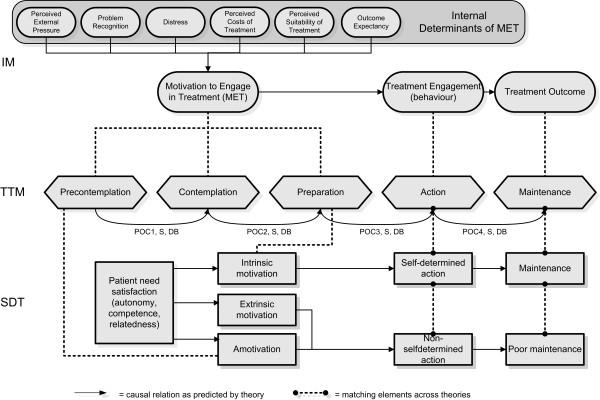
Treatment disengagement and non-completion poses a major problem for the successful treatment of patients with severe mental illness. Motivation for treatment has long been proposed as a major determinant of treatment engagement, but exact mechanisms remain unclear. This current study serves three purposes: 1) to determine whether a feedback intervention based on the patients' motivation for treatment is effective at improving treatment engagement (TE) of severe mentally ill patients in outpatient psychiatric treatment, 2) to gather insight into motivational processes and possible mechanisms regarding treatment motivation (TM) and TE in this patient population and 3) to determine which of three theories of motivation is most plausible for the dynamics of TM and TE in this population.
METHODS/DESIGN: The Motivation and Treatment Engagement Intervention Trial (MotivaTe-IT) is a multi-center cluster randomized trial investigating the effectiveness of feedback generated by clinicians regarding their patients' treatment motivation upon the patients' TE. The primary outcome is the patients' TE. Secondary outcomes are TM, psychosocial functioning and quality of life. Patients whose clinicians generate monthly motivation feedback (additional to treatment as usual) will be compared to patients who receive treatment as usual. An estimated 350 patients, aged 18 to 65 years, with psychotic disorders and/or severe personality disorders will be recruited from outpatient community mental health care. The randomization will be performed by a computerized randomization program, with an allocation ratio of 1:1 (team vs. team or clinician vs. clinician) and patients, but not clinicians, will be blind to treatment allocation at baseline assessment. Due to the nature of the trial, follow-up assessment can not be blinded.
DISCUSSION
The current study can provide important insights regarding motivational processes and the way in which motivation influences the treatment engagement and clinical outcomes. The identification of possible mechanisms through which changes in the outcomes occur, offers a tool for the development of more effective future interventions to improve TM and TE.
TRIAL REGISTRATION
Current Controlled Trials NTR2968.
背景
治疗脱离和不完成对严重精神疾病患者的成功治疗构成了一个主要问题。长期以来,治疗动机一直被认为是治疗参与的主要决定因素,但确切的机制仍不清楚。本研究有三个目的:1)确定基于患者治疗动机的反馈干预是否能有效提高门诊精神科治疗中严重精神疾病患者的治疗参与度(TE);2)深入了解该患者群体中治疗动机(TM)和 TE 的动机过程和可能机制;3)确定三种动机理论中哪一种最适合该人群中 TM 和 TE 的动态。
方法/设计:动机和治疗参与度干预试验(MotivaTe-IT)是一项多中心集群随机试验,研究临床医生对患者治疗动机的反馈对患者治疗参与度的影响。主要结局是患者的治疗参与度。次要结局是 TM、心理社会功能和生活质量。每月为其生成治疗动机反馈(除了常规治疗之外)的患者与接受常规治疗的患者相比,将接受治疗。预计将从门诊社区精神卫生保健中招募 350 名年龄在 18 至 65 岁之间的患有精神病性障碍和/或严重人格障碍的患者。随机分组将通过计算机化的随机分组程序进行,分配比例为 1:1(团队对团队或临床医生对临床医生),患者在基线评估时对治疗分配不知情,但临床医生知情。由于试验的性质,随访评估不能被蒙蔽。
讨论
目前的研究可以提供关于动机过程以及动机影响治疗参与度和临床结果的方式的重要见解。确定可能的机制,通过这些机制发生结果的变化,为开发更有效的未来干预措施提供了一种工具,以提高 TM 和 TE。
试验注册
当前对照试验 NTR2968。


 Zotero 插件