
人类特定地点的接触模式如何影响人群之间的空间传播?
How human location-specific contact patterns impact spatial transmission between populations?
机构信息
Adaptive Networks and Control Laboratory, Department of Electronic Engineering, Fudan University, Shanghai 200433, China.
出版信息
Sci Rep. 2013;3:1468. doi: 10.1038/srep01468.
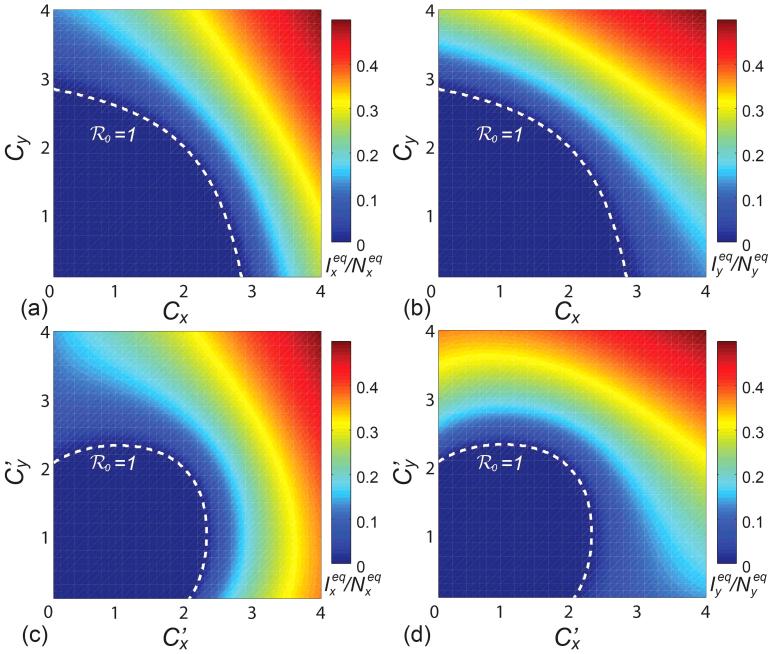
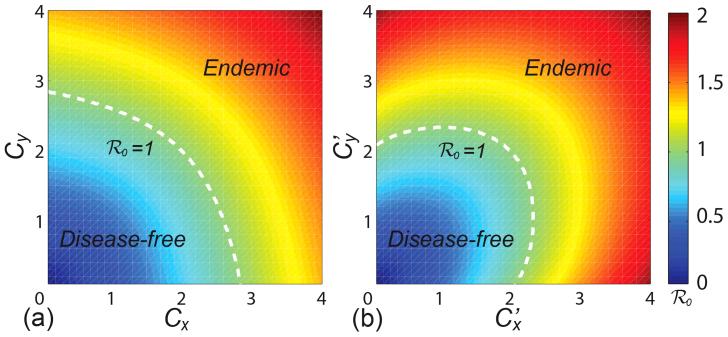
The structured-population model has been widely used to study the spatial transmission of epidemics in human society. Many seminal works have demonstrated the impact of human mobility on the epidemic threshold, assuming that the contact pattern of individuals is mixing homogeneously. Inspired by the recent evidence of location-related factors in reality, we introduce two categories of location-specific heterogeneous human contact patterns into a phenomenological model based on the commuting and contagion processes, which significantly decrease the epidemic threshold and thus favor the outbreak of diseases. In more detail, we find that a monotonic mode presents for the variance of disease prevalence in dependence on the contact rates under the destination-driven contact scenario; while under the origin-driven scenario, enhancing the contact rate counterintuitively weakens the disease prevalence in some parametric regimes. The inclusion of heterogeneity of human contacts is expected to provide valuable support to public health implications.
基于人类通勤和传染过程的现象学模型中,我们引入了两种与位置相关的异质个体接触模式,以此来研究人类移动性对传染病爆发临界点的影响。该模型假设个体的接触模式是均匀混合的。受现实中与位置相关因素的最新证据启发,我们将两种与位置相关的异质个体接触模式引入到基于人类通勤和传染过程的现象学模型中,这显著降低了传染病爆发的临界点,从而更容易导致疾病的爆发。更详细地说,我们发现,在基于目的地的接触场景下,疾病流行率的方差与接触率呈单调关系;而在基于起源的场景下,在某些参数范围内,增强接触率会反直觉地削弱疾病流行率。人类接触的异质性的引入有望为公共卫生提供有价值的支持。



 Zotero 插件