
使用四极左心室导线可提高接受传统双极导线心脏再同步治疗时出现膈神经刺激和/或高起搏阈值患者的成功植入率。
The Use of a Quadripolar Left Ventricular Lead Increases Successful Implantation Rates in Patients with Phrenic Nerve Stimulation and/or High Pacing Thresholds Undergoing Cardiac Resynchronisation Therapy with Conventional Bipolar Leads.
作者信息
Ohlow Marc-Alexander, Lauer Bernward, Brunelli Michele, Daralammouri Yunis, Geller Christoph
机构信息
Department of Cardiology, Zentralklinik Bad Berka, Robert-Koch-Allee 9, 99437 Bad Berka, Germany.
出版信息
Indian Pacing Electrophysiol J. 2013 Mar;13(2):58-65. doi: 10.1016/s0972-6292(16)30605-2. Epub 2013 Mar 7.
BACKGROUND
Phrenic nerve stimulation (PNS) and high pacing thresholds (HPT) hinder biventricular stimulation in patients (pts) undergoing cardiac resynchronization therapy (CRT). A new quadripolar left ventricular (LV) lead (Quartet 1458Q, St. Jude Medical) with increased number of pacing configuration, might overcome this problem.
METHODS
All consecutive pts in whom a standard bipolar lead intraoperatively resulted in PNS and/or HPT (≥4.00V/1mV), received, during the same implant, a quadripolar LV lead. Aim of the study was to evaluate acute and short term outcome.
RESULTS
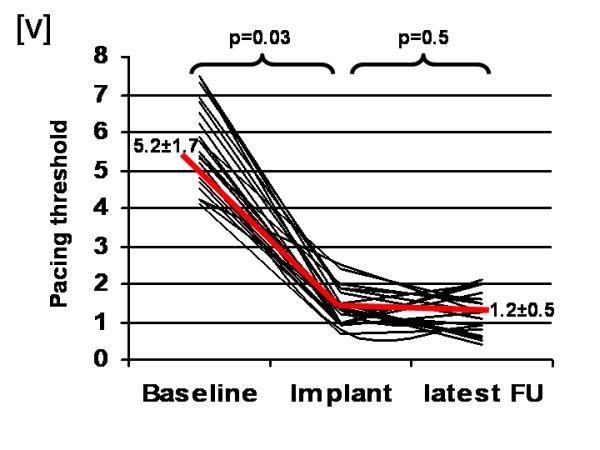
26 pts [24 (92%) male, mean age 74±6 years)] with PNS (22 pts; 85%) and HPT (4 pts; 15%) were included. Permanent right ventricular pacing was the reason for broad QRS complex in 4 (15%) pts, whereas all other pts had a left bundle branch block. Severely symptomatic (NYHA Class ≥3) heart failure with reduced ejection fraction (EF 31±9%) was mostly caused by ischemic heart disease (14 pts; 54%). Idiopathic dilated cardiomyopathy and valvular heart disease were diagnosed in 6 (23%) pts each. In most (24/26, 92%) pts the use of the Quartet lead led to successful biventricular pacing due to a significant reduction in intraoperative pacing threshold (5.2V/1.0ms vs. 1.4V/0.8ms; p=0.03), which was maintained (1.2V/0.7ms) at follow-up. PNS never represented reason for failed LV pacing, neither acutely nor during follow-up.
CONCLUSION
Excessively HPT and/or PNS are frequently encountered when conventional bipolar leads are used for CRT. A new quadripolar LV lead increases the rate of successful biventricular stimulation. Lower pacing threshold and freedom from PNS are maintained at follow-up.
背景
膈神经刺激(PNS)和高起搏阈值(HPT)阻碍了接受心脏再同步治疗(CRT)患者的双心室刺激。一种具有更多起搏配置的新型四极左心室(LV)导线(Quartet 1458Q,圣犹达医疗公司)可能会克服这一问题。
方法
所有术中使用标准双极导线导致PNS和/或HPT(≥4.00V/1mV)的连续患者,在同一植入过程中接受了四极LV导线。该研究的目的是评估急性和短期结果。
结果
纳入了26例患者[24例(92%)男性,平均年龄74±6岁],其中有PNS的患者22例(85%),有HPT的患者4例(15%)。4例(15%)患者中,永久性右心室起搏是宽QRS波群的原因,而所有其他患者均有左束支传导阻滞。射血分数降低(EF 31±9%)的严重症状性(纽约心脏协会心功能分级≥3级)心力衰竭主要由缺血性心脏病引起(14例;54%)。特发性扩张型心肌病和瓣膜性心脏病在6例(23%)患者中各有诊断。在大多数(24/26,92%)患者中,由于术中起搏阈值显著降低(5.2V/1.0ms对1.4V/0.8ms;p=0.03),使用Quartet导线导致双心室起搏成功,随访时该阈值维持在(1.2V/0.7ms)。无论是急性还是随访期间,PNS从未成为左心室起搏失败的原因。
结论
在CRT中使用传统双极导线时,经常会遇到过高的HPT和/或PNS。一种新型四极LV导线提高了双心室刺激成功的几率。随访时维持较低的起搏阈值且无PNS。

 Zotero 插件