
与氧诱导性视网膜病变小鼠模型相关基因的分析
Profiling of genes associated with the murine model of oxygen-induced retinopathy.
作者信息
Yang Xia, Dong Xiaoguang, Jia Changkai, Wang Yiqiang
机构信息
Qingdao University-SEI Joint Ophthalmology Program, Shandong Eye Institute, Shandong Academy of Medical Sciences, Qingdao, China.
出版信息
Mol Vis. 2013 Apr 3;19:775-88. Print 2013.
PURPOSE
To compare the clinical features and gene expression patterns of the physiologic development of retinal vessels and oxygen-induced retinopathy (OIR) in a mouse model, with the aim of identifying differential regulators of physiologic and pathological angiogenesis in the retina.
METHODS
C57BL/6J mice were used. Seven-day-old pups were subjected to OIR induction following the standard protocols of entering a hyperoxic chamber on day 7 (P7) and returning to a normoxic condition (relative hypoxia) on day 12 (P12). The retinal vasculatures in the OIR model 24 h (P8-O) or 5 days (P12-O) after switching to the hyperoxic environment and 24 h (P13-O) after returning to normoxic conditions were evaluated with retinal flat mounts and compared with those of age-matched controls (i.e., P8-N, P12-N, P13-N). Gene expression profiling was performed using Phalanx Mouse Whole Genome OneArray microarrays. Normal 9-day-old mice were considered representative of physiologic angiogenesis and compared with 30-day-old mice. A bioinformatics analysis was performed on differentially expressed genes using various comparisons, and real-time reverse-transcription PCR was used to confirm the changes in the genes of interest.
RESULTS
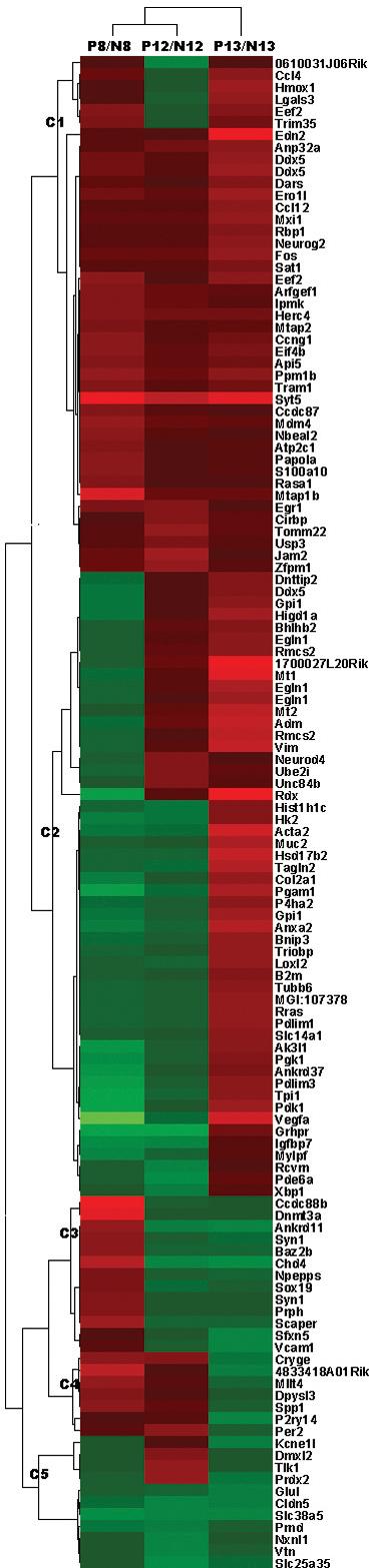
The sequential orders and patterns of vasculature development in normal mice and the OIR models were significantly different. In brief, in the early days (P1 to P7) for normal mice, retinal vessels grew from the optic disc into the non-vascularized retina in a radial fashion. In the hyperoxic stage of the OIR model, the main central retina became devoid of a vascular network, and when the mice returned to the normoxic room, the vessels grew from peripheral perfused areas toward the center of the retina, but the development of intermediate and deep layers of vasculature was significantly delayed. Gene profiling at three critical time points (P8, P12, and P13) showed that 162 probes were upregulated to ≥1.5-fold or downregulated to ≤0.67-fold at one or more time points in the OIR model compared to the controls. In the 45 upregulated genes for the P8-O/P8-N group, enriched genes were mainly related to cytoskeleton formation, whereas the 62 upregulated genes for P13-O/P13-N participated in various pathological processes. In the physiologic conditions on P9, however, 135 genes were upregulated compared with P30; the gap junction and Fc gamma R-mediated phagocytosis were the two main enriched pathways for these genes. Fifty-three probes, including vascular endothelium growth factor A, annexin A2, and endothelin 2, changed at P13-O but not at P9-N, and these changed genes might reflect the modulation of pathological neovascularization.
CONCLUSIONS
Angiogenesis in physiologic and pathological conditions is characterized by the differential presentation of vasculature and gene expression patterns. Investigation of those genes unique to the OIR model may help develop new strategies and therapies for intervening in retinal neovascularization.
目的
在小鼠模型中比较视网膜血管生理发育和氧诱导性视网膜病变(OIR)的临床特征及基因表达模式,以确定视网膜生理性和病理性血管生成的差异调节因子。
方法
使用C57BL/6J小鼠。7日龄幼鼠按照标准方案于第7天(P7)进入高氧舱并于第12天(P12)回到常氧环境(相对低氧)以诱导OIR。在切换至高氧环境后24小时(P8 - O)或5天(P12 - O)以及回到常氧环境后24小时(P13 - O),用视网膜铺片评估OIR模型中的视网膜血管系统,并与年龄匹配的对照(即P8 - N、P12 - N、P13 - N)进行比较。使用Phalanx小鼠全基因组OneArray微阵列进行基因表达谱分析。正常9日龄小鼠被视为生理性血管生成的代表并与30日龄小鼠进行比较。对差异表达基因进行多种比较的生物信息学分析,并使用实时逆转录PCR确认感兴趣基因的变化。
结果
正常小鼠和OIR模型中血管系统发育的顺序和模式显著不同。简而言之,在正常小鼠的早期(P1至P7),视网膜血管从视盘以放射状方式生长到无血管的视网膜中。在OIR模型的高氧阶段中,视网膜中央主要区域没有血管网络,当小鼠回到常氧室时,血管从周边灌注区域向视网膜中心生长,但中间层和深层血管系统的发育明显延迟。在三个关键时间点(P8、P12和P13)的基因谱分析表明,与对照相比,OIR模型中162个探针在一个或多个时间点上调至≥1.5倍或下调至≤0.67倍。在P8 - O/P8 - N组的45个上调基因中,富集基因主要与细胞骨架形成有关,而P13 - O/P13 - N组的62个上调基因参与各种病理过程。然而,在P9的生理条件下,与P30相比有135个基因上调;间隙连接和FcγR介导的吞噬作用是这些基因的两个主要富集途径。包括血管内皮生长因子A、膜联蛋白A2和内皮素2在内的53个探针在P13 - O时发生变化但在P9 - N时未变化,这些变化的基因可能反映了病理性新生血管形成的调节。
结论
生理性和病理性条件下的血管生成以血管系统和基因表达模式的差异呈现为特征。对OIR模型特有的那些基因的研究可能有助于开发干预视网膜新生血管形成的新策略和疗法。


 Zotero 插件