
使用简易精神状态检查表和事件相关电位P300分析对非低氧血症慢性阻塞性肺疾病(COPD)患者与年龄匹配的健康志愿者的认知功能进行比较。
A comparison of cognitive functions in non-hypoxemic chronic obstructive pulmonary disease (COPD) patients and age-matched healthy volunteers using mini-mental state examination questionnaire and event-related potential, P300 analysis.
作者信息
Gupta Prem Parkash, Sood Sushma, Atreja Atulya, Agarwal Dipti
机构信息
Department of Respiratory Medicine, Postgraduate Institute of Medical Sciences, Pt. B D Sharma University of Health Sciences, Rohtak, India.
出版信息
Lung India. 2013 Jan;30(1):5-11. doi: 10.4103/0970-2113.106119.
OBJECTIVE
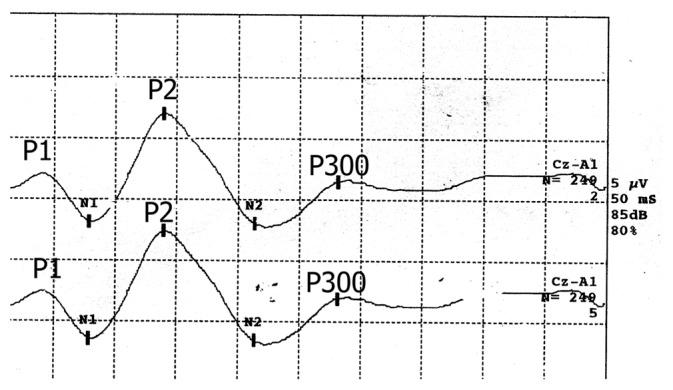
To assess sub-clinical cognitive dysfunctions in stable chronic obstructive pulmonary disease (COPD) patients having no hypoxemia vs. age-matched healthy volunteers using (i) an electrophysiological test: Auditory event related potential, P300 test and (ii) a questionnaire tool: Mini-mental state examination (MMSE) questionnaire.
MATERIALS AND METHODS
EIGHTY MALE SUBJECTS WERE INCLUDED: 40 stable COPD patients (smoking history >20 pack years) and 40 healthy volunteers (HVs). Age, duration of illness, smoking pack years, and spirometric indices were assessed. MMSE scores were evaluated in these groups. Latency of P300 wave and amplitude of P300 wave were studied in both groups to detect P300 abnormalities in COPD group. Correlations of P300 abnormalities with patient characteristic parameters and MMSE scores were assessed. In addition, individual COPD patients having significant cognitive dysfunctions beyond cut-off value of 99(th) percentile of HVs were analyzed.
RESULTS
We observed significantly prolonged P300 latency (P < 0.001) and decreased P300 amplitude (P < 0.001) in COPD group. MMSE scores were significantly reduced in COPD group (P < 0.001). 10/40 COPD patients had prolongation of P300 latency, and 27/40 COPD patients had reduced MMSE scores beyond 99(th) percentile of HV. However, we did not observe any statistically significant correlation between P300 abnormalities and patients' characteristics or MMSE scores (P > 0.05 for all).
CONCLUSIONS
Our study explores cognitive dysfunctions in stable COPD patients with no hypoxemia. This study highlights the relative importance of using MMSE and P300. Cognitive dysfunctions were detected both by MMSE and P300; however, MMSE abnormalities were more frequent compared to P300 abnormalities (27/40 vs. 10/40) in COPD patients.
目的
使用(i)一种电生理测试:听觉事件相关电位P300测试,以及(ii)一种问卷工具:简易精神状态检查表(MMSE)问卷,评估无低氧血症的稳定期慢性阻塞性肺疾病(COPD)患者与年龄匹配的健康志愿者的亚临床认知功能障碍。
材料与方法
纳入80名男性受试者:40名稳定期COPD患者(吸烟史>20包年)和40名健康志愿者(HV)。评估年龄、病程、吸烟包年数和肺功能指标。对这些组进行MMSE评分评估。研究两组中P300波的潜伏期和P300波的振幅,以检测COPD组中的P300异常。评估P300异常与患者特征参数和MMSE评分的相关性。此外,对超过HV第99百分位数临界值且存在显著认知功能障碍的个体COPD患者进行分析。
结果
我们观察到COPD组中P300潜伏期显著延长(P<0.001)且P300振幅降低(P<0.001)。COPD组的MMSE评分显著降低(P<0.001)。40名COPD患者中有10名P300潜伏期延长,40名COPD患者中有27名MMSE评分低于HV的第99百分位数。然而,我们未观察到P300异常与患者特征或MMSE评分之间存在任何统计学显著相关性(所有P>0.05)。
结论
我们的研究探讨了无低氧血症的稳定期COPD患者的认知功能障碍。本研究强调了使用MMSE和P300的相对重要性。MMSE和P300均检测到认知功能障碍;然而,在COPD患者中,MMSE异常比P300异常更常见(27/40对10/40)。

 Zotero 插件