
登革热血清型之间的相互作用突出了交叉免疫的流行病学影响。
Interactions between serotypes of dengue highlight epidemiological impact of cross-immunity.
机构信息
Division of Biostatistics and Epidemiology, University of Massachusetts, Amherst, MA 01002, USA.
出版信息
J R Soc Interface. 2013 Jul 3;10(86):20130414. doi: 10.1098/rsif.2013.0414. Print 2013 Sep 6.
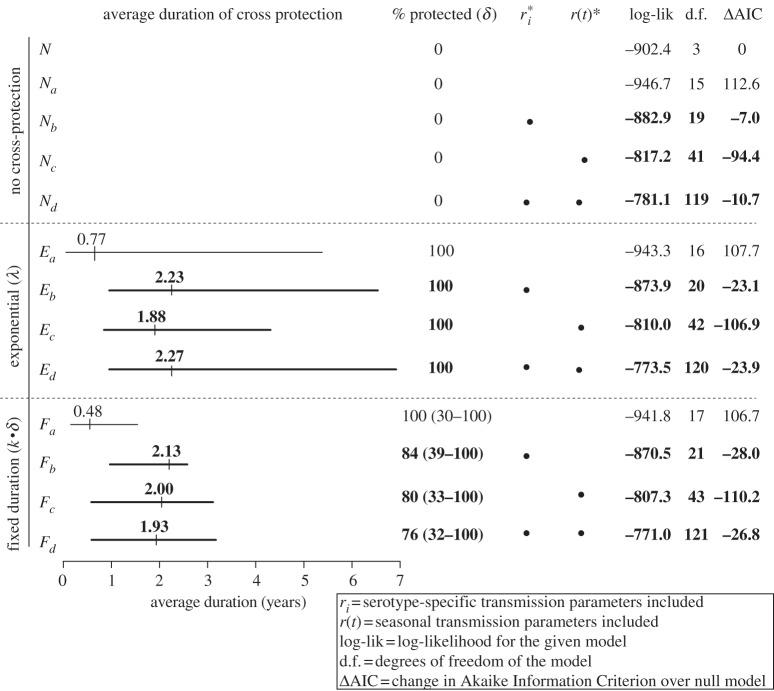
Dengue, a mosquito-borne virus of humans, infects over 50 million people annually. Infection with any of the four dengue serotypes induces protective immunity to that serotype, but does not confer long-term protection against infection by other serotypes. The immunological interactions between serotypes are of central importance in understanding epidemiological dynamics and anticipating the impact of dengue vaccines. We analysed a 38-year time series with 12 197 serotyped dengue infections from a hospital in Bangkok, Thailand. Using novel mechanistic models to represent different hypothesized immune interactions between serotypes, we found strong evidence that infection with dengue provides substantial short-term cross-protection against other serotypes (approx. 1-3 years). This is the first quantitative evidence that short-term cross-protection exists since human experimental infection studies performed in the 1950s. These findings will impact strategies for designing dengue vaccine studies, future multi-strain modelling efforts, and our understanding of evolutionary pressures in multi-strain disease systems.
登革热是一种由蚊子传播的人类病毒,每年感染超过 5000 万人。感染任何一种四型登革热血清型都会对该血清型产生保护免疫力,但不会对其他血清型的感染提供长期保护。不同血清型之间的免疫相互作用对于理解流行病学动态和预测登革热疫苗的影响至关重要。我们分析了来自泰国曼谷一家医院的 38 年时间序列和 12197 例血清分型登革热感染。使用新型机制模型来表示不同血清型之间假设的免疫相互作用,我们发现有强有力的证据表明,感染登革热会对其他血清型提供实质性的短期交叉保护(约 1-3 年)。这是自 20 世纪 50 年代进行人类实验感染研究以来,首次有定量证据表明短期交叉保护的存在。这些发现将影响登革热疫苗研究的设计策略、未来的多株系建模工作以及我们对多株系疾病系统进化压力的理解。



 Zotero 插件