
权衡引入风疹疫苗时的证据和不确定性。
Balancing evidence and uncertainty when considering rubella vaccine introduction.
机构信息
Department of Epidemiology, Johns Hopkins Bloomberg School of Public Health, Baltimore, Maryland, USA.
出版信息
PLoS One. 2013 Jul 5;8(7):e67639. doi: 10.1371/journal.pone.0067639. Print 2013.
BACKGROUND
Despite a safe and effective vaccine, rubella vaccination programs with inadequate coverage can raise the average age of rubella infection; thereby increasing rubella cases among pregnant women and the resulting congenital rubella syndrome (CRS) in their newborns. The vaccination coverage necessary to reduce CRS depends on the birthrate in a country and the reproductive number, R0, a measure of how efficiently a disease transmits. While the birthrate within a country can be known with some accuracy, R0 varies between settings and can be difficult to measure. Here we aim to provide guidance on the safe introduction of rubella vaccine into countries in the face of substantial uncertainty in R0.
METHODS
We estimated the distribution of R0 in African countries based on the age distribution of rubella infection using Bayesian hierarchical models. We developed an age specific model of rubella transmission to predict the level of R0 that would result in an increase in CRS burden for specific birth rates and coverage levels. Combining these results, we summarize the safety of introducing rubella vaccine across demographic and coverage contexts.
FINDINGS
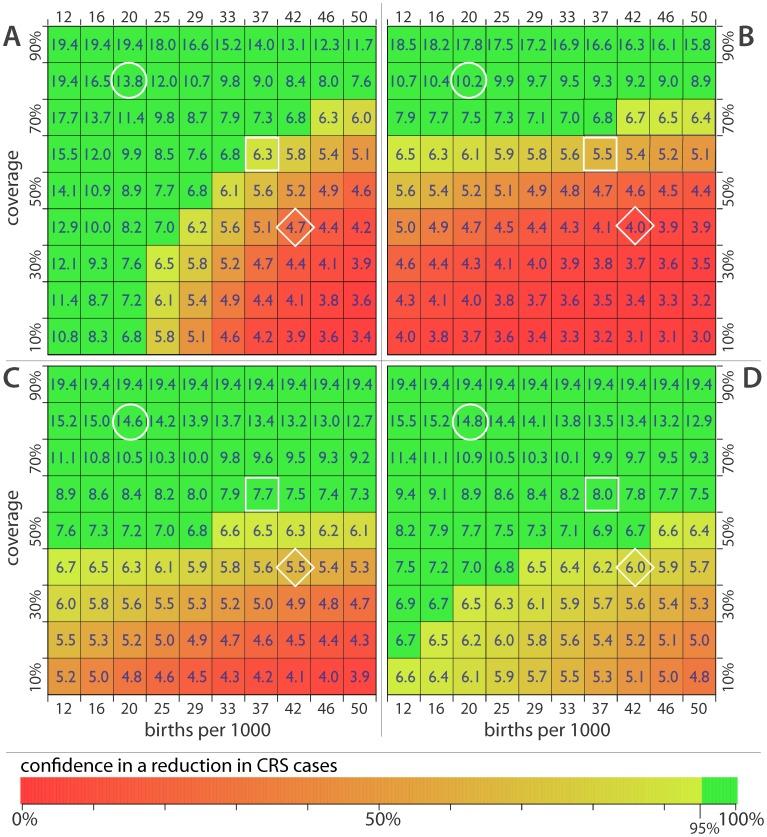
The median R0 of rubella in the African region is 5.2, with 90% of countries expected to have an R0 between 4.0 and 6.7. Overall, we predict that countries maintaining routine vaccination coverage of 80% or higher are can be confident in seeing a reduction in CRS over a 30 year time horizon.
CONCLUSIONS
Under realistic assumptions about human contact, our results suggest that even in low birth rate settings high vaccine coverage must be maintained to avoid an increase in CRS. These results lend further support to the WHO recommendation that countries reach 80% coverage for measles vaccine before introducing rubella vaccination, and highlight the importance of maintaining high levels of vaccination coverage once the vaccine is introduced.
背景
尽管有安全有效的疫苗,但接种率不足的风疹疫苗接种计划可能会提高风疹感染的平均年龄;从而增加孕妇中的风疹病例数,以及她们新生儿的先天性风疹综合征(CRS)。减少 CRS 所需的疫苗接种率取决于一个国家的出生率和繁殖数 R0,这是衡量疾病传播效率的指标。虽然一个国家的出生率可以比较准确地知晓,但 R0 在不同环境下会有所不同,并且难以测量。在此,我们旨在为面对 R0 存在较大不确定性的情况下,为各国安全引入风疹疫苗提供指导。
方法
我们使用贝叶斯层次模型,根据风疹感染的年龄分布来估计非洲国家的 R0 分布。我们开发了一种针对风疹传播的特定年龄模型,以预测在特定出生率和接种率水平下,R0 上升会导致 CRS 负担增加的水平。结合这些结果,我们总结了在不同人口和接种率背景下引入风疹疫苗的安全性。
发现
非洲地区风疹的 R0 中位数为 5.2,90%的国家预计 R0 在 4.0 至 6.7 之间。总体而言,我们预测在 30 年的时间内,保持 80%或更高常规接种率的国家有望看到 CRS 减少。
结论
根据人类接触的现实假设,我们的结果表明,即使在低出生率环境下,也必须维持高疫苗接种率,以避免 CRS 的增加。这些结果进一步支持了世界卫生组织的建议,即在引入风疹疫苗之前,各国应达到麻疹疫苗 80%的覆盖率,并强调了一旦引入疫苗,维持高接种率的重要性。


 Zotero 插件