
体心立方钨中的{110}滑移带与{112}滑移痕迹。
{110} Slip with {112} slip traces in bcc Tungsten.
机构信息
Materials Science and Simulation, NUM/ASQ, Paul Scherrer Institut, Villigen PSI, Switzerland.
出版信息
Sci Rep. 2013;3:2547. doi: 10.1038/srep02547.
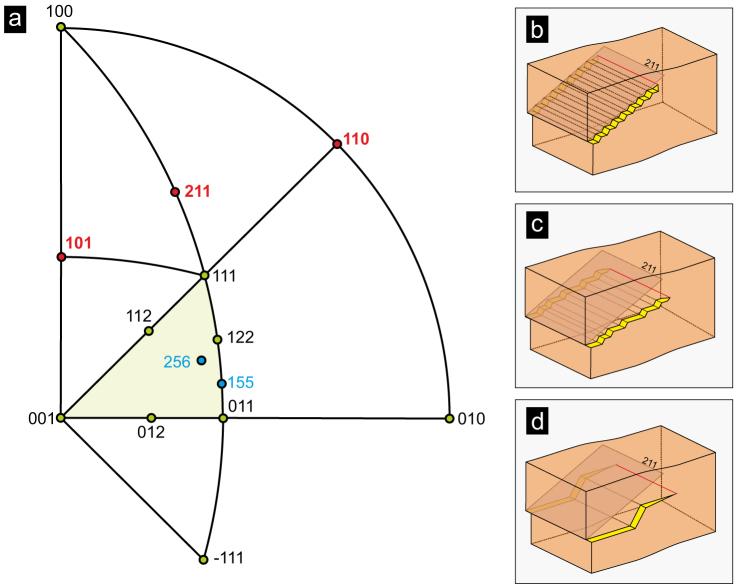
While propagation of dislocations in body centered cubic metals at low temperature is understood in terms of elementary steps on {110} planes, slip traces correspond often with other crystallographic or non-crystallographic planes. In the past, characterization of slip was limited to post-mortem electron microscopy and slip trace analysis on the sample surface. Here with in-situ Laue diffraction experiments during micro-compression we demonstrate that when two {110} planes containing the same slip direction experience the same resolved shear stress, sharp slip traces are observed on a {112} plane. When however the {110} planes are slightly differently stressed, macroscopic strain is measured on the individual planes and collective cross-slip is used to fulfill mechanical boundary conditions, resulting in a zig-zag or broad slip trace on the sample surface. We anticipate that such dynamics can occur in polycrystalline metals due to local inhomogeneous stress distributions and can cause unusual slip transfer among grains.
虽然在低温下体心立方金属位错的传播可以用{110}面上的基本步骤来理解,但滑移痕迹通常与其他晶体学或非晶体学平面相对应。过去,对滑移的描述仅限于死后电子显微镜和样品表面上的滑移痕迹分析。在这里,通过微压缩过程中的原位劳埃衍射实验,我们证明了当两个包含相同滑移方向的{110}面承受相同的分切应力时,在{112}面上会观察到尖锐的滑移痕迹。然而,当{110}面受到略微不同的应力时,在各个面上会测量到宏观应变,并且通过集体交滑移来满足力学边界条件,从而在样品表面上产生锯齿状或宽的滑移痕迹。我们预计,由于局部不均匀的应力分布,这种动力学可能会在多晶金属中发生,并导致晶粒之间异常的滑移传递。



 Zotero 插件