
细胞外而非胞质超氧化物歧化酶可预防氧化剂介导的内皮功能障碍。
Extracellular but not cytosolic superoxide dismutase protects against oxidant-mediated endothelial dysfunction.
作者信息
Foresman Erin L, Miller Francis J
机构信息
Department of Internal Medicine, University of Iowa, Iowa City, IA 52242, USA.
出版信息
Redox Biol. 2013 May 24;1(1):292-6. doi: 10.1016/j.redox.2013.04.003. eCollection 2013.
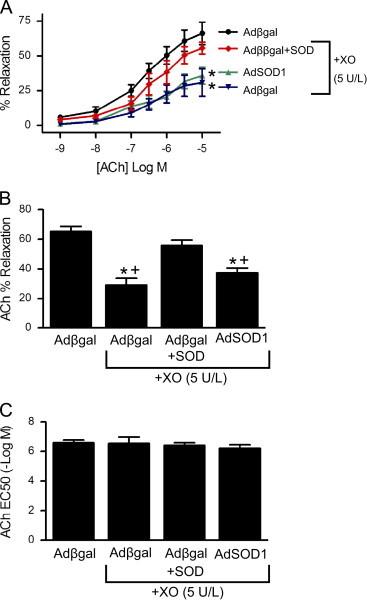
Superoxide (O2 (•-)) contributes to the development of cardiovascular disease. Generation of O2 (•-) occurs in both the intracellular and extracellular compartments. We hypothesized that the gene transfer of cytosolic superoxide dismutase (SOD1) or extracellular SOD (SOD3) to blood vessels would differentially protect against O2 (•-)-mediated endothelial-dependent dysfunction. Aortic ring segments from New Zealand rabbits were incubated with adenovirus (Ad) containing the gene for Escherichia coli β-galactosidase, SOD1, or SOD3. Activity assays confirmed functional overexpression of both SOD3 and SOD1 isoforms in aorta 24 h following gene transfer. Histochemical staining for β-galactosidase showed gene transfer occurred in the endothelium and adventitia. Next, vessels were prepared for measurement of isometric tension in Kreb's buffer containing xanthine. After precontraction with phenylephrine, xanthine oxidase impaired relaxation to the endothelium-dependent dilator acetylcholine (ACh, max relaxation 33±4% with XO vs. 64±3% without XO, p<0.05), whereas relaxation to the endothelium-independent dilator sodium nitroprusside was unaffected. In the presence of XO, maximal relaxation to ACh was improved in vessels incubated with AdSOD3 (55±2%, p<0.05 vs. control) but not AdSOD1 (34±4%). We conclude that adenoviral-mediated gene transfer of SOD3, but not SOD1, protects the aorta from xanthine/XO-mediated endothelial dysfunction. These data provide important insight into the location and enzymatic source of O2 (•-) production in vascular disease.
超氧阴离子(O₂(•⁻))参与心血管疾病的发展。O₂(•⁻)在细胞内和细胞外区室均有生成。我们推测,将胞质超氧化物歧化酶(SOD1)或细胞外超氧化物歧化酶(SOD3)基因转移至血管,可能会对O₂(•⁻)介导的内皮依赖性功能障碍产生不同的保护作用。将来自新西兰兔的主动脉环段与携带大肠杆菌β-半乳糖苷酶、SOD1或SOD3基因的腺病毒(Ad)一起孵育。活性测定证实,基因转移后24小时,主动脉中SOD3和SOD1同工型均有功能性过表达。β-半乳糖苷酶的组织化学染色显示基因转移发生在内皮和外膜。接下来,制备血管以测量含黄嘌呤的Krebs缓冲液中的等长张力。用去氧肾上腺素预收缩后,黄嘌呤氧化酶损害了对内皮依赖性舒张剂乙酰胆碱(ACh,XO存在时最大舒张率为33±4%,无XO时为64±3%,p<0.05)的舒张反应,而对内皮非依赖性舒张剂硝普钠的舒张反应未受影响。在XO存在的情况下,与AdSOD3孵育的血管对ACh的最大舒张反应得到改善(55±2%,与对照组相比p<0.05),而与AdSOD1孵育的血管则未改善(34±4%)。我们得出结论,腺病毒介导的SOD3基因转移而非SOD1基因转移可保护主动脉免受黄嘌呤/黄嘌呤氧化酶介导的内皮功能障碍。这些数据为血管疾病中O₂(•⁻)产生的位置和酶源提供了重要见解。


 Zotero 插件