
噬菌体展示技术衍生的配体能够区分单核细胞增生李斯特菌与其他李斯特菌属物种。
Phage display-derived binders able to distinguish Listeria monocytogenes from other Listeria species.
机构信息
Institute for Global Food Security, School of Biological Sciences, Queen's University, Belfast, Northern Ireland, United Kingdom.
出版信息
PLoS One. 2013 Sep 10;8(9):e74312. doi: 10.1371/journal.pone.0074312. eCollection 2013.
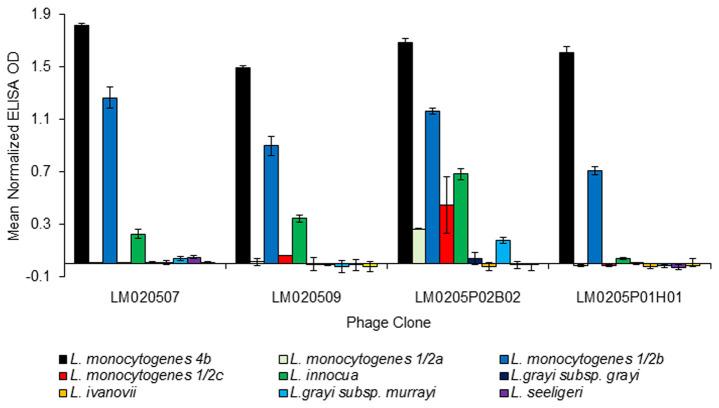
The objective of this study was to produce phage display-derived binders with the ability to distinguish Listeria monocytogenes from other Listeria spp., which may have potential utility to enhance detection of Listeria monocytogenes. To obtain binders with the desired binding specificity a series of surface and solution phage-display biopannings were performed. Initially, three rounds of surface biopanning against gamma-irradiated L. monocytogenes serovar 4b cells were performed followed by an additional surface biopanning round against L. monocytogenes 4b which included prior subtraction biopanning against gamma-irradiated L. innocua cells. In an attempt to further enhance binder specificity for L. monocytogenes 4b two rounds of solution biopanning were performed, both rounds included initial subtraction solution biopanning against L. innocua. Subsequent evaluations were performed on the phage clones by phage binding ELISA. All phage clones tested from the second round of solution biopanning had higher specificity for L. monocytogenes 4b than for L. innocua and three other foodborne pathogens (Salmonella spp., Escherichia coli and Campylobacter jejuni). Further evaluation with five other Listeria spp. revealed that one phage clone in particular, expressing peptide GRIADLPPLKPN, was highly specific for L. monocytogenes with at least 43-fold more binding capability to L. monocytogenes 4b than to any other Listeria sp. This proof-of-principle study demonstrates how a combination of surface, solution and subtractive biopanning was used to maximise binder specificity. L. monocytogenes-specific binders were obtained which could have potential application in novel detection tests for L. monocytogenes, benefiting both the food and medical industries.
本研究的目的是获得能够区分单核细胞增生李斯特菌和其他李斯特菌属的噬菌体展示衍生结合物,这可能对增强单核细胞增生李斯特菌的检测具有潜在的应用价值。为了获得具有所需结合特异性的结合物,进行了一系列表面和溶液噬菌体展示生物淘选。最初,针对γ辐照单核细胞增生李斯特菌 4b 细胞进行了三轮表面生物淘选,随后针对单核细胞增生李斯特菌 4b 进行了额外的表面生物淘选,其中包括针对γ辐照无害李斯特菌细胞的预先消减生物淘选。为了进一步增强对单核细胞增生李斯特菌 4b 的结合物特异性,进行了两轮溶液生物淘选,两轮都包括针对无害李斯特菌的初始消减溶液生物淘选。随后通过噬菌体结合 ELISA 对噬菌体克隆进行了评估。从第二轮溶液生物淘选中测试的所有噬菌体克隆对单核细胞增生李斯特菌 4b 的特异性都高于对无害李斯特菌和其他三种食源性病原体(沙门氏菌、大肠杆菌和空肠弯曲菌)的特异性。对另外五种李斯特菌属的进一步评估表明,特别是表达肽 GRIADLPPLKPN 的一个噬菌体克隆对单核细胞增生李斯特菌具有高度特异性,与任何其他李斯特菌属的结合能力至少高出 43 倍。这项原理验证研究表明了如何结合使用表面、溶液和消减生物淘选来最大化结合物特异性。获得了单核细胞增生李斯特菌特异性结合物,它们可能在单核细胞增生李斯特菌的新型检测试验中有潜在的应用,这将有益于食品和医疗行业。


 Zotero 插件