
Toll 样受体 2 对小鼠金黄色葡萄球菌感染固有免疫反应的贡献。
Contribution of toll-like receptor 2 to the innate response against Staphylococcus aureus infection in mice.
机构信息
Department of Advanced Medicine, Graduate School of Medicine, Hokkaido University, Kita-ku, Sapporo, Japan.
出版信息
PLoS One. 2013 Sep 13;8(9):e74287. doi: 10.1371/journal.pone.0074287. eCollection 2013.
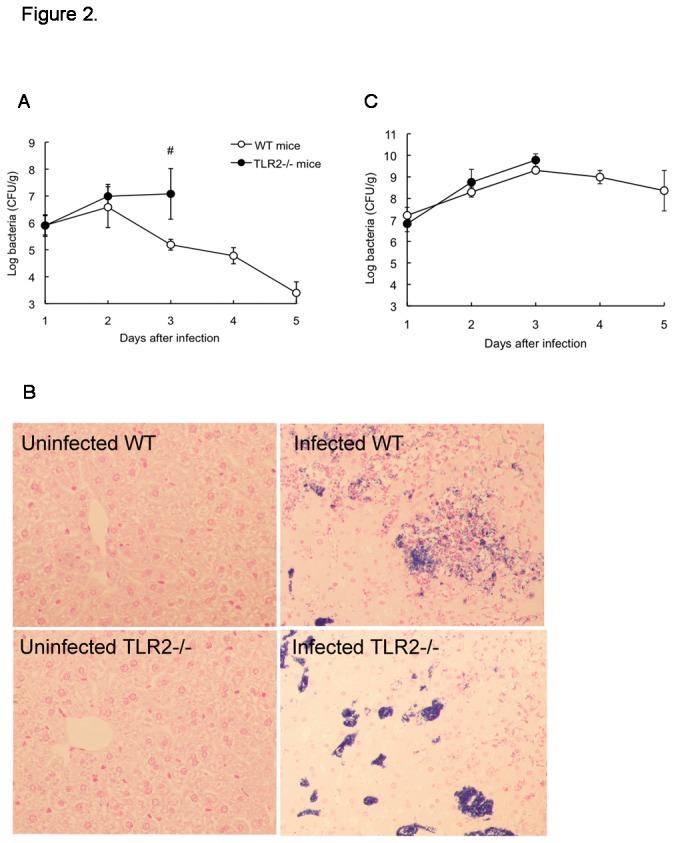
Staphylococcus aureus is a common pathogen that causes a wide range of infectious diseases. The function of TLRs, specifically TLR2, during S. aureus infection is still debated. In this study, we investigated the extent to which TLR2 contributes to the host innate response against the bacterial infection using TLR2-deficient mice. Intravenous inoculation with S. aureus resulted in all TLR2-deficient mice dying within 4 d, along with a high bacterial burden in the livers. However, histological examination showed the same degree of macrophage and neutrophil accumulation in the livers of infected TLR2-deficient mice as that in infected wild-type (WT) mice. TLR2-deficient mouse macrophages also showed normal phagocytic activity, although they failed to express CD36 that appeared on the surface of WT mouse cells upon challenge with heat-killed S. aureus. These data indicate that TLR2, as well as CD36, does not directly affect S. aureus clearance and that CD36 expression on macrophages depends on the presence of TLR2. In vivo infection with S. aureus caused significantly elevated production of TNF-α and IL-6 in the livers and blood of TLR2-deficient mice compared with those in WT mice, while the hepatic and serum levels of IL-10 decreased in these mice. In contrast, lower expression of IL-6 and IL-10, but not of TNF-α, at both the gene and protein levels was found in TLR2-deficient mouse macrophages compared to that in WT mouse cells, in response to challenge with heat-killed S. aureus. These findings suggest that the S. aureus-induced pro-inflammatory cytokine response is not dependent on macrophages and that TLR2 deficiency results in decreased IL-10 release by macrophages, which contributes to dysregulated cytokine balance, impaired bacterial clearance, and mouse death. Therefore, TLR2 possesses a protective function during S. aureus infection by regulating pro- and anti-inflammatory cytokine responses.
金黄色葡萄球菌是一种常见的病原体,可引起广泛的感染性疾病。TLRs,特别是 TLR2,在金黄色葡萄球菌感染中的作用仍存在争议。在这项研究中,我们使用 TLR2 缺陷小鼠研究 TLR2 对宿主固有免疫反应的贡献程度。金黄色葡萄球菌静脉接种导致所有 TLR2 缺陷小鼠在 4 天内死亡,同时肝脏中的细菌负荷很高。然而,组织学检查显示,感染 TLR2 缺陷小鼠肝脏中的巨噬细胞和中性粒细胞积聚程度与感染野生型(WT)小鼠相同。TLR2 缺陷小鼠巨噬细胞也表现出正常的吞噬活性,尽管它们未能表达 CD36,而 WT 细胞在受到热灭活金黄色葡萄球菌刺激时会在表面表达 CD36。这些数据表明,TLR2 以及 CD36 不会直接影响金黄色葡萄球菌的清除,并且巨噬细胞上的 CD36 表达依赖于 TLR2 的存在。与 WT 小鼠相比,TLR2 缺陷小鼠体内金黄色葡萄球菌感染导致肝脏和血液中 TNF-α和 IL-6 的产生显著增加,而这些小鼠肝脏和血清中的 IL-10 水平降低。相比之下,TLR2 缺陷小鼠巨噬细胞对热灭活金黄色葡萄球菌的反应中,IL-6 和 IL-10 的表达水平降低,而 TNF-α的表达水平没有降低,在基因和蛋白水平均如此。这些发现表明金黄色葡萄球菌诱导的促炎细胞因子反应不依赖于巨噬细胞,并且 TLR2 缺陷导致巨噬细胞释放的 IL-10 减少,这有助于细胞因子平衡失调、细菌清除受损和小鼠死亡。因此,TLR2 在金黄色葡萄球菌感染过程中通过调节促炎和抗炎细胞因子反应发挥保护作用。




 Zotero 插件