
汉族乳腺癌的共同基因特征。
Concurrent gene signatures for han chinese breast cancers.
机构信息
Graduate Institute of Biomedical Electronics and Bioinformatics, National Taiwan University, Taipei City, Taiwan ; Cathay General Hospital SiJhih, New, Taipei City, Taiwan ; School of Medicine, Fu-Jen Catholic University, New Taipei City, Taiwan ; School of Medicine, Taipei Medical University, Taipei City, Taiwan.
出版信息
PLoS One. 2013 Oct 3;8(10):e76421. doi: 10.1371/journal.pone.0076421. eCollection 2013.
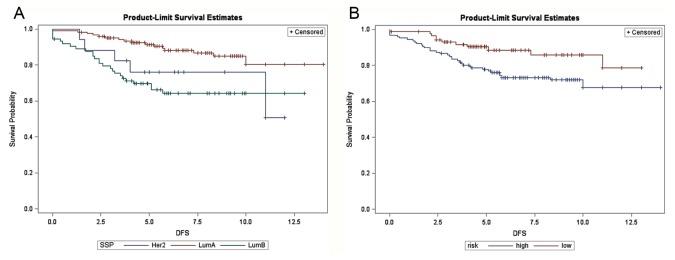
The interplay between copy number variation (CNV) and differential gene expression may be able to shed light on molecular process underlying breast cancer and lead to the discovery of cancer-related genes. In the current study, genes concurrently identified in array comparative genomic hybridization (CGH) and gene expression microarrays were used to derive gene signatures for Han Chinese breast cancers. We performed 23 array CGHs and 81 gene expression microarrays in breast cancer samples from Taiwanese women. Genes with coherent patterns of both CNV and differential gene expression were identified from the 21 samples assayed using both platforms. We used these genes to derive signatures associated with clinical ER and HER2 status and disease-free survival. DISTRIBUTIONS OF SIGNATURE GENES WERE STRONGLY ASSOCIATED WITH CHROMOSOMAL LOCATION: chromosome 16 for ER and 17 for HER2. A breast cancer risk predictive model was built based on the first supervised principal component from 16 genes (RCAN3, MCOLN2, DENND2D, RWDD3, ZMYM6, CAPZA1, GPR18, WARS2, TRIM45, SCRN1, CSNK1E, HBXIP, CSDE1, MRPL20, IKZF1, and COL20A1), and distinct survival patterns were observed between the high- and low-risk groups from the combined dataset of 408 microarrays. The risk score was significantly higher in breast cancer patients with recurrence, metastasis, or mortality than in relapse-free individuals (0.241 versus 0, P<0.001). The concurrent gene risk predictive model remained discriminative across distinct clinical ER and HER2 statuses in subgroup analysis. Prognostic comparisons with published gene expression signatures showed a better discerning ability of concurrent genes, many of which were rarely identifiable if expression data were pre-selected by phenotype correlations or variability of individual genes. We conclude that parallel analysis of CGH and microarray data, in conjunction with known gene expression patterns, can be used to identify biomarkers with prognostic values in breast cancer.
拷贝数变异 (CNV) 与差异基因表达之间的相互作用可能有助于阐明乳腺癌的分子过程,并发现与癌症相关的基因。在本研究中,我们使用同时在阵列比较基因组杂交 (CGH) 和基因表达微阵列中鉴定的基因,为台湾女性的乳腺癌衍生基因特征。我们对来自台湾女性的乳腺癌样本进行了 23 次阵列 CGH 和 81 次基因表达微阵列分析。从使用两种平台检测的 21 个样本中鉴定出具有一致 CNV 和差异基因表达模式的基因。我们使用这些基因来推导与临床 ER 和 HER2 状态和无病生存相关的特征。特征基因的分布与染色体位置强烈相关:染色体 16 与 ER 相关,17 与 HER2 相关。基于来自 16 个基因的第一个监督主成分构建了乳腺癌风险预测模型(RCAN3、MCOLN2、DENND2D、RWDD3、ZMYM6、CAPZA1、GPR18、WARS2、TRIM45、SCRN1、CSNK1E、HBXIP、CSDE1、MRPL20、IKZF1 和 COL20A1),并在来自 408 个微阵列的组合数据集之间观察到高风险组和低风险组之间明显不同的生存模式。与无复发个体相比,复发、转移或死亡的乳腺癌患者的风险评分明显更高(0.241 对 0,P<0.001)。在亚组分析中,该风险评分模型在不同的临床 ER 和 HER2 状态下仍然具有鉴别力。与已发表的基因表达特征进行预后比较表明,同时分析 CGH 和微阵列数据,结合已知的基因表达模式,可以用于识别乳腺癌具有预后价值的生物标志物。


 Zotero 插件