
经三种类型的插管型声门上气道行纤维支气管镜气管插管中使用 Aintree 插管导管的效果:一项模拟人体研究。
Utility of the Aintree Intubation Catheter in fiberoptic tracheal intubation through the three types of intubating supraglottic airways: a manikin simulation study.
机构信息
Department of Anesthesiology, Hyogo College of Medicine, Mukogawa-cho 1-1, Nishinomiya, Hyogo, 663-8501, Japan,
出版信息
J Anesth. 2014 Jun;28(3):363-7. doi: 10.1007/s00540-013-1724-3. Epub 2013 Oct 17.
PURPOSE
The purpose of this study was to examine the utility of the Aintree Intubation Catheter (AIC) with three types of supraglottic airway devices for tracheal intubation (ISGAs) using a manikin.
METHODS
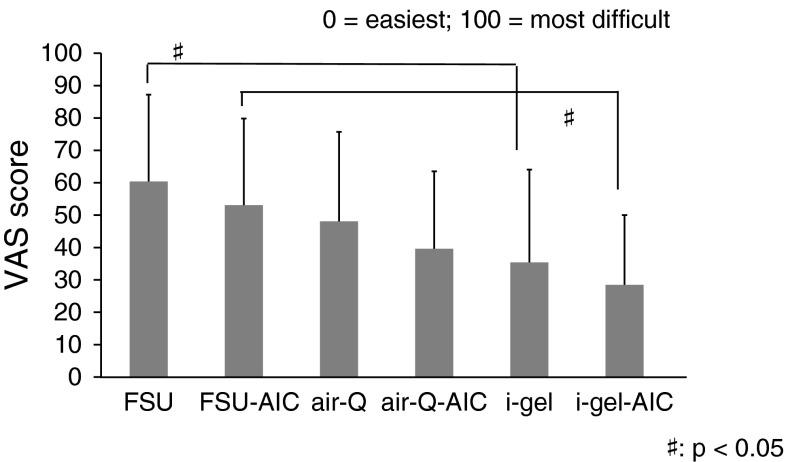
Participants were 21 anesthesiologists with more than 2 years of experience in clinical anesthesia. Three types of ISGAs were passed through the glottis: Fastrack-Single Use (FSU; size 4), air-Q (size 3.5), and i-gel (size 4). Participants attempted fiberoptic tracheal intubation with the ISGAs in random order. Success rate of tracheal intubation, intubation time, and collision with the glottis were recorded. Participants also evaluated the subjective difficulty of the entire intubation process and passing the tracheal tube through the glottis using a Visual Analogue Scale.
RESULTS
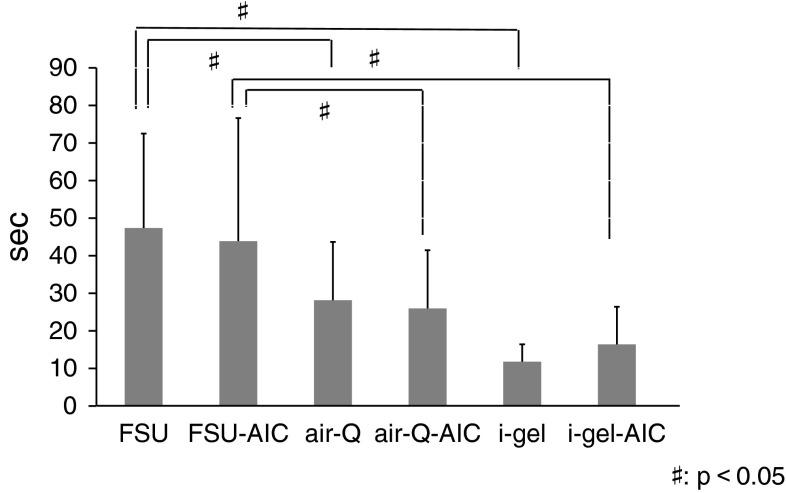
The FSU required a significantly longer time for intubation compared with the other two ISGAs (p < 0.05). AIC use did not significantly improve the success rate of intubation or shorten intubation times for any of the ISGAs. However, there were significantly more collisions with the glottis without AIC use for the FSU and air-Q compared to when they were used with the AIC (FSU, p = 0.015; air-Q, p = 0.025).
CONCLUSION
Among the ISGAs tested, intubation took longer with the FSU, and the FSU had a higher failure rate than the other ISGAs. AIC significantly decreased the number of collisions with the FSU and air-Q. These findings suggest that the AIC is effective in reducing collisions with the tracheal tube and thus will reduce the risk of mechanical injury to the airway.
目的
本研究旨在通过模拟人评估 Aintree 插管导管(AIC)联合三种不同类型的声门上气道装置(Supraglottic Airway Devices,SADs)在纤维支气管镜引导下经口气管插管的临床应用效果。
方法
本研究纳入 21 名具有 2 年以上临床麻醉经验的麻醉医生。三种不同类型的 SADs 依次经声门置入:Fastrack-Single Use(FSU,4 号)、air-Q(3.5 号)和 i-gel(4 号)。参与者以随机顺序使用这些 SADs 进行纤维支气管镜引导下经口气管插管。记录气管插管的成功率、插管时间和与声门的碰撞情况。参与者还使用视觉模拟评分法(Visual Analogue Scale,VAS)评估整个插管过程和 SADs 经声门置入气管导管的主观难度。
结果
与其他两种 SADs 相比,FSU 进行气管插管所需的时间明显更长(p<0.05)。与不使用 AIC 相比,使用 AIC 并没有显著提高任何一种 SADs 的插管成功率或缩短插管时间。然而,在不使用 AIC 时,FSU 和 air-Q 与声门的碰撞次数明显更多(FSU,p=0.015;air-Q,p=0.025)。
结论
在本研究中测试的 SADs 中,FSU 进行气管插管所需的时间最长,FSU 的插管失败率也高于其他两种 SADs。AIC 显著减少了 FSU 和 air-Q 与声门的碰撞次数。这些结果表明,AIC 可有效减少与气管导管的碰撞,从而降低气道机械性损伤的风险。



 Zotero 插件