
遗传和功能研究表明,果蝇神经纤维瘤病 1 生长缺陷与突触过度生长和环咽腺 cAMP/PKA 信号缺陷有关。
Genetic and functional studies implicate synaptic overgrowth and ring gland cAMP/PKA signaling defects in the Drosophila melanogaster neurofibromatosis-1 growth deficiency.
机构信息
Massachusetts General Hospital Center for Cancer Research and Harvard Medical School, Charlestown, Massachusetts, United States of America ; Center for Human Genetic Research, Massachusetts General Hospital, Boston, Massachusetts, United States of America.
出版信息
PLoS Genet. 2013 Nov;9(11):e1003958. doi: 10.1371/journal.pgen.1003958. Epub 2013 Nov 21.
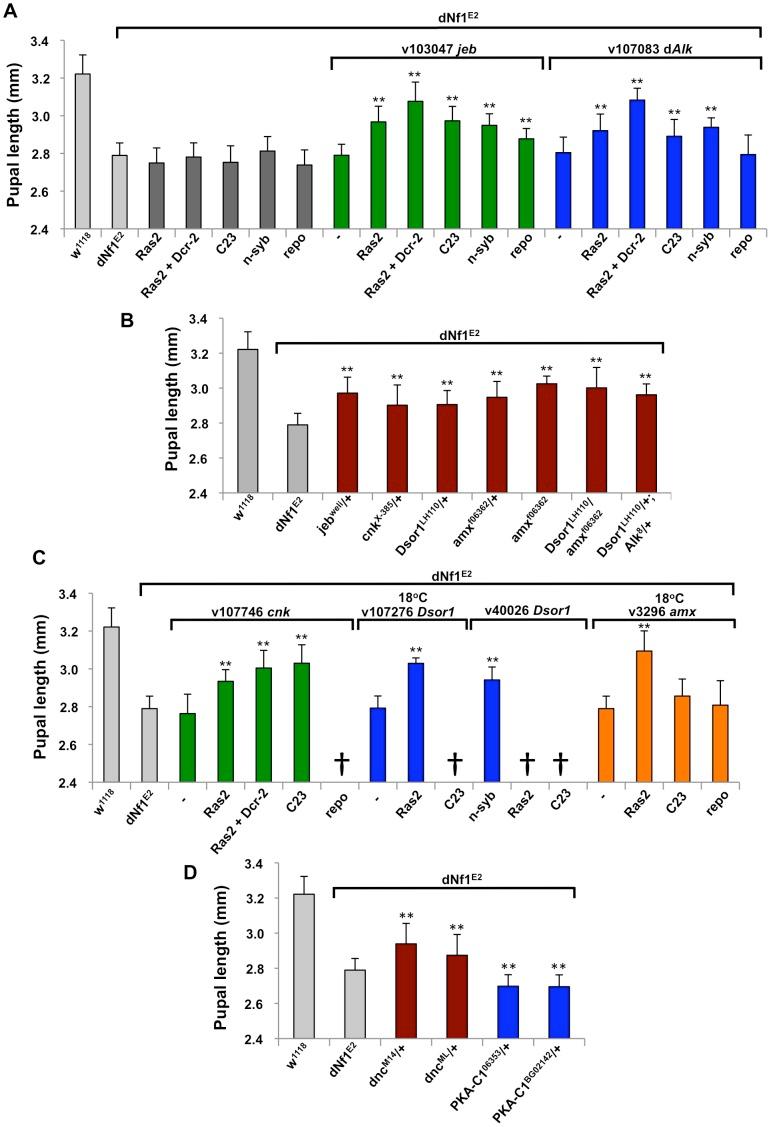
Neurofibromatosis type 1 (NF1), a genetic disease that affects 1 in 3,000, is caused by loss of a large evolutionary conserved protein that serves as a GTPase Activating Protein (GAP) for Ras. Among Drosophila melanogaster Nf1 (dNf1) null mutant phenotypes, learning/memory deficits and reduced overall growth resemble human NF1 symptoms. These and other dNf1 defects are relatively insensitive to manipulations that reduce Ras signaling strength but are suppressed by increasing signaling through the 3'-5' cyclic adenosine monophosphate (cAMP) dependent Protein Kinase A (PKA) pathway, or phenocopied by inhibiting this pathway. However, whether dNf1 affects cAMP/PKA signaling directly or indirectly remains controversial. To shed light on this issue we screened 486 1(st) and 2(nd) chromosome deficiencies that uncover >80% of annotated genes for dominant modifiers of the dNf1 pupal size defect, identifying responsible genes in crosses with mutant alleles or by tissue-specific RNA interference (RNAi) knockdown. Validating the screen, identified suppressors include the previously implicated dAlk tyrosine kinase, its activating ligand jelly belly (jeb), two other genes involved in Ras/ERK signal transduction and several involved in cAMP/PKA signaling. Novel modifiers that implicate synaptic defects in the dNf1 growth deficiency include the intersectin-related synaptic scaffold protein Dap160 and the cholecystokinin receptor-related CCKLR-17D1 drosulfakinin receptor. Providing mechanistic clues, we show that dAlk, jeb and CCKLR-17D1 are among mutants that also suppress a recently identified dNf1 neuromuscular junction (NMJ) overgrowth phenotype and that manipulations that increase cAMP/PKA signaling in adipokinetic hormone (AKH)-producing cells at the base of the neuroendocrine ring gland restore the dNf1 growth deficiency. Finally, supporting our previous contention that ALK might be a therapeutic target in NF1, we report that human ALK is expressed in cells that give rise to NF1 tumors and that NF1 regulated ALK/RAS/ERK signaling appears conserved in man.
神经纤维瘤病 1 型(NF1)是一种遗传疾病,影响 3000 人中的 1 人,由一种作为 Ras 的 GTPase 激活蛋白(GAP)的大型进化保守蛋白的缺失引起。在黑腹果蝇 Nf1(dNf1)缺失突变表型中,学习/记忆缺陷和整体生长减少类似于人类 NF1 症状。这些和其他 dNf1 缺陷对降低 Ras 信号强度的操作相对不敏感,但通过增加通过 3'-5'环腺苷单磷酸(cAMP)依赖性蛋白激酶 A(PKA)途径的信号传递或通过抑制该途径来抑制。然而,dNf1 是否直接或间接影响 cAMP/PKA 信号仍然存在争议。为了阐明这个问题,我们筛选了 486 个 1(st)和 2(nd)染色体缺失,这些缺失揭示了 >80%注释基因的显性修饰子,用于鉴定与突变等位基因杂交或通过组织特异性 RNA 干扰(RNAi)敲低的负责基因。验证筛选,鉴定的抑制剂包括先前涉及的 dAlk 酪氨酸激酶、其激活配体 jelly belly(jeb)、另外两个参与 Ras/ERK 信号转导的基因和几个参与 cAMP/PKA 信号的基因。涉及突触缺陷的新型修饰子在 dNf1 生长缺陷中包括 intersectin 相关突触支架蛋白 Dap160 和胆囊收缩素受体相关 CCKLR-17D1 蝇磺酰氯受体。提供机制线索,我们表明 dAlk、jeb 和 CCKLR-17D1 是也抑制最近鉴定的 dNf1 神经肌肉接头(NMJ)过度生长表型的突变体之一,并且增加在神经内分泌环腺底部产生的肾上腺素能激素(AKH)的细胞中的 cAMP/PKA 信号的操作恢复了 dNf1 的生长缺陷。最后,支持我们之前的论点,即 ALK 可能是 NF1 的治疗靶点,我们报告说人类 ALK 表达在产生 NF1 肿瘤的细胞中,并且 NF1 调节的 ALK/RAS/ERK 信号似乎在人类中保守。




 Zotero 插件