
基于卫星的中国对流层二氧化碳质量的空间和季节变化估算。
Satellite-derived estimations of spatial and seasonal variation in tropospheric carbon dioxide mass over China.
机构信息
Jiangsu Provincial Key Laboratory of Geographic Information Science and Technology, Nanjing University Nanjing, 210093, Jiangsu Province, China.
出版信息
Ecol Evol. 2013 Nov;3(13):4310-25. doi: 10.1002/ece3.823. Epub 2013 Oct 3.
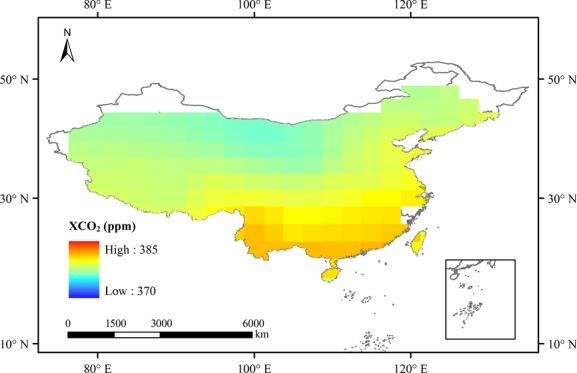
China has frequently been questioned about the data transparency and accuracy of its energy and emission statistics. Satellite-derived remote sensing data potentially provide a useful tool to study the variation in carbon dioxide (CO2) mass over areas of the earth's surface. In this study, Greenhouse gases Observing SATellite (GOSAT) tropospheric CO2 concentration data and NCEP/NCAR reanalysis tropopause data were integrated to obtain estimates of tropospheric CO2 mass variations over the surface of China. These variations were mapped to show seasonal and spatial patterns with reference to China's provincial areas. The estimates of provincial tropospheric CO2 were related to statistical estimates of CO2 emissions for the provinces and considered with reference to provincial populations and gross regional products (GRP). Tropospheric CO2 masses for the Chinese provinces ranged from 53 ± 1 to 14,470 ± 63 million tonnes were greater for western than for eastern provinces and were primarily a function of provincial land area. Adjusted for land area troposphere CO2 mass was higher for eastern and southern provinces than for western and northern provinces. Tropospheric CO2 mass over China varied with season being highest in July and August and lowest in January and February. The average annual emission from provincial energy statistics of CO2 by China was estimated as 10.3% of the average mass of CO2 in the troposphere over China. The relationship between statistical emissions relative to tropospheric CO2 mass was higher than 20% for developed coastal provinces of China, with Shanghai, Tianjin, and Beijing having exceptionally high percentages. The percentages were generally lower than 10% for western inland provinces. Provincial estimates of emissions of CO2 were significantly positively related to provincial populations and gross regional products (GRP) when the values for the provincial municipalities Shanghai, Tianjin, and Beijing were excluded from the linear regressions. An increase in provincial GRP per person was related to a curvilinear increase in CO2 emissions, this being particularly marked for Beijing, Tianjin, and especially Shanghai. The absence of detection of specific elevation of CO2 mass in the troposphere above these municipalities may relate to the rapid mixing and dispersal of CO2 emissions or the proportion of the depth of the troposphere sensed by GOSAT.
中国经常被问及能源和排放统计数据的透明度和准确性。卫星衍生的遥感数据为研究地球表面二氧化碳(CO2)质量的变化提供了有用的工具。在这项研究中,温室气体观测卫星(GOSAT)对流层 CO2 浓度数据和 NCEP/NCAR 再分析对流层顶数据被整合,以获得中国地表对流层 CO2 质量变化的估计。这些变化被绘制出来,以显示与中国省级地区有关的季节性和空间模式。省级对流层 CO2 的估计值与省级 CO2 排放量的统计估计值相关联,并参考省级人口和地区生产总值(GRP)进行考虑。中国各省的对流层 CO2 质量范围从 53 ± 1 到 14470 ± 6300 万吨,西部省份比东部省份大,主要与省级陆地面积有关。调整陆地面积后,东部和南部省份的对流层 CO2 质量高于西部和北部省份。中国的对流层 CO2 质量随季节而变化,7 月和 8 月最高,1 月和 2 月最低。中国省级能源统计的 CO2 年平均排放量估计为中国对流层 CO2 质量的 10.3%。中国沿海发达省份的统计排放量与对流层 CO2 质量的关系高于 20%,上海、天津和北京的比例特别高。对于西部内陆省份,这些比例一般低于 10%。在排除直辖市上海、天津和北京的线性回归后,省级 CO2 排放量的估计值与省级人口和地区生产总值(GRP)呈显著正相关。省级人均 GRP 的增加与 CO2 排放量的曲线增加有关,北京、天津,特别是上海尤为明显。在这些直辖市上空没有探测到对流层中 CO2 质量的特定升高,这可能与 CO2 排放的快速混合和扩散有关,或者与 GOSAT 感知的对流层深度的比例有关。



 Zotero 插件