
SPM-1金属β-内酰胺酶中宿主特异性酶-底物相互作用受二级结构残基调控。
Host-specific enzyme-substrate interactions in SPM-1 metallo-β-lactamase are modulated by second sphere residues.
作者信息
González Lisandro J, Moreno Diego M, Bonomo Robert A, Vila Alejandro J
机构信息
Instituto de Biología Molecular y Celular de Rosario (IBR, CONICET-UNR) and Area Biofísica, Facultad de Ciencias Bioquímicas y Farmacéuticas, Universidad Nacional de Rosario, Rosario, Argentina.
Instituto de Química Rosario (IQUIR, CONICET-UNR), Facultad de Ciencias Bioquímicas y Farmacéuticas, Universidad Nacional de Rosario, Rosario, Argentina.
出版信息
PLoS Pathog. 2014 Jan;10(1):e1003817. doi: 10.1371/journal.ppat.1003817. Epub 2014 Jan 2.
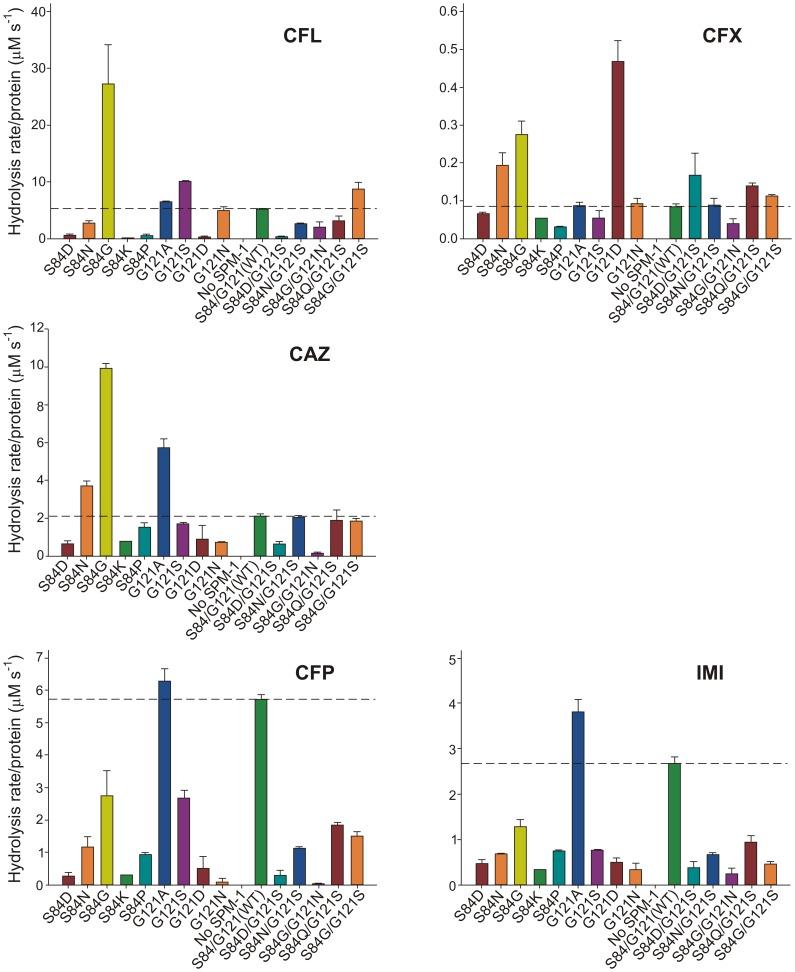
Pseudomonas aeruginosa is one of the most virulent and resistant non-fermenting Gram-negative pathogens in the clinic. Unfortunately, P. aeruginosa has acquired genes encoding metallo-β-lactamases (MβLs), enzymes able to hydrolyze most β-lactam antibiotics. SPM-1 is an MβL produced only by P. aeruginosa, while other MβLs are found in different bacteria. Despite similar active sites, the resistance profile of MβLs towards β-lactams changes from one enzyme to the other. SPM-1 is unique among pathogen-associated MβLs in that it contains "atypical" second sphere residues (S84, G121). Codon randomization on these positions and further selection of resistance-conferring mutants was performed. MICs, periplasmic enzymatic activity, Zn(II) requirements, and protein stability was assessed. Our results indicated that identity of second sphere residues modulates the substrate preferences and the resistance profile of SPM-1 expressed in P. aeruginosa. The second sphere residues found in wild type SPM-1 give rise to a substrate selectivity that is observed only in the periplasmic environment. These residues also allow SPM-1 to confer resistance in P. aeruginosa under Zn(II)-limiting conditions, such as those expected under infection. By optimizing the catalytic efficiency towards β-lactam antibiotics, the enzyme stability and the Zn(II) binding features, molecular evolution meets the specific needs of a pathogenic bacterial host by means of substitutions outside the active site.
铜绿假单胞菌是临床上毒性最强且耐药的非发酵革兰氏阴性病原体之一。不幸的是,铜绿假单胞菌获得了编码金属β-内酰胺酶(MβLs)的基因,这些酶能够水解大多数β-内酰胺抗生素。SPM-1是仅由铜绿假单胞菌产生的一种MβL,而其他MβLs则存在于不同细菌中。尽管活性位点相似,但不同MβL对β-内酰胺类抗生素的耐药谱却有所不同。SPM-1在与病原体相关的MβL中是独特的,因为它含有“非典型”的第二结构域残基(S84、G121)。对这些位置进行密码子随机化,并进一步筛选赋予抗性的突变体。评估了最低抑菌浓度(MIC)、周质酶活性、锌(II)需求和蛋白质稳定性。我们的结果表明,第二结构域残基的一致性调节了在铜绿假单胞菌中表达的SPM-1的底物偏好和耐药谱。野生型SPM-1中发现的第二结构域残基产生了一种仅在周质环境中观察到的底物选择性。这些残基还使SPM-1在锌(II)限制条件下(如感染时预期的条件)能在铜绿假单胞菌中赋予抗性。通过优化对β-内酰胺抗生素的催化效率、酶稳定性和锌(II)结合特性,分子进化通过活性位点以外的取代满足了致病细菌宿主的特定需求。




 Zotero 插件