
乳腺微乳头状癌的基因组特征及融合基因表达特征分析。
Characterization of the genomic features and expressed fusion genes in micropapillary carcinomas of the breast.
机构信息
The Breakthrough Breast Cancer Research Centre, The Institute of Cancer Research, London, UK.
出版信息
J Pathol. 2014 Apr;232(5):553-65. doi: 10.1002/path.4325. Epub 2014 Feb 5.
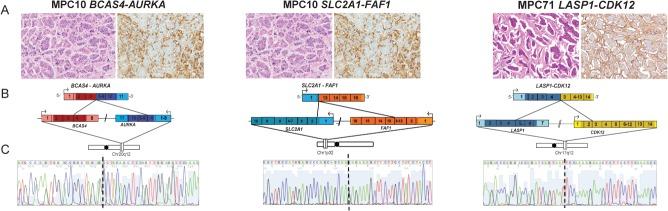
Micropapillary carcinoma (MPC) is a rare histological special type of breast cancer, characterized by an aggressive clinical behaviour and a pattern of copy number aberrations (CNAs) distinct from that of grade- and oestrogen receptor (ER)-matched invasive carcinomas of no special type (IC-NSTs). The aims of this study were to determine whether MPCs are underpinned by a recurrent fusion gene(s) or mutations in 273 genes recurrently mutated in breast cancer. Sixteen MPCs were subjected to microarray-based comparative genomic hybridization (aCGH) analysis and Sequenom OncoCarta mutation analysis. Eight and five MPCs were subjected to targeted capture and RNA sequencing, respectively. aCGH analysis confirmed our previous observations about the repertoire of CNAs of MPCs. Sequencing analysis revealed a spectrum of mutations similar to those of luminal B IC-NSTs, and recurrent mutations affecting mitogen-activated protein kinase family genes and NBPF10. RNA-sequencing analysis identified 17 high-confidence fusion genes, eight of which were validated and two of which were in-frame. No recurrent fusions were identified in an independent series of MPCs and IC-NSTs. Forced expression of in-frame fusion genes (SLC2A1-FAF1 and BCAS4-AURKA) resulted in increased viability of breast cancer cells. In addition, genomic disruption of CDK12 caused by out-of-frame rearrangements was found in one MPC and in 13% of HER2-positive breast cancers, identified through a re-analysis of publicly available massively parallel sequencing data. In vitro analyses revealed that CDK12 gene disruption results in sensitivity to PARP inhibition, and forced expression of wild-type CDK12 in a CDK12-null cell line model resulted in relative resistance to PARP inhibition. Our findings demonstrate that MPCs are neither defined by highly recurrent mutations in the 273 genes tested, nor underpinned by a recurrent fusion gene. Although seemingly private genetic events, some of the fusion transcripts found in MPCs may play a role in maintenance of a malignant phenotype and potentially offer therapeutic opportunities.
微乳头状癌 (MPC) 是一种罕见的乳腺癌组织学特殊类型,其临床行为具有侵袭性,并且拷贝数异常 (CNA) 模式与特定类型的无浸润性癌 (IC-NST) 不同。本研究旨在确定 MPC 是否存在高频复发融合基因或在 273 个乳腺癌高频突变基因中存在突变。对 16 例 MPC 进行了基于微阵列的比较基因组杂交 (aCGH) 分析和Sequenom OncoCarta 突变分析。分别对 8 例和 5 例 MPC 进行了靶向捕获和 RNA 测序。aCGH 分析证实了我们之前对 MPC CNA 谱的观察结果。测序分析显示了一系列与 luminal B IC-NST 相似的突变,并且高频突变影响丝裂原活化蛋白激酶家族基因和 NBPF10。RNA 测序分析鉴定了 17 个高可信度融合基因,其中 8 个得到了验证,2 个为框内融合。在独立的 MPC 和 IC-NST 系列中未发现高频融合。框内融合基因 (SLC2A1-FAF1 和 BCAS4-AURKA) 的强制表达导致乳腺癌细胞活力增加。此外,在一个 MPC 和 13%的 HER2 阳性乳腺癌中发现了由于框外重排引起的 CDK12 基因缺失,这是通过对公开的大规模平行测序数据的重新分析发现的。体外分析显示,CDK12 基因缺失导致对 PARP 抑制剂的敏感性增加,并且在 CDK12 缺失细胞系模型中强制表达野生型 CDK12 导致对 PARP 抑制剂的相对耐药性。我们的研究结果表明,MPC 既不是 273 个测试基因中高频突变所定义的,也不是高频融合基因所定义的。虽然这些融合转录本似乎是特有的遗传事件,但在 MPC 中发现的一些融合转录本可能在维持恶性表型中发挥作用,并可能提供治疗机会。



 Zotero 插件