
PLGA 载双氯芬酸钠纳米粒的设计与优化。
Design and optimization of PLGA-based diclofenac loaded nanoparticles.
机构信息
Department of Pharmaceutical Sciences, Gatton College of Pharmacy, East Tennessee State University, Johnson City, Tennessee, United States of America.
出版信息
PLoS One. 2014 Jan 28;9(1):e87326. doi: 10.1371/journal.pone.0087326. eCollection 2014.
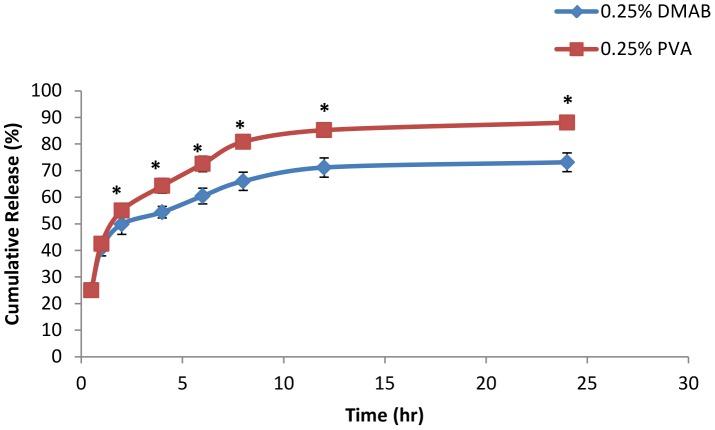
Drug based nanoparticle (NP) formulations have gained considerable attention over the past decade for their use in various drug formulations. NPs have been shown to increase bioavailability, decrease side effects of highly toxic drugs, and prolong drug release. Nonsteroidal anti-inflammatory drugs such as diclofenac block cyclooxygenase expression and reduce prostaglandin synthesis, which can lead to several side effects such as gastrointestinal bleeding and renal insufficiency. The aim of this study was to formulate and characterize diclofenac entrapped poly(lactide-co-glycolide) (PLGA) based nanoparticles. Nanoparticles were formulated using an emulsion-diffusion-evaporation technique with varying concentrations of poly vinyl alcohol (PVA) (0.1, 0.25, 0.5, or 1%) or didodecyldimethylammonium bromide (DMAB) (0.1, 0.25, 0.5, 0.75, or 1%) stabilizers centrifuged at 8,800 rpm or 12,000 rpm. The resultant nanoparticles were evaluated based on particle size, zeta potential, and entrapment efficacy. DMAB formulated NPs showed the lowest particle size (108 ± 2.1 nm) and highest zeta potential (-27.71 ± 0.6 mV) at 0.1 and 0.25% respectively, after centrifugation at 12,000 rpm. Results of the PVA based NP formulation showed the smallest particle size (92.4 ± 7.6 nm) and highest zeta potential (-11.14 ± 0.5 mV) at 0.25% and 1% w/v, respectively, after centrifugation at 12,000 rpm. Drug entrapment reached 77.3 ± 3.5% and 80.2 ± 1.2% efficiency with DMAB and PVA formulations, respectively. The results of our study indicate the use of DMAB for increased nanoparticle stability during formulation. Our study supports the effective utilization of PLGA based nanoparticle formulation for diclofenac.
基于药物的纳米粒子(NP)制剂在过去十年中因其在各种药物制剂中的应用而受到广泛关注。NP 已被证明可以提高生物利用度、降低高毒性药物的副作用并延长药物释放时间。非甾体抗炎药如双氯芬酸会阻断环氧化酶的表达并减少前列腺素的合成,从而导致胃肠道出血和肾功能不全等多种副作用。本研究的目的是制备并表征包封双氯芬酸的聚(丙交酯-共-乙交酯)(PLGA)纳米粒子。纳米粒子采用乳液扩散蒸发技术制备,使用不同浓度的聚乙烯醇(PVA)(0.1、0.25、0.5 或 1%)或双十二烷基二甲基溴化铵(DMAB)(0.1、0.25、0.5、0.75 或 1%)作为稳定剂,在 8800rpm 或 12000rpm 下离心。所得纳米粒子根据粒径、Zeta 电位和包封效率进行评估。在 12000rpm 下离心时,DMAB 配方的 NP 分别在 0.1%和 0.25%时表现出最低的粒径(108±2.1nm)和最高的 Zeta 电位(-27.71±0.6mV)。PVA 基 NP 制剂的结果表明,在 12000rpm 下离心时,在 0.25%和 1%w/v 时粒径最小(92.4±7.6nm),Zeta 电位最高(-11.14±0.5mV)。DMAB 和 PVA 制剂的药物包封率分别达到 77.3±3.5%和 80.2±1.2%。我们的研究结果表明,在制剂过程中使用 DMAB 可以提高纳米粒子的稳定性。我们的研究支持将 PLGA 基纳米粒子制剂有效用于双氯芬酸。


 Zotero 插件