
抑制红树鳉胚胎中的骨形态发生蛋白会导致体轴分裂。
Bmp suppression in mangrove killifish embryos causes a split in the body axis.
作者信息
Mourabit Sulayman, Moles Michael W, Smith Emma, van Aerle Ronny, Kudoh Tetsuhiro
机构信息
Biosciences, College of Life & Environmental Sciences, University of Exeter, Exeter, United Kingdom.
出版信息
PLoS One. 2014 Jan 30;9(1):e84786. doi: 10.1371/journal.pone.0084786. eCollection 2014.
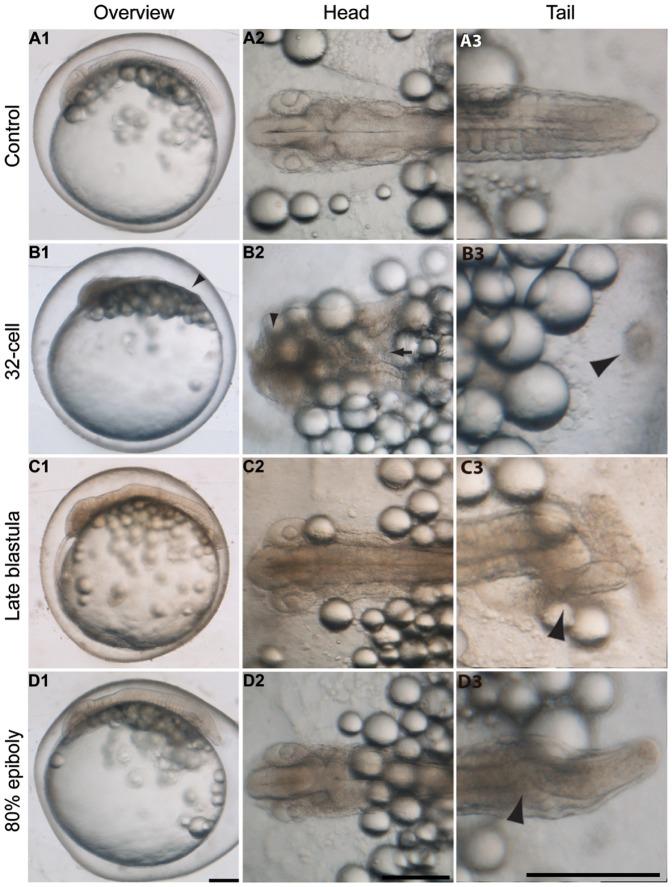
Bone morphogenetic proteins (Bmp) are major players in the formation of the vertebrate body plan due to their crucial role in patterning of the dorsal-ventral (DV) axis. Despite the highly conserved nature of Bmp signalling in vertebrates, the consequences of changing this pathway can be species-specific. Here, we report that Bmp plays an important role in epiboly, yolk syncytial layer (YSL) movements, and anterior-posterior (AP) axis formation in embryos of the self-fertilizing mangrove killifish, Kryptolebias marmoratus. Stage and dose specific exposures of embryos to the Bmp inhibitor dorsomorphin (DM) produced three distinctive morphologies, with the most extreme condition creating the splitbody phenotype, characterised by an extremely short AP axis where the neural tube, somites, and notochord were bilaterally split. In addition, parts of caudal neural tissues were separated from the main body and formed cell islands in the posterior region of the embryo. This splitbody phenotype, which has not been reported in other animals, shows that modification of Bmp may lead to significantly different consequences during development in other vertebrate species.
骨形态发生蛋白(Bmp)是脊椎动物身体模式形成的主要参与者,因为它们在背腹(DV)轴的模式形成中起着关键作用。尽管Bmp信号在脊椎动物中具有高度保守的性质,但改变这条信号通路的后果可能因物种而异。在这里,我们报告Bmp在自体受精的红树鳉(Kryptolebias marmoratus)胚胎的外包、卵黄合胞体层(YSL)运动和前后(AP)轴形成中起重要作用。胚胎在特定阶段和剂量下暴露于Bmp抑制剂多穗柯碱(DM)产生了三种不同的形态,最极端的情况产生了分体表型,其特征是AP轴极短,神经管、体节和脊索两侧分裂。此外,部分尾神经组织与主体分离,并在胚胎后部形成细胞岛状结构。这种分体表型在其他动物中尚未见报道,表明Bmp的改变可能在其他脊椎动物物种的发育过程中导致显著不同的后果。



 Zotero 插件