
卫生系统和政策研究能力建设:对加拿大情况的调查。
Capacity development in health systems and policy research: a survey of the Canadian context.
机构信息
Institute of Health Policy, Management and Evaluation, University of Toronto, Health Sciences Building, 155 College Street, Suite 425, Toronto, Ontario M5T 3M6, Canada.
出版信息
Health Res Policy Syst. 2014 Feb 7;12:9. doi: 10.1186/1478-4505-12-9.
BACKGROUND
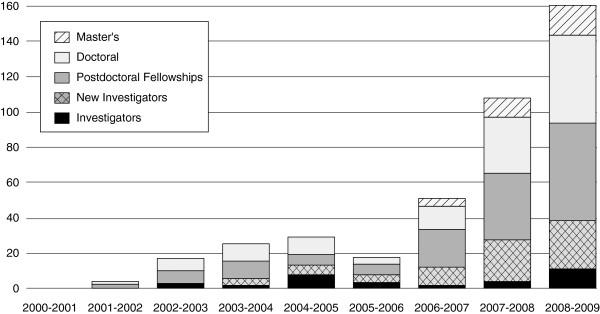
Over the past decade, substantial global investment has been made to support health systems and policy research (HSPR), with considerable resources allocated to training. In Canada, signs point to a larger and more highly skilled HSPR workforce, but little is known about whether growth in HSPR human resource capacity is aligned with investments in other research infrastructure, or what happens to HSPR graduates following training.
METHODS
We collected data from the Canadian Institutes of Health Research, Canada's national health research funding agency, and the Canadian Association for Health Services and Policy Research on recent graduates in the HSPR workforce. We also surveyed 45 Canadian HSPR training programs to determine what information they collect on the career experiences of graduates.
RESULTS
No university programs are currently engaged in systematic follow-up. Collaborative training programs funded by the national health research funding agency report performing short-term mandated tracking activities, but whether and how data are used is unclear. No programs collected information about whether graduates were using skills obtained in training, though information collected by the national funding agency suggests a minority (<30%) of doctoral-level trainees moving on to academic careers.
CONCLUSIONS
Significant investments have been made to increase HSPR capacity in Canada and around the world but no systematic attempts to evaluate the impact of these investments have been made. As a research community, we have the expertise and responsibility to evaluate our health research human resources and should strive to build a stronger knowledge base to inform future investment in HSPR research capacity.
背景
在过去的十年中,全球投入了大量资金来支持卫生系统和政策研究(HSPR),并分配了相当多的资源用于培训。在加拿大,HSPR 人力的迹象表明规模更大、技能更高,但人们对 HSPR 人力资源能力的增长是否与其他研究基础设施的投资相匹配,或培训后 HSPR 毕业生的情况知之甚少。
方法
我们从加拿大卫生研究院(加拿大国家卫生研究资助机构)和加拿大卫生服务与政策研究协会收集了 HSPR 劳动力中最近毕业生的数据。我们还调查了 45 个加拿大 HSPR 培训项目,以确定他们在毕业生的职业经历方面收集了哪些信息。
结果
目前没有大学课程参与系统的跟踪。由国家卫生研究资助机构资助的合作培训计划报告了进行短期强制性跟踪活动,但不清楚是否以及如何使用数据。没有任何项目收集有关毕业生是否正在使用培训中获得的技能的信息,尽管国家资助机构收集的数据表明,少数(<30%)博士水平的受训人员继续从事学术职业。
结论
在加拿大乃至全球,为增加 HSPR 能力投入了大量资金,但尚未对这些投资的影响进行系统评估。作为一个研究社区,我们有评估我们的卫生研究人力资源的专业知识和责任,应努力建立一个更强大的知识库,为未来对 HSPR 研究能力的投资提供信息。

 Zotero 插件