
隐源性卒中合并卵圆孔未闭患者经皮封堵与药物治疗的系统评价
Systematic review of percutaneous closure versus medical therapy in patients with cryptogenic stroke and patent foramen ovale.
作者信息
Spencer Frederick A, Lopes Luciane C, Kennedy Sean A, Guyatt Gordon
机构信息
Department of Medicine, Mcmaster University, Hamilton, Ontario, Canada.
出版信息
BMJ Open. 2014 Mar 7;4(3):e004282. doi: 10.1136/bmjopen-2013-004282.
OBJECTIVES
To provide a comprehensive comparison of patent foramen ovale (PFO) closure versus medical therapy in patients with cryptogenic stroke or transient ischaemic attack (TIA) and demonstrated PFO.
DESIGN
Systematic review with complete case meta-analysis and sensitivity analyses. Data sources included MEDLINE and EMBASE from 1980 up to May 2013. All randomised controlled trials (RCTs) comparing treatment with percutaneous catheter-based closure of PFO to anticoagulant or antiplatelet therapy in patients with cryptogenic stroke or TIA and echocardiographically confirmed PFO or atrial septal defect (ASD) were eligible.
PARTICIPANTS
1967 participants with prior stroke or TIA and echocardiographically confirmed PFO or ASD.
PRIMARY OUTCOME MEASURES
The primary outcome of interest was recurrence of ischaemic stroke. We utilised data from complete cases only for the primary endpoint and combined data from trials to estimate the pooled risk ratio (RR) and associated 95% CIs calculated using random effects models.
RESULTS
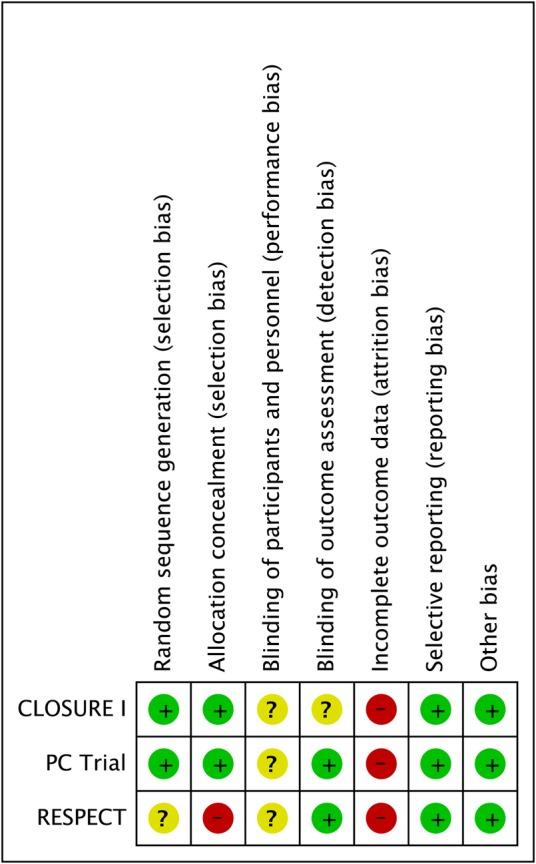
We identified 284 potentially eligible articles of which three RCTs including 2303 patients proved eligible and 1967 patients had complete data. Of the 1026 patients randomised to PFO closure and followed to study conclusion 22 experienced non-fatal ischaemic strokes, as did 34 of 941 patients randomised to medical therapy (risk ratio (RR) 0.61, 95% CI 0.34 to 1.07; heterogeneity: p=0.34, I(2)=8%, confidence in estimates low due to risk of bias and imprecision). Analyses for ischaemic stroke restricted to 'per-protocol' patients or patients with concomitant atrial septal aneurysm did not substantially change the observed RRs. Complication rates associated with either PFO closure or medical therapy were low.
CONCLUSIONS
Pooled data from three RCTs provides insufficient support that PFO closure is preferable to medical therapy for secondary prevention of cryptogenic stroke in patients with PFO.
目的
对卵圆孔未闭(PFO)封堵术与药物治疗在不明原因卒中或短暂性脑缺血发作(TIA)且已证实存在PFO的患者中的疗效进行全面比较。
设计
采用完全病例荟萃分析和敏感性分析的系统评价。数据来源包括1980年至2013年5月的MEDLINE和EMBASE。所有比较经皮导管封堵PFO治疗与抗凝或抗血小板治疗对不明原因卒中或TIA且经超声心动图证实存在PFO或房间隔缺损(ASD)患者疗效的随机对照试验(RCT)均符合纳入标准。
研究对象
1967例既往有卒中或TIA且经超声心动图证实存在PFO或ASD的患者。
主要结局指标
主要关注的结局是缺血性卒中的复发。我们仅使用完全病例的数据作为主要终点,并合并各试验的数据以估计合并风险比(RR)及使用随机效应模型计算的相关95%可信区间(CI)。
结果
我们识别出284篇可能符合纳入标准的文章,其中3项RCT(共2303例患者)被证明符合要求,1967例患者有完整数据。在1026例随机接受PFO封堵术并随访至研究结束的患者中,22例发生非致命性缺血性卒中;在941例随机接受药物治疗的患者中,34例发生非致命性缺血性卒中(风险比(RR)0.61,95%CI 0.34至1.07;异质性:p = 0.34,I² = 8%,由于存在偏倚风险和不精确性,对估计值的可信度较低)。对仅限于“符合方案”患者或伴有房间隔瘤患者的缺血性卒中分析,并未显著改变观察到的RR。与PFO封堵术或药物治疗相关的并发症发生率均较低。
结论
三项RCT的汇总数据不足以支持在PFO患者中,PFO封堵术在不明原因卒中二级预防方面优于药物治疗。



 Zotero 插件