
用于人乳寡糖样品诊断性离子筛选的基质辅助激光解吸电离飞行时间串联质谱法
MALDI Q-TOF CID MS for diagnostic ion screening of human milk oligosaccharide samples.
作者信息
Jovanović Marko, Tyldesley-Worster Richard, Pohlentz Gottfried, Peter-Katalinić Jasna
机构信息
Department of Biotechnology, University of Rijeka, Radmile Matejčić 2, Rijeka 51000, Croatia.
Waters Corporation, Stamford Avenue, Altrincham Road, Wilmslow SK9 4AX, UK.
出版信息
Int J Mol Sci. 2014 Apr 16;15(4):6527-43. doi: 10.3390/ijms15046527.
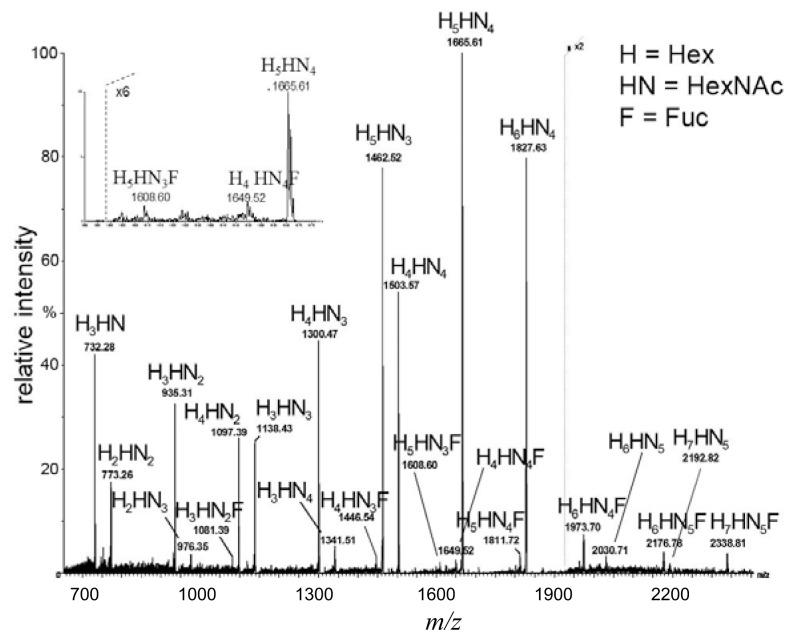
Human milk oligosaccharides (HMO) represent the bioactive components of human milk, influencing the infant's gastrointestinal microflora and immune system. Structurally, they represent a highly complex class of analyte, where the main core oligosaccharide structures are built from galactose and N-acetylglucosamine, linked by 1-3 or 1-4 glycosidic linkages and potentially modified with fucose and sialic acid residues. The core structures can be linear or branched. Additional structural complexity in samples can be induced by endogenous exoglycosidase activity or chemical procedures during the sample preparation. Here, we show that using matrix-assisted laser desorption/ionization (MALDI) quadrupole-time-of-flight (Q-TOF) collision-induced dissociation (CID) as a fast screening method, diagnostic structural information about single oligosaccharide components present in a complex mixture can be obtained. According to sequencing data on 14 out of 22 parent ions detected in a single high molecular weight oligosaccharide chromatographic fraction, 20 different oligosaccharide structure types, corresponding to over 30 isomeric oligosaccharide structures and over 100 possible HMO isomers when biosynthetic linkage variations were taken into account, were postulated. For MS/MS data analysis, we used the de novo sequencing approach using diagnostic ion analysis on reduced oligosaccharides by following known biosynthetic rules. Using this approach, de novo characterization has been achieved also for the structures, which could not have been predicted.
人乳寡糖(HMO)是母乳中的生物活性成分,影响婴儿的胃肠道微生物群和免疫系统。从结构上看,它们是一类高度复杂的分析物,其中主要的核心寡糖结构由半乳糖和N-乙酰葡糖胺构建而成,通过1-3或1-4糖苷键连接,并可能被岩藻糖和唾液酸残基修饰。核心结构可以是线性的或分支的。样品制备过程中的内源性外切糖苷酶活性或化学程序会导致样品结构更加复杂。在此,我们表明,使用基质辅助激光解吸/电离(MALDI)四极杆飞行时间(Q-TOF)碰撞诱导解离(CID)作为一种快速筛选方法,可以获得复杂混合物中单个寡糖成分的诊断结构信息。根据在一个高分子量寡糖色谱馏分中检测到的22个母离子中的14个的测序数据,推测出20种不同的寡糖结构类型,对应于30多种寡糖异构体结构以及考虑生物合成连接变化时超过100种可能的HMO异构体。对于MS/MS数据分析,我们采用了从头测序方法,通过遵循已知的生物合成规则对还原寡糖进行诊断离子分析。使用这种方法,对于无法预测的结构也实现了从头表征。



 Zotero 插件