
大规模部署集鱼装置改变了西太平洋海域鲣鱼基于环境的洄游行为。
The large-scale deployment of fish aggregation devices alters environmentally-based migratory behavior of skipjack tuna in the Western Pacific Ocean.
作者信息
Wang Xuefang, Chen Yong, Truesdell Samuel, Xu Liuxiong, Cao Jie, Guan Wenjiang
机构信息
College of Marine Sciences, Shanghai Ocean University, Shanghai, China; National Engineering Research Center for Oceanic Fisheries, Shanghai, China; The Key Laboratory of Sustainable Exploitation of Oceanic Fisheries Resources, Ministry of Education, Shanghai, China.
School of Marine Sciences, University of Maine, Orono, Maine, United States of America; The Key Laboratory of Sustainable Exploitation of Oceanic Fisheries Resources, Ministry of Education, Shanghai, China.
出版信息
PLoS One. 2014 May 21;9(5):e98226. doi: 10.1371/journal.pone.0098226. eCollection 2014.
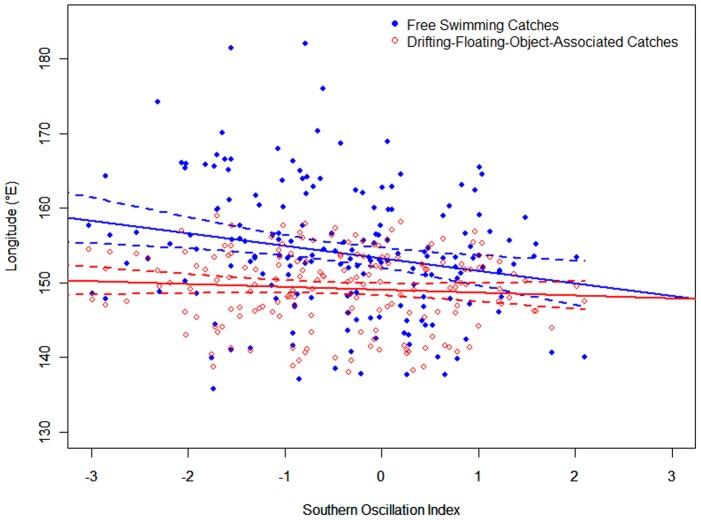
Fish aggregation devices (FADs) have been used extensively in the tuna purse seine fishery since the 1980s. This long-term modification of natural habitat has generated discussions as to whether FADs impact movement patterns of tuna species. We examined this question using data collected from the skipjack tuna (Katsuwonus pelamis) fishery. We used the longitudinal gravitational center of catch (G) to examine temporal variability in skipjack movement in the Western and Central Pacific Ocean, and related this to El Niño Southern Oscillation (ENSO) events. We found that in most cases G for free-swimming school sets changed with the onset of ENSO events, while G for floating-object-associated school sets remained relatively constant. This suggests that skipjack exhibit distinguishable behavioral strategies in response to ENSO events: they either react by moving long distances or they associate with floating objects. There has been no previous attempt to evaluate the interaction between FADs and the environmentally-determined movement of skipjack; this study shows evidence of an interaction, which should be considered when managing skipjack populations.
自20世纪80年代以来,集鱼装置(FADs)在金枪鱼围网渔业中得到了广泛应用。这种对自然栖息地的长期改变引发了关于集鱼装置是否会影响金枪鱼种类洄游模式的讨论。我们利用从鲣鱼(Katsuwonus pelamis)渔业收集的数据来研究这个问题。我们使用渔获物的纵向重心(G)来研究西太平洋和中太平洋鲣鱼洄游的时间变化,并将其与厄尔尼诺南方涛动(ENSO)事件相关联。我们发现,在大多数情况下,自由游动鱼群捕捞的G值会随着ENSO事件的开始而变化,而与漂浮物相关鱼群捕捞的G值则保持相对稳定。这表明鲣鱼在应对ENSO事件时表现出可区分的行为策略:它们要么通过远距离移动做出反应,要么与漂浮物聚集在一起。此前没有研究尝试评估集鱼装置与环境决定的鲣鱼洄游之间的相互作用;本研究显示了两者相互作用的证据,在管理鲣鱼种群时应予以考虑。




 Zotero 插件