Nakane Yusuke, Yoshimura Takashi
Laboratory of Animal Physiology, Department of Applied Molecular Biosciences, Graduate School of Bioagricultural Sciences, Nagoya University Nagoya, Japan.
Laboratory of Animal Physiology, Department of Applied Molecular Biosciences, Graduate School of Bioagricultural Sciences, Nagoya University Nagoya, Japan ; Institute of Transformative Bio-Molecules (WPI-ITbM), Nagoya University Nagoya, Japan ; Avian Bioscience Research Center, Graduate School of Bioagricultural Sciences, Nagoya University Nagoya, Japan ; Division of Seasonal Biology, Department of Environmental Biology, National Institute for Basic Biology Okazaki, Japan.
Front Neurosci. 2014 May 21;8:115. doi: 10.3389/fnins.2014.00115. eCollection 2014.
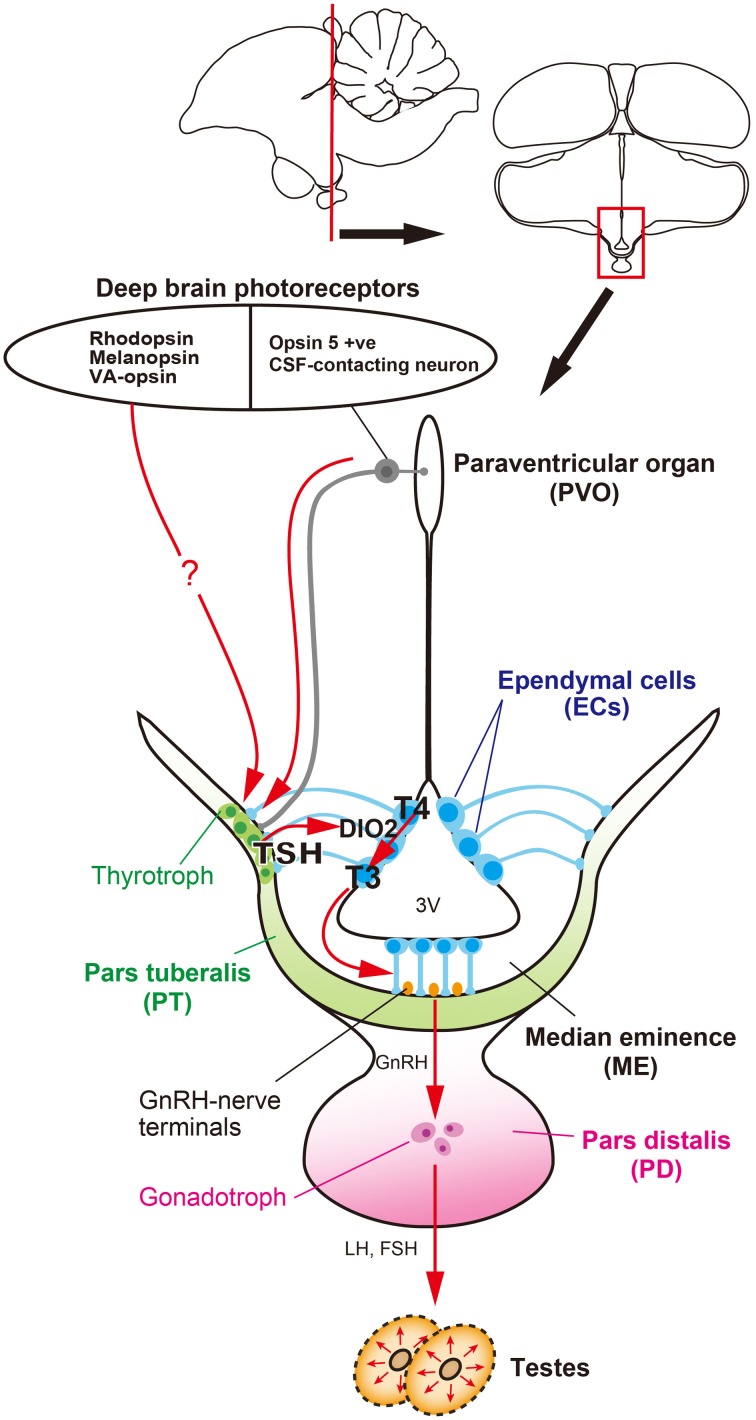
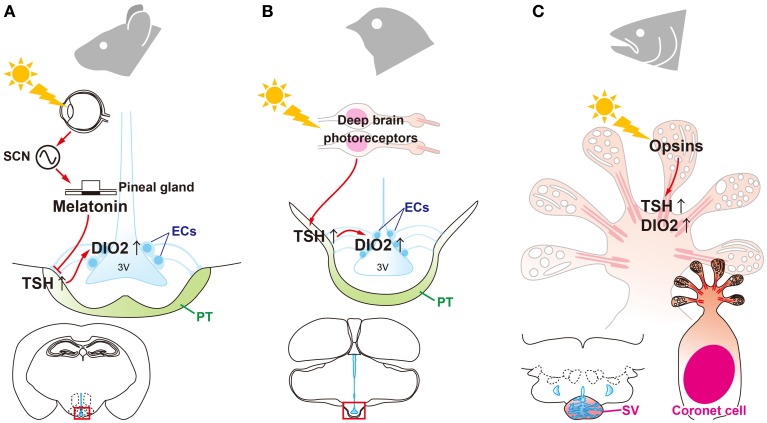
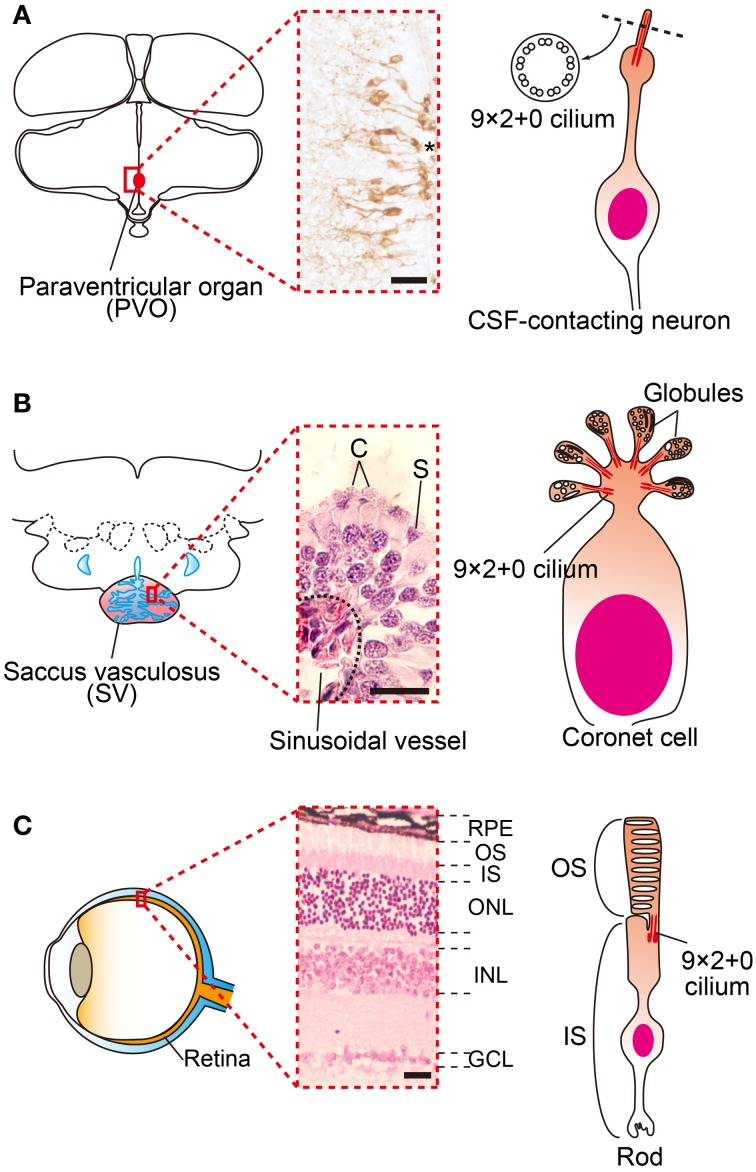
Most vertebrates living outside the tropical zone show robust physiological responses in response to seasonal changes in photoperiod, such as seasonal reproduction, molt, and migration. The highly sophisticated photoperiodic mechanism in Japanese quail has been used to uncover the mechanism of seasonal reproduction. Molecular analysis of quail mediobasal hypothalamus (MBH) revealed that local thyroid hormone activation within the MBH plays a critical role in the photoperiodic response of gonads. This activation is accomplished by two gene switches: thyroid hormone-activating (DIO2) and thyroid hormone-inactivating enzymes (DIO3). Functional genomics studies have shown that long-day induced thyroid-stimulating hormone (TSH) in the pars tuberalis (PT) of the pituitary gland regulates DIO2/3 switching. In birds, light information received directly by deep brain photoreceptors regulates PT TSH. Recent studies demonstrated that Opsin 5-positive cerebrospinal fluid (CSF)-contacting neurons are deep brain photoreceptors that regulate avian seasonal reproduction. Although the involvement of TSH and DIO2/3 in seasonal reproduction has been confirmed in various mammals, the light input pathway that regulates PT TSH in mammals differs from that of birds. In mammals, the eye is the only photoreceptor organ and light information received by the eye is transmitted to the pineal gland through the circadian pacemaker, the suprachiasmatic nucleus. Nocturnal melatonin secretion from the pineal gland indicates the length of night and regulates the PT TSH. In fish, the regulatory machinery for seasonal reproduction, from light input to neuroendocrine output, has been recently demonstrated in the coronet cells of the saccus vasculosus (SV). The SV is unique to fish and coronet cells are CSF-contacting neurons. Here, we discuss the universality and diversity of signal transduction pathways that regulate vertebrate seasonal reproduction.
大多数生活在热带地区以外的脊椎动物会对光周期的季节性变化表现出强烈的生理反应,如季节性繁殖、换羽和迁徙。日本鹌鹑高度复杂的光周期机制已被用于揭示季节性繁殖的机制。对鹌鹑中脑基底部下丘脑(MBH)的分子分析表明,MBH内的局部甲状腺激素激活在性腺的光周期反应中起关键作用。这种激活是通过两个基因开关实现的:甲状腺激素激活酶(DIO2)和甲状腺激素失活酶(DIO3)。功能基因组学研究表明,垂体结节部(PT)中长日照诱导的促甲状腺激素(TSH)调节DIO2/3的转换。在鸟类中,深部脑光感受器直接接收的光信息调节PT TSH。最近的研究表明,视蛋白5阳性的脑脊液(CSF)接触神经元是调节鸟类季节性繁殖的深部脑光感受器。尽管TSH和DIO2/3参与季节性繁殖已在各种哺乳动物中得到证实,但调节哺乳动物PT TSH的光输入途径与鸟类不同。在哺乳动物中,眼睛是唯一的光感受器器官,眼睛接收的光信息通过昼夜节律起搏器视交叉上核传递到松果体。松果体夜间分泌褪黑素指示夜晚长度并调节PT TSH。在鱼类中,最近在血管囊(SV)的冠状细胞中证明了从光输入到神经内分泌输出的季节性繁殖调节机制。SV是鱼类特有的,冠状细胞是CSF接触神经元。在这里,我们讨论调节脊椎动物季节性繁殖的信号转导途径的普遍性和多样性。